
⏱️ 7 min read
Did You Know? 10 Fascinating Facts About Camels
Camels have captivated human imagination for thousands of years, serving as essential companions in some of the world’s harshest environments. These remarkable creatures, often called “ships of the desert,” possess extraordinary adaptations that enable them to thrive where few other large mammals can survive. From their distinctive humps to their incredible endurance, camels are far more complex and fascinating than many people realize. This article explores ten remarkable facts about these desert-dwelling mammals that showcase their unique biology, behavior, and importance to human civilization.
1. Camels Don’t Store Water in Their Humps
Contrary to popular belief, camels do not store water in their humps. The humps are actually composed of fatty tissue that serves as an energy reserve. When food is scarce, camels metabolize this fat for nutrition and energy. A well-fed camel has firm, upright humps, while a malnourished camel’s humps will shrink and even flop to one side. This fat storage system is remarkably efficient, allowing camels to survive for extended periods without eating. The ability to store energy in concentrated areas rather than throughout their bodies also helps camels regulate their body temperature more effectively in extreme desert conditions.
2. Two Main Species With Different Hump Configurations
There are two distinct species of camels: the dromedary (one-humped camel) and the Bactrian (two-humped camel). Dromedaries, which account for approximately 94% of the world’s camel population, are found primarily in hot desert regions of the Middle East, Africa, and Australia. Bactrian camels inhabit the colder desert regions of Central Asia, particularly Mongolia and China. The wild Bactrian camel is critically endangered, with fewer than 1,000 individuals remaining in remote areas of the Gobi Desert. Each species has evolved specific adaptations suited to their particular environments, with Bactrian camels developing thicker coats to withstand freezing temperatures.
3. Extraordinary Water Conservation Abilities
Camels possess some of the most impressive water conservation mechanisms in the animal kingdom. They can lose up to 25% of their body weight through dehydration without suffering ill effects, whereas most mammals would die after losing just 15% of their water content. Their kidneys are highly efficient at concentrating urine, and their intestines extract maximum moisture from food. Camels also produce extremely dry feces, minimizing water loss. When water becomes available, camels can drink up to 40 gallons in a single session, rehydrating rapidly. Their red blood cells are oval-shaped rather than round, which allows blood to continue flowing even when dehydrated.
4. Specialized Feet for Desert Terrain
Camels have evolved unique feet perfectly adapted for walking on sand and rocky terrain. Their feet consist of two toes connected by a tough, leathery web that spreads when they step down, creating a snowshoe-like effect that prevents them from sinking into soft sand. The bottom of their feet is covered with thick, callused pads that protect against hot sand and sharp rocks. These specialized feet allow camels to travel long distances across desert landscapes that would be impassable for most other large animals. The broad surface area also provides excellent traction on loose terrain.
5. Temperature Regulation Masters
Camels have developed sophisticated temperature regulation mechanisms that allow them to survive extreme desert conditions. They can tolerate body temperature fluctuations ranging from 93°F to 106°F, reducing the need for cooling through sweating or panting. During cold desert nights, their body temperature drops, and during hot days, it rises gradually, minimizing water loss. Their thick coat provides insulation against both heat and cold, reflecting sunlight and trapping cooler air near their skin. Camels also orient their bodies to minimize sun exposure and huddle together in groups to reduce heat absorption.
6. Remarkable Eyelashes and Protective Features
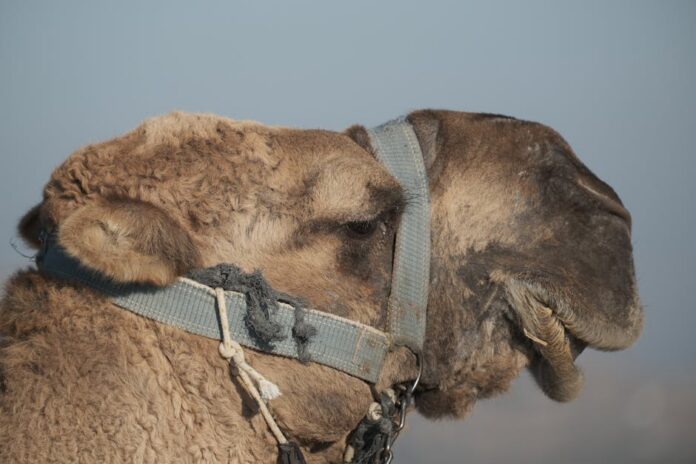
Camels possess exceptional protective features adapted for sandstorms and harsh desert conditions. They have three eyelids, including a thin, translucent third eyelid that moves sideways across the eye, protecting it from sand while still allowing the camel to see during sandstorms. Their eyes are equipped with two rows of long, thick eyelashes that provide additional protection from sand and intense sunlight. Camels can also close their nostrils completely, forming an airtight seal that prevents sand from entering their respiratory system during storms. Their ears are small and covered with hair, both inside and out, offering further protection from blowing sand.
7. Impressive Speed and Endurance
Despite their large size and seemingly ungainly appearance, camels are remarkably fast and have extraordinary endurance. Dromedary camels can run at speeds up to 40 miles per hour in short bursts and maintain a steady pace of 25 miles per hour for extended periods. More impressively, they can travel up to 100 miles in a single day without water. Their unique gait, called pacing, involves moving both legs on one side of their body simultaneously, creating the swaying motion that gives riders the sensation of being on a ship. This efficient movement pattern allows camels to cover vast distances while conserving energy.
8. Complex Social Structure and Communication
Camels are highly social animals with complex herd structures and communication systems. Wild and feral camels typically live in groups led by a dominant male, with females and their young forming the core of the herd. They communicate through various vocalizations, including moans, bellows, and bleats, each conveying different messages about danger, mating readiness, or distress. Camels also use body language extensively, with ear position, tail movement, and posture indicating their emotional state. They can recognize individual members of their herd and maintain long-term social bonds. During mating season, males become territorial and engage in elaborate displays of dominance.
9. Diverse Diet and Efficient Digestion
Camels are remarkably adaptable browsers and grazers capable of consuming plants that most other animals cannot digest. Their tough mouths and split upper lips allow them to eat thorny desert vegetation, including cacti, dry grasses, and saltbush. They can consume plants high in salt content that would be toxic to other animals. Camels are pseudo-ruminants with three-chambered stomachs that efficiently extract nutrients from poor-quality vegetation. They regurgitate their food and chew cud like true ruminants, maximizing nutrient absorption. This dietary flexibility allows camels to survive in environments where food resources are scarce and of low nutritional value.
10. Historical and Economic Importance to Humans
Camels have been domesticated for approximately 4,000 years and have played crucial roles in human civilization, particularly in arid regions. They have served as primary transportation for people and goods across desert trade routes, including the famous Silk Road. Camels provide humans with milk, which is more nutritious than cow’s milk and can be made into cheese and butter. Their meat is consumed in many cultures, their hide produces leather, and their hair is woven into textiles. In modern times, camels continue to be economically important for tourism, racing, and sustainable agriculture in desert regions. They remain essential to the livelihoods of millions of people worldwide.
Conclusion
These ten remarkable facts demonstrate that camels are far more than simply desert survivors—they are highly evolved, complex animals with extraordinary adaptations that enable them to thrive in some of Earth’s most challenging environments. From their efficient water conservation systems and specialized physical features to their social intelligence and historical significance to humanity, camels represent a pinnacle of evolutionary adaptation. Understanding and appreciating these magnificent creatures helps us recognize the importance of preserving both wild camel populations and the desert ecosystems they inhabit. As climate change continues to impact global environments, the camel’s remarkable resilience and adaptability offer valuable insights into survival in extreme conditions.