
⏱️ 6 min read
Did You Know? 10 Fascinating Facts About Minotaurs
The Minotaur stands as one of the most iconic creatures in Greek mythology, a fearsome being that has captured human imagination for thousands of years. This legendary creature, with the body of a man and the head of a bull, represents a unique intersection of human civilization and bestial nature. While many people recognize the Minotaur from popular culture, the rich mythological history surrounding this creature contains numerous surprising details that often go unnoticed. Here are ten fascinating facts about the Minotaur that reveal the complexity and depth of this ancient legend.
1. The Minotaur Had a Real Name
While commonly referred to simply as “the Minotaur,” this creature actually had a proper name: Asterion, which means “starry one” in Greek. The term “Minotaur” itself is derived from “Minos” and “taurus” (bull), essentially meaning “Bull of Minos.” This designation refers to King Minos of Crete, who played a central role in the creature’s origin story. The name Asterion appears in various ancient sources and adds a layer of tragic humanity to what is often portrayed as merely a monster.
2. The Minotaur Was Born from Divine Punishment
The creature’s origin stems from King Minos’s broken promise to the god Poseidon. When Minos prayed for a sign to legitimize his claim to the Cretan throne, Poseidon sent a magnificent white bull from the sea, expecting Minos to sacrifice it in return. However, Minos was so impressed by the bull’s beauty that he kept it and sacrificed a different animal instead. As punishment for this deception, Poseidon caused Minos’s wife, Pasiphaë, to fall in love with the bull, resulting in the birth of the Minotaur.
3. A Master Craftsman Built Its Prison
The legendary labyrinth that housed the Minotaur was designed by Daedalus, one of the greatest inventors and craftsmen in Greek mythology. King Minos commissioned Daedalus to create a prison so complex that no one could escape from it. The labyrinth was constructed beneath Minos’s palace at Knossos and featured countless winding passages designed to confuse and trap anyone who entered. The maze was so intricate that even Daedalus himself could barely find his way out after completing it.
4. The Minotaur Required Human Sacrifice
According to myth, Athens was forced to send seven young men and seven young women to Crete every seven or nine years (sources vary) as tribute to King Minos. These unfortunate youths were sent into the labyrinth to be devoured by the Minotaur. This grim practice resulted from Athens’s defeat in a war against Crete following the death of Minos’s son, Androgeus, in Athenian territory. The human sacrifice continued until the hero Theseus volunteered to be among the tributes with the intention of slaying the beast.
5. Love Helped Defeat the Minotaur
The Minotaur’s defeat came not just through Theseus’s bravery but also through the love of Princess Ariadne, daughter of King Minos. Ariadne fell in love with Theseus and provided him with a ball of thread (often called Ariadne’s thread) and a sword. By unwinding the thread as he ventured deeper into the labyrinth, Theseus could retrace his path after slaying the Minotaur. This clever solution transformed an impossible task into an achievable one, demonstrating that intelligence and love could triumph over brute force.
6. Archaeological Evidence Connects to the Myth
The palace of Knossos in Crete, excavated by archaeologist Sir Arthur Evans in the early 1900s, revealed a complex structure with numerous corridors and rooms that some scholars believe inspired the labyrinth legend. The palace features intricate architectural designs and bull imagery throughout, including the famous bull-leaping frescoes. Additionally, the Minoan civilization that inhabited Crete was known for bull worship and conducted rituals involving bulls, potentially providing historical context for the myth’s creation.
7. The Minotaur Represents Dual Nature
In philosophical and literary interpretations, the Minotaur symbolizes the duality of human nature—the conflict between civilization and savagery, reason and passion, humanity and bestiality. The creature’s hybrid form, trapped in an elaborate man-made structure, represents the struggle to contain our more primal instincts within the constructs of civilized society. This symbolism has made the Minotaur a enduring subject for artists, writers, and philosophers throughout history.
8. Different Accounts Describe Different Deaths
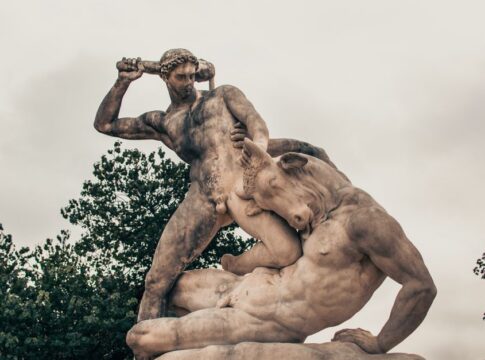
While the most common version of the myth states that Theseus killed the Minotaur with a sword provided by Ariadne, other ancient sources offer alternative accounts. Some versions claim Theseus beat the creature to death with his bare hands or with a club. A few variants even suggest that Theseus simply captured the Minotaur rather than killing it. These variations demonstrate how oral traditions evolved differently across various Greek city-states and time periods.
9. The Minotaur Had No Companions
One of the most tragic aspects of the Minotaur’s existence is its complete isolation. Confined alone in the dark labyrinth from birth, the creature had no companions, no society, and no possibility of a normal life. This solitary confinement, combined with its hybrid nature that belonged to neither human nor animal world, makes the Minotaur a deeply tragic figure. Some modern reinterpretations emphasize this loneliness, portraying the creature more as a victim of circumstance than a villain.
10. The Minotaur’s Influence Extends to Modern Times
The Minotaur continues to influence contemporary culture in numerous ways. The term “labyrinth” has become synonymous with any complex, maze-like structure or situation. The creature appears in countless books, films, video games, and artworks, from Pablo Picasso’s series of Minotaur drawings to Rick Riordan’s Percy Jackson novels. The myth has been reinterpreted to explore themes of identity, isolation, and what it means to be considered a monster, ensuring that this ancient story remains relevant thousands of years after its creation.
Conclusion
The Minotaur represents far more than a simple monster in a maze. Through these ten facts, we see a complex mythological narrative involving divine retribution, human sacrifice, heroic courage, and tragic isolation. From its birth through divine punishment to its lonely existence in the labyrinth, from the archaeological evidence at Knossos to its continued presence in modern culture, the Minotaur’s story encompasses themes that continue to resonate with audiences today. Understanding these details enriches our appreciation of Greek mythology and reveals why certain ancient stories maintain their power across millennia, speaking to fundamental aspects of the human experience.