
How Mermaid Sightings Were Actually Manatees
By Trivia Owl, Staff Writer — Published October 31, 2026
Table of Contents
- Key Takeaways
- Why Mermaid Sightings Were Actually Manatee Encounters
- The Science Behind Sirenia and Seafaring Myths
- Conditions That Fueled the Mermaid Myth
- Comparing Manatees to Mermaid Descriptions
- Famous Historical Mermaid Sightings Explained
- Modern Manatee Conservation and the Legacy of Myths
- Frequently Asked Questions
For centuries, sailors swore they’d seen beautiful women with fish tails beckoning from the waves. Christopher Columbus himself logged mermaid sightings during his voyage to the Americas. But here’s the surprising truth behind these legendary encounters: most mermaid sightings were actually glimpses of manatees, the gentle marine mammals now known as sea cows. These slow-moving, whiskered creatures don’t exactly match the enchanting image we associate with mermaids today, yet exhausted sailors mistook them for mythical beings time and again. This fascinating case of mistaken identity reveals how human perception, folklore, and the challenges of life at sea combined to keep the mermaid myth alive for generations.
The connection between manatees and mermaid legends offers a window into how myths take root and persist. When you discover the facts behind these sightings, the story becomes even more interesting than the fantasy.
Key Takeaways
- Sailors frequently mistook manatees for mermaids during long ocean voyages, with even Christopher Columbus recording such sightings in 1493.
- Manatees nurse their young while holding them with their flippers, creating a silhouette that resembles a woman cradling a child when viewed from a distance.
- The scientific order Sirenia, which includes manatees and dugongs, takes its name directly from the sirens of Greek mythology.
- Manatees can hold their breath for up to 20 minutes and often surface vertically, behaviors that would have appeared mysterious to observers unfamiliar with marine mammals.
- Poor visibility, long months at sea, vitamin deficiencies affecting vision, and cultural expectations all contributed to sailors interpreting manatee sightings as mermaids.
- The myth persisted across multiple cultures and centuries because manatees inhabit coastal waters worldwide where sailors traveled most frequently.
Why Mermaid Sightings Were Actually Manatee Encounters
The manatee-mermaid confusion wasn’t pure fantasy. These marine mammals possess several characteristics that, when glimpsed under the right conditions, could fool a weary sailor. Manatees have horizontal tail flukes that move up and down when swimming, creating an undulating motion reminiscent of a fish tail. Their rounded bodies taper toward the tail in a way that vaguely suggests a humanoid upper body transitioning to something aquatic.
Most compelling is their nursing behavior. Female manatees cradle their calves with their flippers while nursing, often floating vertically near the surface. From a distance, especially in poor light or through sea spray, this scene could resemble a woman holding an infant. The maternal gesture struck a chord with homesick sailors who hadn’t seen their families in months or years.
Manatees also have flexible flippers that bend at what appears to be an elbow joint, and they sometimes use these appendages to “walk” along the sea floor or even bring food to their mouths. These almost hand-like movements would have seemed eerily human to observers who had never encountered such a creature. When a manatee surfaces to breathe—which they must do regularly despite being able to hold their breath for extended periods—the rounded head breaking through the waves could spark the imagination of someone primed by folklore to expect the extraordinary.
The Science Behind Sirenia and Seafaring Myths
Scientists recognized the connection between myth and mammal when they classified manatees and their relatives in the order Sirenia, named for the sirens of Greek legend. This taxonomic choice acknowledges the long history of humans mistaking these gentle herbivores for something supernatural. The order includes three species of manatees and one species of dugong, all of which inhabit warm coastal waters where sailors historically traveled.
These animals evolved from land mammals roughly 50 million years ago, losing their hind limbs and developing paddle-like tails for aquatic life. Despite their aquatic adaptations, they retain certain mammalian features that would have seemed strangely familiar to human observers: they have fingernails on their flippers, give birth to live young, and nurse their babies with milk. This blend of familiar and alien characteristics made them perfect candidates for mythological interpretation.
The animals’ habitat preferences reinforced the pattern of sightings. Manatees favor shallow, slow-moving rivers, estuaries, and coastal areas—exactly where ships would anchor, take on fresh water, or navigate carefully. Sailors weren’t encountering these creatures in the open ocean but in transitional waters where they spent significant time and where visibility often suffered from sediment and vegetation.
Conditions That Fueled the Mermaid Myth
Several factors beyond the manatees themselves contributed to persistent misidentification. Long sea voyages took a serious toll on sailors’ health and mental state. Scurvy, caused by vitamin C deficiency, affects vision and can cause hallucinations in severe cases. Dehydration, exhaustion, and the psychological strain of isolation all influenced perception.
Cultural conditioning played a major role. Sailors embarked on voyages already familiar with mermaid legends from their home cultures. European folklore, African traditions, and Asian mythology all featured aquatic human-like beings. When sailors encountered something unusual in the water, their brains filled in gaps with familiar mythological templates. They saw what they expected to see.
The power of suggestion within ship communities cannot be understated. Once one sailor reported a mermaid sighting, others became primed to interpret ambiguous shapes similarly. These shared experiences reinforced belief and became part of the collective story sailors told about the sea’s mysteries.
Comparing Manatees to Mermaid Descriptions
| Mermaid Legend Features | Actual Manatee Characteristics | How Confusion Occurred |
|---|---|---|
| Human-like upper body | Rounded torso with flexible flippers | Vertical nursing position resembles humanoid form from distance |
| Fish-like tail | Horizontal tail fluke that undulates | Swimming motion creates illusion of mermaid tail movement |
| Long flowing hair | Algae and seaweed often clings to their backs | Marine vegetation draping over body suggests hair |
| Singing voice | Vocalizations including squeaks and chirps | Underwater sounds carry strangely and seem mysterious |
| Surfaces near ships | Curious and unafraid of boats historically | Manatees approached vessels in coastal waters where ships anchored |
Famous Historical Mermaid Sightings Explained
Christopher Columbus recorded in his log that he saw three mermaids off the coast of Hispaniola in January 1493. He noted they were “not as pretty as they are depicted, for somehow in the face they look like men.” This honest observation actually supports the manatee theory—he saw something that didn’t match the beautiful mermaid of legend but still categorized it as such because that was his only frame of reference for a human-like sea creature.
Explorer Henry Hudson reported mermaid sightings in the Arctic in 1608. His crew described a creature with a white body and long black hair. Given the location and description, this was likely a seal or possibly a misidentified person in the water, but the report demonstrates how the mermaid framework persisted across different maritime cultures and environments.
Even into the 19th century, sightings continued. As naturalists and scientists began cataloging marine life more systematically, they started connecting these persistent reports with actual animals. The establishment of natural history museums and improved scientific communication helped demystify many creatures that had previously existed only in sailors’ tales and folklore.
Modern Manatee Conservation and the Legacy of Myths
Today, manatees face serious threats from boat strikes, habitat loss, and water pollution. The three species—West Indian, Amazonian, and West African manatees—plus the dugong all have conservation concerns. The Florida manatee, a subspecies of the West Indian manatee, has received particular attention from conservation groups and government agencies.
Ironically, the mermaid connection has helped modern conservation efforts. The romantic association makes manatees more appealing to the public and helps generate support for protection measures. Tourist attractions offering manatee encounters in Florida and other locations capitalize on the “mermaid” mystique while educating visitors about these remarkable animals’ true biology and conservation needs.
Organizations like the U.S. Fish and Wildlife Service and various marine research institutions monitor manatee populations and work to reduce human impacts. Slow-speed zones in waterways, rescue and rehabilitation programs, and habitat protection all contribute to giving these animals a better chance at survival in an increasingly crowded coastal environment.
Frequently Asked Questions
Did sailors really think manatees were mermaids?
Yes, historical records including ship logs and journals document sailors reporting mermaid sightings in areas where manatees live. The combination of distance, poor visibility, exhaustion, and cultural expectations led to genuine misidentification of these marine mammals as mythical creatures.
What do manatees actually look like up close?
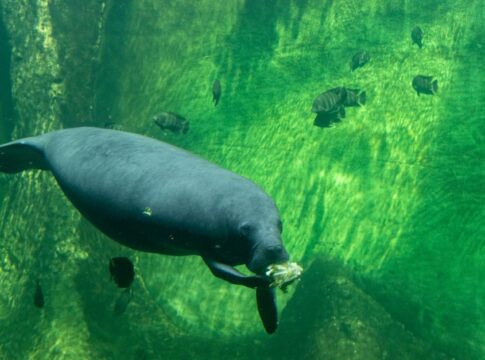
Manatees are large, gray, wrinkled marine mammals with paddle-like flippers, whiskered faces, and horizontal tail flukes. Adults typically weigh 800 to 1,200 pounds and reach 10 feet in length. They have small eyes, flexible lips for grazing on vegetation, and skin that often hosts algae growth.
Are there other animals that were mistaken for mythical creatures?
Yes, many legendary creatures have real-world counterparts. Giant squids likely inspired the kraken myth, oarfish sightings contributed to sea serpent legends, and rhinoceros may have influenced unicorn stories. Fossil discoveries of extinct species also fed dragon myths in various cultures.
Do manatees still live in the same areas where mermaid sightings occurred?
Manatees continue to inhabit warm coastal waters, rivers, and estuaries in the Caribbean, West Africa, the Amazon basin, and the southeastern United States. Dugongs, their close relatives, live in the Indo-Pacific region. These habitats overlap with historical shipping routes where mermaid legends flourished.
The next time you hear a mermaid story, remember the whiskered, gentle manatee floating in shallow waters. These remarkable animals remind us that reality often proves stranger and more wonderful than fiction—and that sometimes the most amazing discoveries come from looking more closely at what we thought we already understood. The sea still holds mysteries, but the solved ones are just as captivating as the legends they inspired.