
Why Cats Have Vertical Pupils: The Predatory Advantage
By Trivia Daily, Staff Writer — Published October 1, 2026
Table of Contents
- Key Takeaways
- The Light Control Advantage of Cats Vertical Pupils
- Depth Perception and the Ambush Hunter Profile
- Why Big Cats Have Round Pupils
- Vertical vs. Horizontal: The Predator-Prey Divide
- The Night Vision Connection
- Frequently Asked Questions
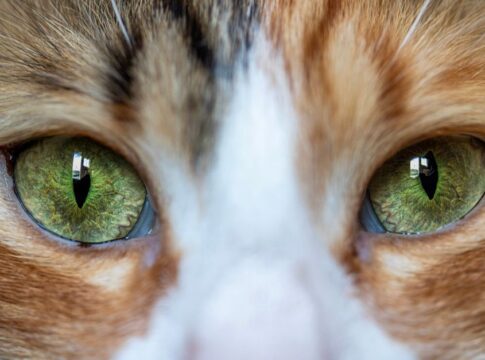
Look closely into a cat’s eyes, and you’ll notice something curious: their pupils aren’t round like ours. Instead, they form distinctive vertical slits that can expand and contract dramatically. This fascinating feature isn’t just for show—cats vertical pupils represent millions of years of evolutionary refinement, perfectly adapted for their role as ambush predators. The science behind these remarkable eyes reveals surprising truths about how cats hunt, see in the dark, and judge distances with deadly precision.
While many people assume all predators have similar eyes, the vertical slit pupil is actually quite specific. It’s a design that tells us exactly what kind of hunter a cat really is.
Key Takeaways
- Vertical pupils allow cats to control light exposure across a much wider range than round pupils—up to 135-fold changes in brightness compared to the 15-fold range of human eyes.
- The slit shape enhances depth perception for ambush predators that hunt close to the ground, helping cats judge the exact distance to prey before pouncing.
- Vertical pupils work best in animals with eyes positioned forward on their heads and bodies close to the ground—the typical profile of an ambush hunter.
- Not all cats have vertical pupils; large cats like lions, tigers, and leopards have round pupils because they hunt from greater heights and distances.
- The orientation of the pupil (vertical vs. horizontal) correlates strongly with whether an animal is a predator or prey species.
The Light Control Advantage of Cats Vertical Pupils
Cats are crepuscular hunters, meaning they’re most active during dawn and dusk when light levels change rapidly. Their vertical pupils function like adjustable camera apertures, opening wide in darkness and narrowing to thin slits in bright light. This incredible range of adjustment protects the sensitive retina while maximizing visual information in varying conditions.
When fully dilated, a cat’s pupil can occupy nearly the entire visible portion of the eye, gathering every available photon. In bright sunlight, that same pupil constricts to a narrow vertical line, reducing light exposure far more effectively than a round pupil could. Round pupils, like those in humans, can only close down to a small circle—they can’t achieve the same degree of light exclusion.
The vertical shape matters because it allows for asymmetric closure. The pupil can become extremely narrow while still maintaining some vertical opening, preserving a degree of peripheral awareness even in the brightest conditions. This design represents an elegant solution to the challenge of hunting in environments where light levels fluctuate dramatically.
Depth Perception and the Ambush Hunter Profile
Here’s where the story gets interesting. Research has revealed a striking pattern across the animal kingdom: vertical slit pupils appear predominantly in ambush predators whose eyes sit relatively close to the ground. Domestic cats, foxes, and many snake species share this feature. They hunt by stalking prey, remaining low and still, then launching a precisely calculated strike.
The vertical pupil enhances depth perception through a phenomenon called multifocal optics. The slit shape creates different focal points for light passing through different parts of the pupil, essentially giving the eye multiple “focal lengths” simultaneously. This provides additional depth cues that help the predator judge exactly how far away that mouse or bird might be—critical information when you need to pounce with perfect accuracy.
The effect works best when the animal’s head is low and the prey is on the same horizontal plane. This explains why domestic cats, with their eyes positioned just inches above the ground during a stalk, benefit so dramatically from vertical pupils. The orientation of the slit perpendicular to the ground maximizes the depth perception advantage.
Why Big Cats Have Round Pupils
If vertical pupils are so advantageous, why don’t lions and tigers have them? The answer lies in hunting strategy and body size. Large cats hunt from greater heights—their eyes sit much farther from the ground even when they’re crouched. They also frequently pursue prey over longer distances rather than relying solely on the ambush approach.
Research analyzing pupil shape across dozens of species found a clear correlation: predators taller than approximately two feet at the shoulder typically have round pupils, while shorter ambush hunters have vertical slits. The depth perception benefits of vertical pupils diminish as the predator’s viewpoint rises higher above the ground plane where prey typically moves.
| Cat Species | Pupil Shape | Typical Hunting Style |
|---|---|---|
| Domestic Cat | Vertical Slit | Low ambush, close-range pounce |
| Bobcat | Vertical Slit | Stalking and ambush |
| Cheetah | Round | High-speed pursuit |
| Lion | Round | Coordinated group hunting |
| Tiger | Round | Solitary stalking from height |
Vertical vs. Horizontal: The Predator-Prey Divide
Nature reveals another fascinating pattern when examining pupil orientation. While ambush predators have vertical slits, many grazing prey animals have horizontal pupils. Sheep, goats, horses, and deer all share this feature. The horizontal orientation provides a wide panoramic view along the horizon, perfect for detecting predators approaching from any direction while grazing.
The horizontal pupil also helps prey animals keep the ground and sky in focus simultaneously while their head is down feeding—a clever optical trick that vertical pupils can’t achieve as effectively. This complementary design illustrates how evolution shapes anatomy based on survival needs: predators optimize for precise depth perception in the strike zone, while prey optimize for broad environmental awareness.
Interestingly, prey animals with horizontal pupils often have specialized eye movements that keep their pupils horizontal even when they tilt their heads. Watch a grazing goat turn its head sideways, and you’ll notice its eyes rotate to maintain that horizontal alignment with the ground.
The Night Vision Connection
Beyond pupil shape, cats possess other remarkable adaptations for low-light hunting. Behind their retinas lies a reflective layer called the tapetum lucidum, which bounces light back through the retina for a second chance at photon capture. This is why cat eyes seem to glow in darkness when light hits them—you’re seeing that reflection.
The combination of vertical pupils that open extremely wide and the tapetum lucidum gives cats vision capabilities in near-darkness that far exceed human abilities. While cats can’t see in complete darkness (no animal can without specialized heat-sensing organs), they can see clearly in light levels six times lower than what humans require.
This night vision advantage comes with a trade-off: cats see fewer colors than humans. Their eyes contain fewer cone cells (responsible for color vision) and more rod cells (responsible for light sensitivity and motion detection). For an ambush predator, detecting movement in dim light matters far more than distinguishing whether prey is red or green.
Frequently Asked Questions
Do all cats have vertical pupils?
No. Domestic cats and small wild cats typically have vertical slit pupils, but large cats like lions, tigers, leopards, and cheetahs have round pupils. The difference relates to body size and hunting strategy—larger cats hunt from greater heights where vertical pupils provide less advantage.
Can cats see better than humans in the dark?
Yes, cats can see in light levels approximately six times dimmer than what humans need. Their combination of large pupils, high rod cell density, and the reflective tapetum lucidum layer makes them exceptionally well-adapted for low-light conditions, though they cannot see in complete darkness.
Why do cat pupils change shape so dramatically?
Cat pupils can adjust their size across a much wider range than human pupils—expanding and contracting up to 135-fold compared to our 15-fold range. This allows cats to function effectively in both bright daylight and near-darkness, protecting their sensitive retinas while maximizing light capture when needed.
Do vertical pupils help cats hunt?
Yes, vertical pupils enhance depth perception for ambush predators hunting close to the ground. The slit shape creates multiple focal points that help cats judge distances accurately when stalking and pouncing on prey, giving them a significant advantage in their natural hunting behavior.
The next time you catch your cat staring at you with those mesmerizing vertical slits, remember you’re looking at millions of years of predatory evolution compressed into a feature smaller than a grain of rice. Those pupils tell the story of twilight hunts, lightning-fast pounces, and the extraordinary adaptations that make cats such successful hunters—even when the hunt involves nothing more dangerous than a toy mouse skittering across your living room floor.