
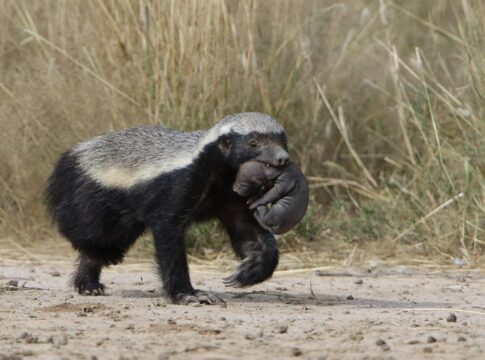
The Hidden Story of Honey Badgers Fearless Nature
By Trivia Daily, Animals Desk — Published October 30, 2026
Table of Contents
- Key Takeaways
- The Hidden Story of Honey Badgers’ Physical Arsenal
- Venom Resistance and Recovery Abilities
- Intelligence and Problem-Solving Behavior
- Diet and Hunting Strategies
- Interactions with Other Predators
- Frequently Asked Questions
The honey badger has earned a reputation as one of the most fearless animals on Earth, and the hidden story of honey badgers reveals behavior that seems almost reckless by the standards of most wildlife. This stocky member of the weasel family routinely confronts lions, shrugs off venomous snake bites, and raids beehives without hesitation. What looks like courage to human observers is actually a fascinating combination of physical adaptations, behavioral strategies, and a metabolism that makes this creature uniquely equipped for survival in harsh African and Asian habitats.
Despite weighing only 20 to 30 pounds, honey badgers have become legendary among researchers and wildlife enthusiasts for their willingness to take on animals many times their size. Their scientific name, Mellivora capensis, translates to “honey eater of the Cape,” but their diet extends far beyond the sweet substance that inspired their common name.
Key Takeaways
- Honey badgers possess remarkably thick and loose skin that protects them from predator bites, bee stings, and even porcupine quills.
- These animals have been documented attacking buffalo, young lions, and other creatures far larger than themselves when threatened or competing for food.
- Their metabolism allows them to recover from venomous snake bites that would kill most mammals of similar size within hours rather than succumbing immediately.
- Honey badgers use tools in captivity and demonstrate problem-solving abilities that rival some primates.
- The species ranges across sub-Saharan Africa, the Middle East, and parts of India, adapting to habitats from grasslands to forests.
- Their fearlessness stems from effective physical defenses rather than an inability to feel fear or pain.
The Hidden Story of Honey Badgers’ Physical Arsenal
The foundation of honey badger fearlessness lies in extraordinary physical adaptations. Their skin measures about a quarter-inch thick in places and hangs loosely on their muscular frame. This design serves multiple purposes. When a predator grabs a honey badger, the animal can twist inside its own skin to bite back at its attacker. The loose fit creates a buffer zone that prevents teeth and claws from reaching vital organs.
The skin also provides remarkable resistance to bee stings. Honey badgers frequently raid beehives for both honey and protein-rich larvae, enduring thousands of stings in the process. While the stings do cause some irritation, the thick hide and dense fur prevent most stingers from penetrating deeply enough to inject significant venom. This physical barrier allows them to exploit a food source that most predators cannot access.
Their claws deserve special mention. Each front paw sports curved claws measuring up to 1.5 inches long, perfect for digging, climbing, and fighting. Honey badgers can excavate extensive burrows in hard-packed soil and tear open termite mounds with ease. These same claws become formidable weapons when the animal feels threatened.
Venom Resistance and Recovery Abilities
One of the most remarkable aspects of honey badger biology involves their response to venomous snake bites. These animals regularly hunt and eat venomous snakes, including cobras, puff adders, and other deadly species. While not completely immune to venom, honey badgers possess a unique physiological response that researchers are still working to fully understand.
When bitten by a venomous snake, a honey badger often experiences temporary paralysis or extreme lethargy. The animal may appear dead or nearly so for several hours. Then, remarkably, it recovers and often returns to eating the very snake that bit it. This recovery ability likely involves specialized proteins in their blood that neutralize or slow the effects of certain toxins, combined with a metabolism that can process and eliminate venom more efficiently than most mammals.
Scientists have studied honey badger blood for potential medical applications. Understanding how these creatures survive encounters that would kill humans or other animals could lead to better antivenom treatments. The exact mechanisms remain subjects of ongoing research, but the practical result is clear: honey badgers can hunt prey that most predators wisely avoid.
Intelligence and Problem-Solving Behavior
Beyond physical prowess, honey badgers demonstrate cognitive abilities that surprise researchers. In controlled settings, they have shown the capacity to use tools, work cooperatively, and solve complex problems to reach food rewards. One famous example involved a captive honey badger that learned to stack objects, use rakes, and even create makeshift ladders to escape its enclosure.
This intelligence serves them well in nature. Honey badgers remember the locations of food sources across vast territories and adjust their hunting strategies based on prey type. They’ve been observed working with other species in mutually beneficial relationships. The most famous example involves honeyguide birds, which lead honey badgers to beehives. The bird cannot access the hive alone, but once the honey badger breaks it open, both animals feast.
Their problem-solving extends to defense. When confronted by multiple predators, honey badgers have been seen backing into burrows or rock crevices to protect their vulnerable rear while presenting their formidable front end to attackers. This tactical thinking demonstrates awareness of their own strengths and vulnerabilities.
Diet and Hunting Strategies
The honey badger diet reflects their fearless nature and opportunistic approach to survival. These omnivorous creatures eat virtually anything they can overpower or scavenge:
- Small mammals including rodents, hares, and young antelope
- Reptiles and amphibians, particularly venomous snakes
- Birds, eggs, and nestlings
- Insects, especially bee larvae and honey from raided hives
- Fruits, roots, and berries when available
- Carrion from kills made by larger predators
Their hunting style combines persistence with brute force. Honey badgers will pursue prey into burrows, digging furiously to reach animals that hide underground. They climb trees with surprising agility to raid bird nests. When hunting larger prey, they often target vulnerable areas with precision, using their powerful jaws and sharp teeth to deliver incapacitating bites.
Interactions with Other Predators
The most striking demonstrations of honey badger fearlessness occur during encounters with Africa’s apex predators. Lions, leopards, and hyenas generally avoid confrontations with honey badgers when possible. While these large predators could certainly kill a honey badger, the smaller animal’s aggressive defense makes it not worth the effort for a relatively small meal.
Honey badgers employ a dramatic defensive display when threatened. They raise their fur to appear larger, arch their backs, and produce hissing and growling sounds. If this display fails to deter an attacker, they release a foul-smelling secretion from anal glands similar to skunks. This chemical defense often convinces predators to seek easier prey elsewhere.
When defense escalates to combat, honey badgers aim for sensitive areas. They’ve been documented biting the faces, legs, and even genitals of attacking animals, inflicting painful injuries that quickly convince most predators to retreat. This willingness to fight rather than flee, combined with their ability to inflict real damage, has earned them respect across the animal kingdom.
Frequently Asked Questions
Are honey badgers actually immune to snake venom?
Honey badgers are not completely immune but have remarkable resistance to many snake venoms. They can survive bites that would kill most animals their size, often recovering after several hours of incapacitation.
Why are honey badgers so aggressive compared to other animals?
Their aggression is actually a survival strategy made possible by physical defenses like thick skin and powerful jaws. This behavior allows them to access food sources and defend themselves against much larger predators effectively.
Do honey badgers really attack lions?
Yes, honey badgers have been documented confronting lions, though they typically do so defensively rather than as predators. Lions generally avoid the confrontation because honey badgers can inflict painful injuries despite their smaller size.
How long do honey badgers live in the wild?
Honey badgers typically live seven to eight years in the wild, though they can survive up to 24 years in captivity. Their fearless lifestyle likely contributes to relatively shorter wild lifespans compared to their potential longevity.
The honey badger’s reputation as nature’s most fearless animal rests on a foundation of remarkable adaptations rather than mere recklessness. Every aspect of their biology supports a lifestyle that would be suicidal for most creatures. Perhaps the real lesson isn’t about fearlessness at all, but about how evolution can equip even small animals with the tools needed to thrive in a world full of much larger, more powerful competitors.