







⏱️ 7 min read
Top 10 Facts About the Solar System
The solar system, our cosmic neighborhood, has fascinated humanity for millennia. From ancient astronomers who first charted the movements of planets to modern space probes exploring the furthest reaches of our celestial domain, our understanding of the solar system continues to expand. This remarkable collection of planets, moons, asteroids, and comets orbiting our Sun holds countless wonders that challenge our imagination and scientific understanding. Here are ten fascinating facts about the solar system that showcase its extraordinary nature and the ongoing discoveries that continue to reshape our knowledge of space.
1. The Sun Contains 99.86% of the Solar System's Mass
The Sun is not just the center of our solar system; it is the solar system in terms of mass. This massive star contains approximately 99.86% of all the mass in our solar system, with Jupiter accounting for most of the remaining 0.14%. The Sun's immense gravitational pull, generated by its tremendous mass of about 1.989 × 10^30 kilograms, keeps all the planets, asteroids, comets, and other celestial bodies in their orbits. To put this in perspective, you could fit approximately 1.3 million Earths inside the Sun, demonstrating the sheer scale of our parent star.
2. Venus Rotates Backwards Compared to Most Planets
While most planets in our solar system rotate counterclockwise when viewed from above the Sun's north pole, Venus spins clockwise, a phenomenon known as retrograde rotation. Scientists believe this unusual rotation may have resulted from a massive collision with another celestial body early in the solar system's history. Additionally, Venus rotates so slowly that a single day on Venus (243 Earth days) is actually longer than its year (225 Earth days). This makes Venus one of the most peculiar planets in terms of rotational dynamics.
3. Mars Has the Largest Volcano in the Solar System
Olympus Mons on Mars holds the title of the largest volcano in our solar system. This shield volcano towers approximately 21 kilometers (13 miles) high, making it nearly three times the height of Mount Everest. Its base spans roughly 600 kilometers (373 miles) in diameter, an area approximately the size of Arizona. Olympus Mons formed over billions of years through countless lava flows, and while it's currently dormant, scientists cannot definitively say it's extinct. The volcano's immense size is possible partly because Mars lacks plate tectonics, allowing lava to accumulate in one location over extended periods.
4. Saturn Could Float in Water
Despite being the second-largest planet in our solar system, Saturn has such a low density that it would theoretically float if placed in a body of water large enough to hold it. With an average density of just 0.687 grams per cubic centimeter, Saturn is less dense than water, which has a density of 1 gram per cubic centimeter. This low density results from Saturn's composition, which is primarily hydrogen and helium gas. Of course, finding an ocean large enough to test this theory remains impossible, but the mathematical reality demonstrates just how different gas giants are from terrestrial planets.
5. A Day on Mercury Equals 59 Earth Days
Mercury, the closest planet to the Sun, has one of the most unusual day-night cycles in the solar system. The planet rotates very slowly on its axis, taking approximately 59 Earth days to complete one full rotation. However, it orbits the Sun quickly, completing a full orbit in just 88 Earth days. This creates a strange situation where Mercury's day (from sunrise to sunrise) actually lasts about 176 Earth days, meaning two Mercury years pass during one Mercury day. This complex relationship between rotation and revolution creates extreme temperature variations on the planet's surface.
6. Jupiter's Great Red Spot Is Shrinking
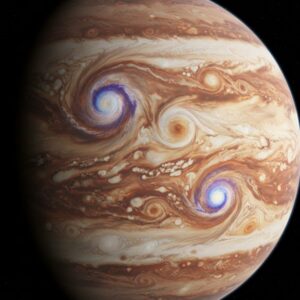
Jupiter's iconic Great Red Spot, a massive storm system that has raged for at least 300 years, is gradually decreasing in size. Historical observations show that in the 1800s, the storm was approximately 41,000 kilometers across, but recent measurements indicate it has shrunk to roughly 16,000 kilometers in diameter. Despite this shrinkage, the Great Red Spot remains enormous—large enough to swallow Earth completely. Scientists continue to monitor this colossal anticyclonic storm to understand why it's diminishing and whether it will eventually disappear entirely, though it still shows no signs of stopping in the near future.
7. There Are Five Recognized Dwarf Planets
Since Pluto's reclassification in 2006, our solar system officially recognizes five dwarf planets: Pluto, Eris, Haumea, Makemake, and Ceres. These celestial bodies are large enough to be rounded by their own gravity but haven't cleared their orbital paths of other debris, which distinguishes them from full planets. Ceres, located in the asteroid belt between Mars and Jupiter, is the only dwarf planet in the inner solar system. The other four reside in the Kuiper Belt beyond Neptune. Scientists suspect dozens more dwarf planets await discovery in the outer reaches of our solar system.
8. Neptune's Winds Exceed 2,000 Kilometers Per Hour
Neptune experiences the fastest winds in the solar system, with speeds reaching up to 2,100 kilometers per hour (1,300 miles per hour). These supersonic winds are particularly remarkable considering Neptune's great distance from the Sun, which means it receives very little solar energy. Scientists theorize that Neptune must have an internal heat source driving these powerful atmospheric currents. These extreme winds create dark storm systems similar to Jupiter's Great Red Spot, though Neptune's storms tend to be shorter-lived and more dynamic.
9. The Asteroid Belt Contains Millions of Objects
Located between Mars and Jupiter, the asteroid belt contains millions of rocky objects ranging from dust-sized particles to Ceres, the largest object in the belt with a diameter of about 940 kilometers. Despite its portrayal in science fiction as a dense, dangerous field of rocks, the asteroid belt is actually quite sparse, with vast distances between most objects. The total mass of all asteroids in the belt combined is less than that of Earth's Moon. These remnants from the solar system's formation never coalesced into a planet, likely due to Jupiter's powerful gravitational influence disrupting the accretion process.
10. The Solar System Is 4.6 Billion Years Old
Our solar system formed approximately 4.6 billion years ago from a giant rotating cloud of gas and dust called the solar nebula. When a nearby supernova explosion sent shock waves through this nebula, it triggered its collapse, causing the material to condense and heat up. The center became dense enough to initiate nuclear fusion, creating our Sun, while the remaining material in the rotating disk gradually coalesced into planets, moons, and other celestial bodies. Scientists have determined this age through radiometric dating of meteorites and Moon rocks, which represent some of the oldest unchanged materials from the solar system's formation.
Conclusion
These ten facts merely scratch the surface of the solar system's complexity and wonder. From the Sun's overwhelming dominance in mass to the ancient age of our cosmic neighborhood, each fact reveals how extraordinary and diverse our solar system truly is. The backward rotation of Venus, the shrinking storm on Jupiter, the incredible winds of Neptune, and the unusual characteristics of other planets demonstrate that our solar system is far from uniform or predictable. As space exploration technology advances and our scientific methods improve, we continue to uncover new mysteries and refine our understanding of these celestial bodies. The solar system remains a frontier of discovery, reminding us that even our own cosmic backyard holds secrets waiting to be revealed. Whether through robotic missions, telescopic observations, or theoretical modeling, humanity's quest to understand our place in the solar system continues to drive scientific innovation and inspire wonder about the universe we inhabit.