
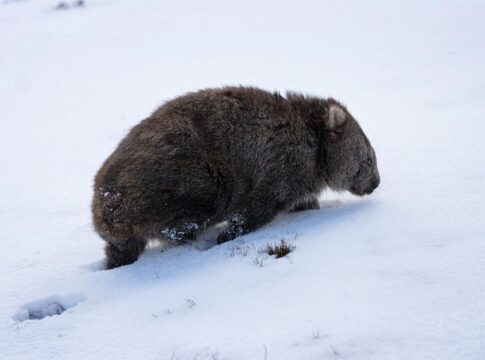
Why Wombats Poop Cubes: The Bizarre Science Explained
By Trivia Daily, Staff Writer — Published July 29, 2026
Table of Contents
- Key Takeaways
- Why Wombats Poop Cubes: The Anatomical Secret
- The Evolutionary Advantage of Cubic Droppings
- Comparing Wombat Species and Their Cubic Output
- The Scientific Quest to Understand Cubic Poop
- Wombat Ecology and Behavior Beyond the Bathroom
- Frequently Asked Questions
Among nature’s countless curiosities, few facts capture the imagination quite like this: wombats poop cubes. Not rounded pellets. Not cylindrical logs. Perfect little geometric blocks, stacked like nature’s own building bricks. This surprising anatomical quirk has puzzled scientists for decades, and the explanation reveals one of the most fascinating digestive adaptations in the animal kingdom. Discover why these Australian marsupials produce the only known cube-shaped feces on Earth, and what evolutionary advantage this strange ability provides.
The cube-shaped droppings aren’t just mildly angular—they’re remarkably geometric, with distinct edges and flat sides. Wombats deposit these unusual calling cards to mark their territory, stacking them on rocks and logs where they won’t roll away. That last detail is key to understanding the whole bizarre adaptation.
Key Takeaways
- Wombats are the only animals known to produce cube-shaped feces, a fact confirmed by researchers studying their unique digestive anatomy.
- The cubes form due to varying elasticity in the wombat’s intestinal walls, which mold the waste into corners and flat sides during an extremely slow digestive process.
- Wombats use their distinctive droppings as territorial markers, and the cubic shape prevents them from rolling off rocks and elevated surfaces.
- The digestive process takes 14 to 18 days, one of the longest among mammals, allowing maximum nutrient extraction from tough, fibrous grasses.
- Research published by scientists studying wombat intestines revealed that two grooves of varying stiffness in the intestinal wall create the cube formation.
- Each wombat produces 80 to 100 individual cube-shaped droppings per day to mark their territory across their range.
Why Wombats Poop Cubes: The Anatomical Secret
The cube formation happens entirely inside the wombat’s intestine. Unlike most mammals, whose intestines contract uniformly, wombat intestines feature regions of dramatically different elasticity. Researchers examining wombat digestive tracts discovered that the final section of the intestine contains alternating stiff and flexible areas that squeeze the waste material into its distinctive shape.
Think of it like squeezing a balloon. Apply pressure unevenly, and you create edges and corners. The wombat’s intestine does exactly this over an extended period. Two grooves of stiffer tissue run along the intestine, creating pressure points that form the cube’s edges. Between these grooves, more elastic tissue allows the sides to flatten. The result? Nature’s most geometrically precise poop.
The entire process unfolds slowly. Wombats have one of the longest digestive transit times of any mammal—their food takes roughly two weeks to pass through the system. This marathon digestion serves a purpose: wombats survive on tough, fibrous native grasses that require extensive processing to extract nutrients. The extended time allows their gut bacteria to break down cellulose efficiently. The cube shape is essentially a byproduct of this highly specialized digestive system.
The Evolutionary Advantage of Cubic Droppings
Wombats don’t produce cube-shaped feces by accident. This unusual trait serves a specific behavioral purpose tied to their territorial nature. Wombats are solitary animals that maintain defined home ranges, and they communicate their presence through scent marking. Their droppings serve as both visual and olfactory territorial markers.
Here’s where the cube shape becomes brilliant. Wombats deliberately place their droppings on elevated surfaces—rocks, logs, and prominent landscape features—to maximize visibility and scent dispersal. Round droppings would simply roll off these perches. Cubic droppings stay put. Each flat side provides stability, keeping the marker exactly where the wombat intended.
A single wombat may deposit 80 to 100 droppings per night while patrolling its territory. The strategic placement of these stable, non-rolling markers creates an effective communication network across their range. Other wombats encountering these signs receive clear messages about territory boundaries and the presence of neighbors.
Comparing Wombat Species and Their Cubic Output
| Wombat Species | Average Weight | Cube Size | Conservation Status |
|---|---|---|---|
| Common Wombat | 20-35 kg | Approximately 2 cm | Least Concern |
| Southern Hairy-Nosed Wombat | 19-32 kg | Approximately 2 cm | Near Threatened |
| Northern Hairy-Nosed Wombat | 25-40 kg | Approximately 2 cm | Critically Endangered |
All three wombat species produce cube-shaped droppings, though the Northern Hairy-Nosed Wombat is so rare—with fewer than 300 individuals remaining—that studying their bathroom habits has understandably been a low research priority compared to conservation efforts.
The Scientific Quest to Understand Cubic Poop
For years, the cubic nature of wombat droppings remained an amusing biological footnote without a clear explanation. Researchers initially theorized various mechanisms, from specialized sphincter muscles to dehydration effects. The breakthrough came when scientists conducted detailed dissections and mechanical testing of wombat intestines.
By inflating intestinal sections and measuring tissue elasticity at different points, researchers mapped how the varying stiffness creates the cubic shape. They even built mathematical models and physical prototypes to test their hypothesis. The research demonstrated that the cube formation doesn’t require any special muscular action at the moment of defecation—the shape is already locked in by the time the waste reaches the end of the digestive tract.
This discovery has applications beyond satisfying curiosity about unusual animal facts. Engineers interested in soft-tissue mechanics and manufacturing processes that create shapes without molds have studied the wombat intestine as a model. Nature solved a geometric manufacturing problem millions of years before humans started thinking about it.
Wombat Ecology and Behavior Beyond the Bathroom
While their cubic droppings capture attention, wombats possess other remarkable adaptations. These stocky marsupials are powerful diggers, excavating extensive burrow systems that can extend 30 meters and feature multiple entrances. Their backward-facing pouches prevent dirt from entering while they dig—a clever adaptation for a burrowing lifestyle.
Wombats are surprisingly fast despite their chunky build. They can reach speeds up to 40 kilometers per hour in short bursts. Their defense strategy is equally interesting: when threatened, a wombat retreats into its burrow and uses its tough rump—reinforced with cartilage and thick skin—to block the entrance and crush predators against the burrow roof.
These nocturnal herbivores emerge at night to graze on grasses, roots, and bark. Their rodent-like front teeth grow continuously to compensate for the wear from grinding tough vegetation. The efficient digestive system that produces those famous cubes allows them to survive on relatively poor-quality forage in their native Australian habitats.
Frequently Asked Questions
Are wombat droppings perfectly cube-shaped?
They’re remarkably cubic with distinct edges and flat sides, though not geometrically perfect. The shape is consistent enough that the cubes can be stacked, which is exactly what wombats do when marking territory on rocks and logs.
Do baby wombats produce cube-shaped poop?
Young wombats in the pouch produce liquid waste initially, but as they mature and transition to solid food, their droppings gradually take on the characteristic cubic shape. The full cube formation develops as their digestive system matures.
Can you find wombat cube droppings in zoos?
Yes, wombats in captivity produce the same cube-shaped droppings as their wild counterparts. The shape is an anatomical feature of their digestive system, not dependent on their environment, though captive wombats may not display the same territorial marking behavior.
What do wombat droppings smell like?
Wombat droppings have a distinctive grassy, earthy smell, reflecting their herbivorous diet. The scent contains chemical signals that communicate information to other wombats, though the exact compounds involved in this communication are still being studied.
The next time you encounter an interesting animal fact, remember that nature’s strangest adaptations often reveal elegant solutions to survival challenges. Wombats didn’t evolve cubic droppings to amuse humans—they evolved a highly efficient digestive system, and the cubes are simply a geometric consequence that happens to serve a useful purpose. Sometimes the most bizarre trivia leads to the most amazing science.