
Medusa Myth: Why She Was Cursed With Snakes for Hair
By TriviaOwl, Staff Writer — Published July 29, 2026
Table of Contents
- Key Takeaways
- The Conflicting Origins of the Medusa Myth Cursed by the Gods
- Why the Story Changed Over Time
- The Symbolism Behind Serpent Hair
- Comparing the Major Ancient Sources
- The Legacy of Medusa in Modern Culture
- Frequently Asked Questions
Few figures in Greek mythology spark as much curiosity as Medusa, the snake-haired Gorgon whose gaze turned onlookers to stone. But the Medusa myth cursed with serpents isn’t quite what most people think. The surprising truth behind her transformation reveals a darker, more complex story about power, punishment, and the gods’ capricious nature. What many assume is a tale of inherent monstrosity is actually a tragedy of victimization rewritten over centuries.
The earliest versions of her story paint a very different picture than the monster we know today. Discover how this ancient myth evolved and why the reasons for her curse matter more than you might expect.
Key Takeaways
- Medusa was originally a beautiful mortal woman, not born a monster, according to later Greek and Roman sources.
- The most famous version of the Medusa myth cursed her after an encounter with Poseidon in Athena’s temple, though earlier versions differ significantly.
- Ovid’s Metamorphoses, written around 8 CE, popularized the narrative of Medusa as a victim punished for desecration she didn’t initiate.
- In Hesiod’s earlier Theogony, Medusa and her sisters were born as monstrous Gorgons, with no mention of transformation or curse.
- The conflicting versions reflect how myths changed across cultures and centuries, adapting to different moral frameworks.
- Medusa’s severed head retained its petrifying power even after Perseus killed her, becoming a protective symbol called the Gorgoneion.
The Conflicting Origins of the Medusa Myth Cursed by the Gods
The story most people know comes from the Roman poet Ovid’s Metamorphoses. In this version, Medusa was a stunning maiden with gorgeous hair who served as a priestess in Athena’s temple. Poseidon, god of the sea, desired her and violated her within the sacred space. Athena, enraged by the desecration of her temple, punished Medusa by transforming her beautiful locks into writhing serpents and making her face so hideous that anyone who looked upon it would turn to stone.
This version raises uncomfortable questions. Why punish the victim rather than the perpetrator? The answer lies partly in ancient Greek religious concepts about pollution and sacred space. Defilement of a temple, regardless of intent or consent, was considered a serious transgression that demanded purification or punishment. Athena’s response, though seemingly unjust by modern standards, reflected the idea that the victim herself had become polluted.
But here’s the interesting twist: this wasn’t the original story at all. Hesiod’s Theogony, written roughly 700 years before Ovid, presents Medusa and her two sisters—Stheno and Euryale—as born monstrous. They were daughters of the ancient sea deities Phorcys and Ceto, creatures of primordial chaos. No transformation. No curse. No tragic backstory. They simply existed as fearsome beings from birth, with Medusa being the only mortal among them.
Why the Story Changed Over Time
The shift from born-monster to cursed-maiden reveals how myths adapted across cultures and centuries. Greek mythology had no single canonical version—stories evolved through oral tradition, regional variations, and the creative license of poets and playwrights. Each retelling served different purposes and reflected different values.
Ovid, writing during the Roman Empire, had particular reasons to emphasize transformation narratives. His Metamorphoses is entirely about change, containing over 250 myths of transformation. The Roman audience appreciated these tragic, emotionally complex tales that explored the consequences of divine interference in mortal lives. A story about an innocent woman punished for a god’s crime created dramatic tension and moral complexity that a simple monster-slaying tale lacked.
The earlier Greek version served different functions. Monsters in archaic Greek myth often represented primordial chaos and the dangers lurking at the edges of civilization. They didn’t need backstories or motivations—they existed as obstacles for heroes to overcome, proving their worth through combat.
The Symbolism Behind Serpent Hair
Snakes held powerful symbolic meaning in ancient Mediterranean cultures. They represented danger, certainly, but also wisdom, regeneration, and chthonic (underworld) power. The serpent’s ability to shed its skin made it a symbol of renewal and transformation. In religious contexts, snakes appeared as guardians of sacred spaces and as attributes of various deities.
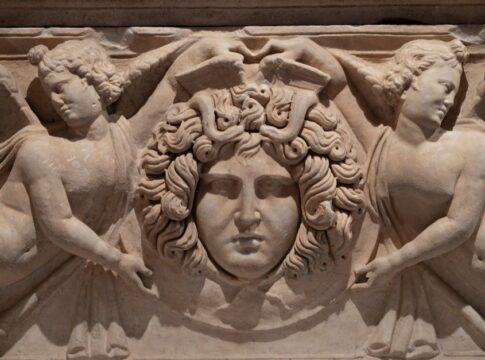
Medusa’s serpent hair connected her to this complex web of meanings. The snakes weren’t merely grotesque—they marked her as a creature bridging different realms: mortal and divine, beautiful and terrible, protective and destructive. After Perseus beheaded her, Athena placed Medusa’s head on her aegis (shield), where it became the Gorgoneion, an apotropaic symbol meant to ward off evil. The same face that brought death now offered protection.
This dual nature appears throughout Medusa’s mythology. From her blood sprang both Pegasus, the divine winged horse, and Chrysaor, a golden giant. Even in death, she generated both wonder and terror, beauty and monstrosity.
Comparing the Major Ancient Sources
| Source | Approximate Date | Medusa’s Origin | Key Differences |
|---|---|---|---|
| Hesiod’s Theogony | ~700 BCE | Born as a Gorgon monster | No transformation; mortal sister of immortal Gorgons |
| Pindar’s Poetry | ~500 BCE | Born monstrous | Emphasizes Perseus’s heroism; brief mentions |
| Apollodorus’s Library | ~100 BCE–100 CE | Born as Gorgon | Detailed Perseus narrative; no curse story |
| Ovid’s Metamorphoses | ~8 CE | Cursed by Athena | Transformation narrative; emphasizes tragedy |
The Legacy of Medusa in Modern Culture
The Medusa myth cursed with serpents continues to resonate today, though interpretations have shifted dramatically. Modern retellings often reclaim her story as one of survival and female rage against patriarchal violence. Feminist scholars and artists have reimagined Medusa not as a monster but as a symbol of women’s justified anger and the consequences of male aggression.
The Gorgoneion appears in art, architecture, and popular culture worldwide. Fashion designer Gianni Versace adopted it as his brand’s logo, drawn to its apotropaic power and classical beauty. The image adorns buildings from ancient temples to modern courthouses, still functioning as a protective emblem thousands of years after its origin.
Psychologically, Medusa represents the “monstrous feminine”—the idea that female power, particularly when it defies male control, gets coded as dangerous and ugly. Her story asks uncomfortable questions about victimhood, punishment, and whose perspective shapes the narrative. Is she a cautionary tale? A tragic victim? A symbol of power? The answer depends on who’s telling the story and when.
Frequently Asked Questions
Was Medusa always depicted with snake hair?
Yes, across all ancient sources, Medusa and her Gorgon sisters are consistently described with serpents for hair. This feature remained constant even as other aspects of her origin story changed between Greek and Roman versions.
Why was Medusa the only mortal Gorgon?
Ancient sources don’t explain why Medusa alone was mortal while her sisters Stheno and Euryale were immortal. This distinction made her vulnerable to Perseus and allowed the hero’s quest to succeed, serving the narrative function of making her defeatable.
Did Medusa have children?
According to myth, Pegasus the winged horse and the giant Chrysaor sprang from Medusa’s neck when Perseus beheaded her. They were fathered by Poseidon, born at the moment of her death rather than through normal birth.
What happened to Medusa’s head after Perseus killed her?
Perseus used Medusa’s severed head as a weapon several times before giving it to Athena. The goddess mounted it on her aegis (shield or breastplate), where it became the Gorgoneion, a protective symbol used in Greek art and architecture for centuries.
The multiple versions of Medusa’s story remind us that myths were never static. They evolved, contradicted each other, and served different purposes across centuries and cultures. Whether you see her as monster, victim, or symbol, her serpent-crowned head continues to captivate imaginations—still powerful, still dangerous, still turning heads after more than two millennia.