
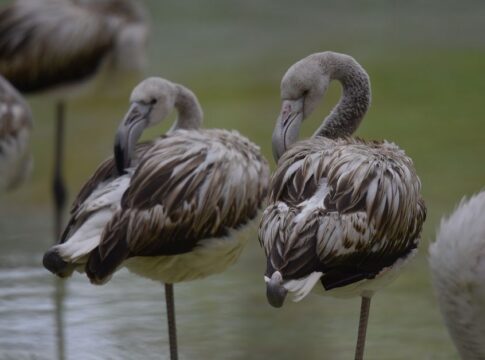
Why Flamingos Stand on One Leg: The Science Explained
By TriviaOwl, Staff Writer — Published July 28, 2026
Table of Contents
- Key Takeaways
- Why Flamingos Stand Science Reveals a Mechanical Marvel
- The Thermoregulation Factor
- How Other Birds Compare
- Busting Common Myths About Flamingo Posture
- The Anatomy Behind the Balance
- Frequently Asked Questions
Flamingos stand science has puzzled researchers and delighted zoo visitors for generations. These elegant pink birds spend hours balanced on a single leg, often while sleeping, and seem completely at ease in a position that would leave most creatures wobbling. It’s one of nature’s most curious postures, and the answer reveals surprising facts about bird anatomy and energy conservation that extend far beyond what meets the eye.
For years, scientists proposed various theories—perhaps flamingos were warming one leg at a time, or maybe standing on one leg reduced muscle fatigue. The truth turned out to be even more interesting. Discover how physics and biology combine to make this iconic pose not just possible, but actually easier than standing on two legs.
Key Takeaways
- Flamingos can lock their leg joints in place, allowing them to stand on one leg with zero muscular effort—it’s a passive mechanical system.
- Research shows flamingos are more stable on one leg than two, especially when resting or sleeping.
- The one-legged stance helps conserve body heat by reducing the surface area exposed to cold water.
- Dead flamingos can remain standing on one leg due to the locked joint mechanism, demonstrating it requires no active muscle engagement.
- Many bird species use similar one-legged resting postures, but flamingos have perfected the technique thanks to their unique anatomy.
- Flamingos alternate legs regularly, though they show no consistent preference for left or right.
Why Flamingos Stand Science Reveals a Mechanical Marvel
The breakthrough came when researchers studied both living and deceased flamingos. When scientists examined flamingo cadavers, they made an amazing discovery: the birds could remain standing on one leg even after death. This proved the stance wasn’t maintained by active muscle control but rather by a passive anatomical mechanism.
The secret lies in the flamingo’s unique skeletal and ligament structure. When a flamingo shifts its body weight directly over one leg, the joints lock into place through a “stay apparatus”—a system of bones, tendons, and ligaments that holds the leg rigid without any muscular effort. Think of it like clicking a folding chair into position: once locked, it stays put until deliberately released.
This mechanical advantage means a flamingo expends essentially zero energy maintaining its one-legged posture. Standing on two legs, by contrast, requires active muscle engagement to maintain balance and keep both legs properly positioned. The one-legged stance is literally the path of least resistance.
Testing the Theory
Researchers measured body sway in flamingos and found that resting birds were significantly more stable on one leg than two. When standing on both legs, flamingos exhibited more postural adjustments and micro-movements. On one leg, they barely moved at all. The physics work in their favor: a single point of contact creates a stable column directly beneath the bird’s center of gravity.
The Thermoregulation Factor
While the mechanical explanation is primary, thermoregulation plays a supporting role. Flamingos often stand in cold water for extended periods while feeding and resting. Birds lose significant body heat through their legs, which lack the insulating feathers covering the rest of their bodies.
By tucking one leg up into their warm belly feathers, flamingos reduce heat loss by roughly half. This becomes especially important in cooler climates or during cold nights. The energy saved from reduced heat loss compounds the energy already conserved by the passive standing mechanism. It’s a double efficiency bonus.
Interestingly, studies have shown flamingos are more likely to stand on one leg in colder conditions and more likely to use both legs when temperatures rise. This behavioral shift supports the heat conservation theory as a complementary benefit to the primary mechanical advantage.
How Other Birds Compare
Flamingos aren’t alone in their one-legged habits. Many wading birds adopt similar postures, though few match the flamingo’s commitment to the stance. Here’s how various species stack up:
| Bird Species | One-Legged Behavior | Typical Duration |
|---|---|---|
| Flamingos | Frequent, especially when resting | Hours at a time |
| Herons | Common while resting | Extended periods |
| Storks | Regular during rest | Long durations |
| Ducks | Occasional | Moderate periods |
| Geese | Sometimes while sleeping | Shorter periods |
Busting Common Myths About Flamingo Posture
Several misconceptions persist about why flamingos stand on one leg. Let’s set the record straight:
- Myth: They’re resting tired muscles. The opposite is true—standing on one leg with locked joints requires no muscular effort, while standing on two legs does.
- Myth: It’s purely about warmth. Heat conservation is a benefit, but the primary reason is the effortless mechanical stability of the one-legged stance.
- Myth: They can’t balance on two legs well. Flamingos can stand perfectly well on both legs; they simply choose not to when resting because one leg is more efficient.
- Myth: Only old or sick flamingos do this. All healthy flamingos of all ages adopt this posture regularly—it’s completely normal behavior.
The Anatomy Behind the Balance
A flamingo’s leg structure differs significantly from human anatomy. Their visible backward-bending “knee” is actually their ankle—their true knee sits hidden high up near the body, tucked under feathers. This creates an exceptionally long lower leg segment that functions like a natural pendulum.
The hip and knee joints work together as part of the stay apparatus. When weight is centered over the supporting leg, these joints align and lock through a combination of bone shape and ligament tension. The bird can literally sleep standing up without fear of toppling over. No conscious thought required.
This same mechanism explains why flamingos sometimes appear to stand motionless for remarkably long periods. They’re not frozen in concentration—they’re simply relaxing in their most energy-efficient position, perhaps dozing while digesting their latest meal of algae and small crustaceans.
Frequently Asked Questions
Do flamingos prefer one leg over the other?
Flamingos show no consistent preference for left or right legs. They regularly alternate which leg they stand on, likely to ensure both legs share the workload over time and to allow each tucked leg to warm up equally.
Can flamingos sleep while standing on one leg?
Yes, flamingos commonly sleep while balanced on one leg. The passive locking mechanism means they can rest completely without risk of falling, making it their preferred sleeping posture both in water and on land.
Do baby flamingos stand on one leg?
Young flamingos begin adopting the one-legged stance as they mature, though they’re less steady at first. Like many bird behaviors, it improves with practice as their skeletal structure fully develops and they learn to position their weight correctly.
Why don’t flamingos fall over when they’re asleep on one leg?
The stay apparatus in their leg joints locks into place mechanically, requiring no active muscle control. This passive system keeps them upright even during deep sleep, functioning much like a kickstand on a bicycle.
Next time you see a flamingo standing serenely on one leg, you’re witnessing millions of years of evolutionary engineering at work. What looks like a quirky balancing act is actually nature’s solution to minimizing energy expenditure—proof that sometimes, less really is more.