
Why Bananas Are Curved: The Surprising Science Behind It
By Trivia Daily, Staff Writer — Published July 31, 2026
Table of Contents
- Key Takeaways
- The Bananas Curved Science: How Negative Geotropism Works
- Why Bending Toward the Sun Matters
- Wild Bananas vs. Store-Bought: A Striking Difference
- The Clone Army: Why All Bananas Look Alike
- Other Fruits That Bend and Grow
- Frequently Asked Questions
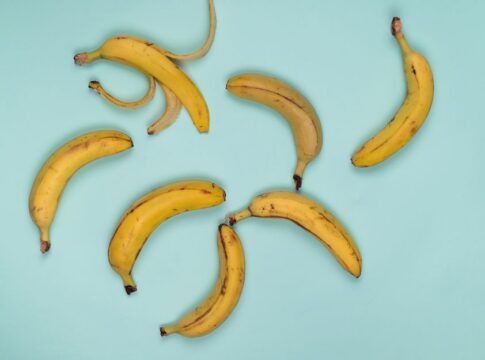
Every banana you’ve ever eaten shares a distinctive curved shape, arcing gracefully upward like a smile. This isn’t random. The bananas curved science reveals a fascinating biological process driven by a phenomenon called negative geotropism—the plant’s response to gravity and light. While most people never stop to wonder why their breakfast fruit bends the way it does, the answer uncovers an amazing story about plant behavior, survival strategies, and the hidden intelligence of the natural world.
Bananas don’t start out curved. They begin growing downward due to gravity, but something remarkable happens as they develop. Understanding this transformation opens a window into how plants sense and respond to their environment in ways that might surprise you.
Key Takeaways
- Bananas curve upward due to negative geotropism, a process where the fruit grows against gravity toward sunlight.
- The fruit initially grows downward but gradually reorients itself as it matures, creating the characteristic arc.
- Each banana is technically a berry, and what we call a “bunch” is actually a single flower cluster that can contain 50 to 150 individual fruits.
- The curvature helps maximize sun exposure for photosynthesis, allowing the fruit to ripen more efficiently.
- Wild bananas look dramatically different from cultivated varieties and contain large, hard seeds throughout the flesh.
- Commercial bananas are clones, genetically identical to one another, which is why they all curve in remarkably similar ways.
The Bananas Curved Science: How Negative Geotropism Works
Bananas grow on what looks like a tree but is actually the world’s largest herbaceous plant—a giant herb, if you will. The “trunk” is a pseudostem made of tightly packed leaf bases. When the plant flowers, a large purple bud emerges and produces rows of flowers that eventually become bananas.
Here’s where the interesting science begins. Initially, the entire flower cluster hangs downward under its own weight. The individual bananas start growing in this downward position. But as they develop, they begin exhibiting negative geotropism—literally “negative response to Earth.” Plant hormones called auxins accumulate on the lower side of each banana, causing cells there to grow more slowly than cells on the upper side.
This uneven growth creates tension. The top side elongates faster, forcing the banana to curve upward. Over several days, each fruit gradually reorients itself until it’s pointing toward the sky. The result? That familiar curved shape we all recognize.
This behavior isn’t unique to bananas. Many plants display geotropism in different forms. Roots exhibit positive geotropism, growing downward into soil. Stems show negative geotropism, growing upward toward light. Bananas simply take this principle and create one of nature’s most visually distinctive fruits.
Why Bending Toward the Sun Matters
The curve isn’t just aesthetically pleasing—it serves a critical function. By growing upward, bananas position themselves for maximum sun exposure. Photosynthesis doesn’t stop when fruit forms. The banana peel contains chlorophyll and continues photosynthesizing as the fruit matures, which helps convert starches into sugars.
Think of it as solar panels adjusting their angle. A downward-facing banana would receive less direct sunlight, especially in dense tropical environments where banana plants naturally thrive. The upward curve ensures each fruit catches as much light as possible, speeding ripening and improving nutritional content.
The entire bunch benefits from this arrangement. With dozens of bananas all curving upward in organized rows, they avoid shading each other excessively. It’s a surprisingly efficient design that maximizes the plant’s reproductive success—because from the plant’s perspective, these fruits exist to spread seeds (even though commercial bananas have been bred to be seedless).
Wild Bananas vs. Store-Bought: A Striking Difference
The bananas you buy at the grocery store are cultivated varieties, primarily the Cavendish banana. These have been selectively bred for thousands of years to be seedless, sweet, and uniform. But wild bananas tell a different story entirely.
| Characteristic | Wild Bananas | Commercial Bananas |
|---|---|---|
| Seeds | Large, hard, numerous throughout flesh | Tiny, sterile, barely noticeable |
| Size | Smaller, often just 2-3 inches long | 6-8 inches, uniform sizing |
| Taste | Starchy, sometimes bitter | Sweet, creamy when ripe |
| Curvature | Variable, less pronounced | Consistent, distinctive arc |
| Reproduction | Sexual (via seeds) | Asexual (via offshoots/cloning) |
Wild bananas still exist throughout Southeast Asia, where bananas originated. These fruits curve too, but the effect is less dramatic because the fruits are smaller and the bunches less organized. The pronounced curve we associate with bananas is partly a result of selective breeding that created larger, heavier fruits requiring more dramatic reorientation.
The Clone Army: Why All Bananas Look Alike
Every Cavendish banana is genetically identical. They’re all clones propagated from offshoots of parent plants. This means they all respond to environmental stimuli in exactly the same way, producing remarkably uniform curves.
This genetic uniformity has benefits—predictable harvests, consistent quality, reliable shipping characteristics. But it also creates vulnerability. A disease that affects one Cavendish banana can potentially affect them all. This actually happened before. The Gros Michel banana, once the dominant commercial variety, was nearly wiped out by Panama disease in the 1950s. The Cavendish replaced it, but now faces its own disease threats.
The uniform curvature we see today might not last forever. If banana cultivation shifts to different varieties for disease resistance, we might see fruits with different shapes, sizes, and degrees of curvature. The banana’s curve is as much a product of human agricultural choices as it is of plant biology.
Other Fruits That Bend and Grow
Bananas aren’t alone in their gravitational gymnastics. Several other fruits and vegetables exhibit similar behavior:
- Cucumbers and zucchini curve upward when growing on vines, responding to light and gravity
- Certain squash varieties develop pronounced curves depending on how they rest while growing
- Eggplants often curve slightly as they hang from the plant and reorient toward light
- Some pepper varieties naturally curve as they mature and change weight distribution
What makes bananas special is the consistency and drama of their transformation. Few fruits change orientation so completely or predictably during development.
Frequently Asked Questions
Do all bananas curve in the same direction?
Yes, bananas almost universally curve upward, away from the ground and toward the sky. This happens because of negative geotropism affecting all fruits in the bunch similarly. Occasionally, a banana growing on the edge of a bunch or facing unusual conditions might develop a slightly different curve, but the upward arc is nearly universal.
Are bananas really berries?
Botanically speaking, yes. Bananas meet the scientific definition of a berry: a fruit produced from a single flower with one ovary, containing seeds (even if tiny) embedded in the flesh. Strawberries and raspberries, ironically, are not true berries by this definition, while bananas, grapes, and tomatoes are.
Why do some bananas have less curve than others?
Curvature can vary based on growing conditions, the banana’s position in the bunch, and how much room it has to reorient during development. Bananas crowded together may curve less dramatically, while those with more space often develop more pronounced arcs. Younger, smaller bananas harvested early may also show less curvature.
Can you grow straight bananas?
It’s theoretically possible by physically constraining the fruit or manipulating its orientation during growth, but it would work against the plant’s natural processes. Some farmers have experimented with positioning or supports, but the effort required makes it impractical. The curve is so integral to banana development that fighting it serves no commercial purpose.
Next time you peel a banana, take a moment to appreciate the botanical ballet that created its shape. That simple curve represents millions of years of evolution, thousands of years of human cultivation, and the quiet intelligence of plants responding to their environment. It’s a reminder that even the most ordinary objects around us carry extraordinary stories—if we just take time to discover them.