
Why Pineapples Take Two Years to Grow: The Surprising Truth
By TriviaOwl, Staff Writer — Published July 29, 2026
Table of Contents
- Key Takeaways
- Why Pineapples Take Years: The Biology Behind the Wait
- The One-Fruit Wonder: A Unique Reproductive Strategy
- How Commercial Growers Work Around Nature’s Timeline
- Comparing Pineapple Growth to Other Fruits
- Why This Matters for Price and Availability
- Frequently Asked Questions
Most fruits grow quickly. Strawberries ripen in about a month. Tomatoes take roughly three. But pineapples? They need an astonishing 18 to 24 months to produce a single fruit. If you’ve ever wondered why pineapples take years to grow while other fruits sprint to harvest, you’re about to discover one of nature’s most fascinating curiosities. This tropical marvel doesn’t just grow slowly—it rewrites the rules of fruit production in ways that make it one of the most interesting plants on Earth.
The pineapple’s leisurely timeline isn’t laziness. It’s biology. Each plant produces exactly one fruit per cycle, and the entire growth process unfolds in stages that can’t be rushed. Understanding why reveals amazing facts about plant reproduction, agricultural patience, and the true cost of that sweet tropical flavor.
Key Takeaways
- A single pineapple plant requires 18 to 24 months to produce one fruit, making it one of the slowest-growing commercial crops.
- Unlike trees that bear fruit year after year, each pineapple plant produces only one fruit before requiring propagation from side shoots.
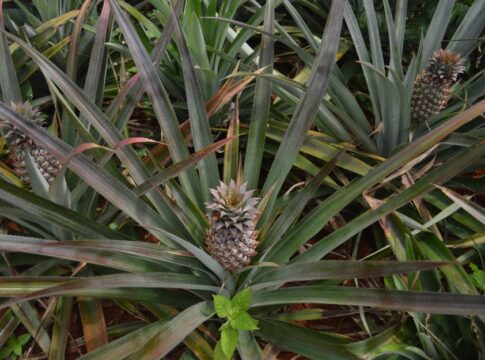
- Pineapples don’t grow on trees—they emerge from the center of a ground-level plant that resembles a large, spiky rosette.
- The fruit forms from dozens of individual flowers that fuse together, creating the distinctive hexagonal pattern on its surface.
- Commercial growers can use ethylene gas to trigger flowering and synchronize harvests, but the biological timeline remains largely fixed.
- After harvest, the plant produces side shoots called “slips” and “suckers” that can be replanted, continuing the cycle.
Why Pineapples Take Years: The Biology Behind the Wait
Pineapples belong to the bromeliad family, a group of plants known for their slow, deliberate growth patterns. The journey begins when a farmer plants a crown (the leafy top), a slip, or a sucker from a previous plant. For the first 12 to 18 months, the plant focuses entirely on vegetative growth—building a robust root system and developing those iconic sword-shaped leaves.
During this phase, nothing that looks like fruit appears. The plant is essentially charging its biological battery, storing energy and nutrients in its leaves. Only when the plant reaches sufficient maturity does it switch from vegetative to reproductive mode. This transition can’t be forced through extra water or fertilizer alone. The plant operates on its own internal clock.
When flowering finally begins, something remarkable happens. The plant produces up to 200 small purple flowers arranged in a spiral pattern. Each flower is capable of developing into a fruitlet. Over several weeks, these individual fruitlets fuse together around a central core, creating what we recognize as a single pineapple. This composite fruit structure explains the hexagonal eyes on the surface—each represents an individual flower’s contribution.
After pollination (which commercial growers actively prevent to avoid seeds), the fruit itself requires another five to six months to mature. The flesh sweetens, acids balance, and the exterior transitions from green to golden yellow. Only then is the pineapple ready for harvest. The entire process, from planting to picking, spans nearly two years for first-generation plants.
The One-Fruit Wonder: A Unique Reproductive Strategy
Here’s where pineapples diverge sharply from most fruit-bearing plants. An apple tree produces bushels of fruit year after year. A strawberry plant sends out runners and generates berries throughout a season. A pineapple plant? It creates one fruit, then it’s essentially done.
After harvest, the mother plant begins to decline. But before it dies, it produces offshoots. These baby plants—slips growing from the fruit stalk, suckers emerging from leaf axils, or crowns topping the fruit itself—become the next generation. Farmers remove and replant these offshoots, which have a head start over crown plantings and may fruit slightly faster, in about 15 to 18 months.
This reproductive strategy makes pineapple cultivation labor-intensive. There’s no passive income from a mature orchard. Each plant is a one-shot investment requiring nearly two years of care, water, pest management, and patience before delivering a single harvestable product.
How Commercial Growers Work Around Nature’s Timeline
Modern agriculture has found ways to work with, if not entirely overcome, the pineapple’s stubborn schedule. Growers use ethylene gas or calcium carbide to artificially trigger flowering. This doesn’t speed up growth, but it does synchronize it across thousands of plants, ensuring predictable harvest windows.
Without this intervention, plants in the same field would flower randomly over many months, making efficient harvesting nearly impossible. By inducing flowering when plants reach adequate size—typically 12 to 16 months after planting—growers create uniform crops that ripen together. The fruit still needs five to six months to mature after flowering begins, but at least the timing becomes manageable.
Temperature and daylight also influence the timeline. Pineapples thrive in tropical and subtropical climates where temperatures remain between 65°F and 95°F year-round. Cooler weather slows growth. Insufficient sunlight reduces sugar accumulation. The ideal conditions exist in places like Hawaii, Costa Rica, the Philippines, and Thailand—regions that dominate global production.
Comparing Pineapple Growth to Other Fruits
| Fruit | Time to First Harvest | Fruits Per Plant/Tree |
|---|---|---|
| Pineapple | 18-24 months | 1 per cycle |
| Strawberry | 4-6 weeks (after transplant) | Multiple per season |
| Tomato | 60-85 days | 10-30+ per plant |
| Apple Tree | 2-5 years (then annual) | 100-300+ per year |
| Banana | 9-12 months | 1 bunch per cycle |
| Orange Tree | 3-5 years (then annual) | 200-400+ per year |
The comparison makes pineapple’s economics clear. While an apple tree represents a multi-year investment that pays dividends for decades, and a strawberry patch turns over multiple times per season, pineapples demand maximum patience for minimal yield per plant.
Why This Matters for Price and Availability
The lengthy growth cycle directly impacts what you pay at the grocery store. Labor costs accumulate over two years of weeding, pest control, and irrigation. Land remains occupied by a single crop for extended periods, preventing farmers from rotating to faster-growing alternatives. Transportation costs add up because pineapples are heavy and must be harvested at peak ripeness for best flavor.
Despite these challenges, global production exceeds 28 million tons annually. Costa Rica alone exports over two million tons, primarily of the Smooth Cayenne and MD-2 (Del Monte Gold) varieties favored by international markets. The industry persists because demand remains strong, and tropical regions have climates where pineapples grow reliably despite their slow pace.
Interestingly, the two-year timeline has remained largely unchanged throughout pineapple cultivation history. While selective breeding has improved disease resistance, fruit size, and sweetness, no one has successfully bred a pineapple that matures substantially faster. Biology sets the limits.
Frequently Asked Questions
Can you grow a pineapple faster indoors or in a greenhouse?
No, the biological timeline remains essentially the same regardless of setting. While controlled environments can optimize temperature and light, pineapples still require 18 to 24 months to produce fruit because their growth stages are genetically programmed.
Do pineapples continue to ripen after being picked?
No, pineapples do not ripen further after harvest. Unlike bananas or avocados, which produce ethylene and continue developing, pineapples must be picked at full maturity. This is why choosing a ripe pineapple at purchase is essential for best flavor.
Why don’t pineapples have seeds?
Commercial pineapples are cultivated to be seedless through careful agricultural practices that prevent pollination. Wild pineapples do produce seeds when pollinated by birds or bats, but seedless varieties are preferred for eating because seeds would make the flesh unpleasantly crunchy.
How many pineapples can one plant produce in its lifetime?
A single pineapple plant produces one main fruit, then generates offshoots that can be replanted. If managed for multiple cycles using ratoon crops (allowing the plant to fruit again from suckers), a plant might yield two or occasionally three fruits over several years, though quality typically declines after the first.
Next time you slice into a pineapple, take a moment to appreciate the two years of tropical sun, careful cultivation, and botanical patience that made it possible. That sweet, tangy flavor is the reward for one of nature’s longest waits—a reminder that some of the best things really do take time.