
The Truth About Crows Using Tools to Solve Problems
By Trivia Daily, Animals Desk — Published September 24, 2026
Table of Contents
- Key Takeaways
- The Truth Crows Using Tools Reveals About Animal Intelligence
- How Crow Problem-Solving Compares to Other Species
- The Crow Brain: Small But Mighty
- Real-World Examples of Crow Innovation
- What Crow Behavior Teaches Us About Evolution
- Frequently Asked Questions
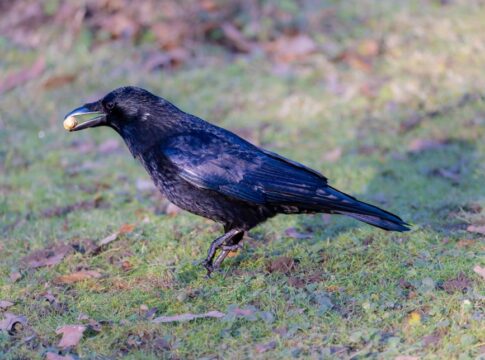
When you watch a crow drop a walnut onto a busy street and wait for a car to crack it open, you’re witnessing something remarkable. The truth about crows using tools to solve problems reveals an intelligence that rivals some primates. These jet-black birds don’t just stumble upon solutions—they plan, innovate, and even teach their young. In the animal kingdom, crows stand out as creatures capable of reasoning through multi-step challenges that would stump most wildlife species.
Crows belong to the corvid family, which includes ravens, jays, and magpies. Scientists have documented these birds fashioning hooks from wire, using sticks to extract insects from tree bark, and understanding water displacement principles. Their behavior in nature demonstrates cognitive abilities once thought exclusive to humans and great apes.
Key Takeaways
- Crows can craft and modify tools from materials they find, including bending wire into hooks to retrieve food from containers.
- New Caledonian crows show the most sophisticated tool use among bird species, creating hooked sticks from specific plant materials.
- Crows understand cause and effect, demonstrating this by dropping stones into water tubes to raise the water level and access floating food.
- These birds can solve problems requiring three or more sequential steps, a cognitive feat that places them alongside dolphins and great apes.
- Young crows learn tool-making techniques from their parents and other adults, showing cultural transmission of knowledge within populations.
- Crows remember human faces for years and can communicate warnings about dangerous individuals to other crows in their habitat.
The Truth Crows Using Tools Reveals About Animal Intelligence
Tool use was once considered the defining characteristic of humanity. Then Jane Goodall observed chimpanzees fishing for termites with modified twigs, and the definition shifted. But corvids—particularly crows and ravens—have shattered assumptions about which animals possess this ability.
New Caledonian crows manufacture tools with stunning precision. They select pandanus leaves and carefully tear them to create serrated edges, fashioning instruments perfectly suited for extracting grubs. They don’t just grab any stick. They assess the problem, choose appropriate materials, and modify them to fit the task. Some crows even carry their favorite tools from location to location.
Research has shown that crows understand water displacement at a level comparable to a five-to-seven-year-old human child. In controlled experiments, crows consistently drop stones into water-filled tubes to bring floating food within reach. They distinguish between hollow and solid objects, choosing only items that will actually raise the water level. This isn’t trial and error—it’s comprehension.
How Crow Problem-Solving Compares to Other Species
| Animal | Tool Use Capability | Problem-Solving Complexity |
|---|---|---|
| New Caledonian Crow | Manufactures hooked tools, uses multiple tool types | Solves multi-step puzzles, understands physics |
| Chimpanzee | Uses sticks for termite fishing, stones for cracking nuts | High spatial reasoning, social learning |
| Bottlenose Dolphin | Uses marine sponges to protect snouts while foraging | Complex social strategies, pattern recognition |
| Sea Otter | Uses rocks to crack open shellfish | Moderate; primarily repetitive tool use |
| Octopus | Carries coconut shells for shelter, manipulates objects | Excellent spatial navigation, rapid adaptation |
The Crow Brain: Small But Mighty
A crow’s brain weighs about 15 grams. For comparison, a human brain weighs roughly 1,400 grams. Size, however, tells only part of the story. Corvid brains have a neuron density that rivals primate brains, particularly in regions responsible for higher-order thinking.
The nidopallium caudolaterale in corvid brains performs functions similar to the prefrontal cortex in mammals. This area handles executive functions: planning, impulse control, and working memory. Crows can hold information in mind, resist immediate gratification, and work toward delayed rewards—all hallmarks of advanced cognition.
Their eyes are positioned to provide excellent binocular vision. This helps them judge distances precisely when manipulating objects. Crows also possess remarkable memory, both spatial and social. They remember where they’ve cached thousands of food items and recall which individual birds have stolen from them in the past.
Real-World Examples of Crow Innovation
Urban crows have adapted to human environments with impressive creativity. In Japan, crows have been observed placing walnuts at crosswalks, waiting for the red light so cars will run over the nuts, then retrieving the kernels when pedestrians cross. They’ve essentially recruited humans and automobiles into their foraging strategy.
Crows in cities have learned to access food in seemingly impossible containers. They’ve been documented removing multiple lids, pulling strings to lift food, and even using one tool to obtain another tool needed for the actual task. This meta-tool use—using a tool to get a tool—represents a sophisticated level of planning.
In wild habitats, crows demonstrate social learning that borders on cultural transmission. Young birds don’t instinctively know which tools work best. They watch experienced adults, practice techniques, and refine their skills over time. Different crow populations have distinct tool-making styles, passed down through generations.
What Crow Behavior Teaches Us About Evolution
Intelligence evolved independently in corvids and primates. Our last common ancestor lived roughly 320 million years ago and possessed nothing resembling advanced cognition. This convergent evolution demonstrates that complex problem-solving can emerge through different evolutionary pathways when environmental pressures favor it.
Crows face challenges that reward innovation. Finding food in bark crevices, accessing marrow in bones, and thriving in variable habitats all benefit from flexible thinking. Natural selection favored birds that could improvise, remember solutions, and pass knowledge to offspring.
The corvid example suggests intelligence isn’t about brain size or structure alone. It’s about neural organization, information processing efficiency, and the ecological niche an animal occupies. Species that must solve novel problems regularly tend to develop the cognitive machinery to handle them.
Frequently Asked Questions
Can all crow species use tools?
Not all crows demonstrate the same level of tool use. New Caledonian crows show the most sophisticated abilities, while American crows and carrion crows display tool use less frequently but still demonstrate problem-solving skills that surpass most bird species.
Do crows teach their young how to use tools?
Yes, young crows learn tool-making and problem-solving techniques through observation and practice. Parents and other adults in the group provide models, and juveniles refine their skills over several months through trial and social learning.
How long can crows remember solutions to problems?
Crows have excellent long-term memory and can remember problem-solving techniques for years. They also remember individual human faces for at least five years and can recall specific locations where they’ve hidden food for months.
Are ravens smarter than crows?
Ravens and crows have comparable intelligence, with each excelling in different areas. Ravens may have slight advantages in social manipulation and cooperative tasks, while some crow species demonstrate superior tool-manufacturing abilities. Both are among the most intelligent bird species.
The next time you see a crow inspecting a piece of wire or watching traffic patterns, remember you’re observing one of nature’s great problem-solvers. These birds challenge our assumptions about consciousness, planning, and what it means to think. In their glossy feathers and sharp eyes lies a reminder that intelligence blooms in unexpected forms across the tree of life.