
Dragon Myths: 9 Cultures That Worshipped Serpent Gods
By TriviaOwl, Staff Writer — Published August 15, 2026
Table of Contents
- Key Takeaways
- Dragon Myths Cultures Developed Across Continents
- Why Serpents Became Gods
- Comparing Dragon Characteristics Across Cultures
- Frequently Asked Questions
Long before modern fantasy novels made dragons household names, ancient civilizations around the world revered massive serpent deities as forces of creation, destruction, and cosmic balance. What’s truly surprising is how these dragon myths from cultures separated by oceans and millennia share strikingly similar characteristics—despite having no contact with one another. From the feathered serpents of Mesoamerica to the water dragons of East Asia, these mythological creatures reveal fascinating insights into how different societies understood power, nature, and the divine.
Discover the amazing connections between dragon myths cultures developed independently, and explore the curious truths behind these legendary beasts that continue to captivate our imagination today.
Key Takeaways
- Nearly every major ancient civilization developed dragon or serpent deity myths independently, suggesting universal human fascination with these creatures.
- Eastern and Western dragon myths differ fundamentally: Asian dragons typically symbolize wisdom and prosperity, while European dragons often represent chaos and evil.
- Many dragon myths likely originated from discoveries of large fossil bones, which ancient peoples interpreted as evidence of giant reptilian creatures.
- Serpent gods frequently controlled water, rain, and agricultural fertility across diverse cultures, reflecting the importance of these elements to survival.
- The Quetzalcoatl deity of Mesoamerica was worshipped continuously for over 2,000 years across multiple civilizations.
- Dragon symbolism remains deeply embedded in modern culture, from national flags to corporate logos and popular entertainment.
Dragon Myths Cultures Developed Across Continents
The independent emergence of dragon myths across geographically isolated cultures presents one of mythology’s most intriguing puzzles. Anthropologists have long debated whether these parallel myths arose from common prehistoric roots or developed separately as humans encountered similar natural phenomena—massive bones, dangerous reptiles, and powerful natural forces—that sparked similar imaginative responses.
What makes these myths particularly interesting is their persistence. Unlike many ancient beliefs that faded with time, dragon symbolism has proven remarkably durable, evolving but never disappearing from human culture. The serpent’s ability to shed its skin likely contributed to its association with rebirth and immortality across multiple traditions.
1. Chinese Long: The Celestial Water Bringers
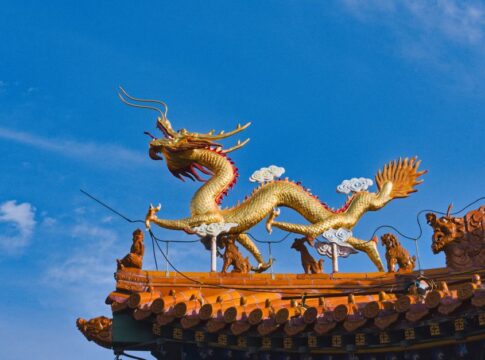
Chinese dragon mythology represents perhaps the most enduring and complex serpent deity tradition in human history. The Long (or lung) dragon symbolized imperial power, wisdom, and control over water and weather for thousands of years. Unlike their Western counterparts, Chinese dragons were generally benevolent beings associated with prosperity and good fortune. These serpentine creatures—depicted with deer antlers, fish scales, eagle claws, and flowing whiskers—were believed to live in rivers, lakes, and seas, rising to the heavens to bring rain during droughts. The emperor himself was considered the “dragon’s face,” and only he could wear robes adorned with five-clawed dragons. This reverence was so profound that during certain dynasties, commoners could be executed for using dragon imagery reserved for royalty.
2. Quetzalcoatl: The Feathered Serpent of Mesoamerica
The Aztec and Maya civilizations worshipped Quetzalcoatl, whose name literally means “feathered serpent” in Nahuatl. This deity represented the fusion of earthly power (the serpent) and heavenly divinity (the bird’s feathers), embodying the connection between ground and sky. Quetzalcoatl was credited with creating humanity, inventing the calendar, and teaching agriculture and crafts. Archaeological evidence shows this god was venerated as early as the first century BCE by the Teotihuacan culture and continued to be central to religious practice until the Spanish conquest. The massive Pyramid of the Feathered Serpent at Teotihuacan, adorned with hundreds of serpent head sculptures, demonstrates the architectural and artistic sophistication dedicated to this deity’s worship.
3. Tiamat: Mesopotamia’s Primordial Chaos Dragon
In ancient Babylonian mythology, Tiamat embodied the salt sea and primordial chaos from which all creation emerged. The Enuma Elish, Babylon’s creation epic dating to approximately the 18th century BCE, describes Tiamat as a massive dragon whose body was split by the god Marduk to create heaven and earth. This myth established a pattern seen in many cultures: the dragon as a force of primal chaos that must be defeated for ordered civilization to exist. Tiamat’s serpentine form represented the untamed power of nature—both life-giving and destructive—that early agricultural societies sought to understand and control. Her worship reflects humanity’s earliest attempts to explain cosmic origins through narrative.
4. Jörmungandr: The Norse World Serpent
Norse mythology features Jörmungandr, a serpent so immense it encircles the entire world, grasping its own tail in the depths of the ocean. According to the Prose Edda, this creature was one of three monstrous children of the trickster god Loki. The god Thor repeatedly encounters Jörmungandr, and their final battle during Ragnarök—the Norse apocalypse—results in mutual destruction. This myth embodies the Viking understanding of fate, cyclical time, and the inevitable destruction and renewal of the cosmos. The world serpent’s circular form symbolized completeness and the boundaries of the known world, while its position in the sea reflected Scandinavian culture’s intimate relationship with maritime life and its dangers.
5. Nāga: Buddhism and Hinduism’s Serpent Protectors
Throughout South and Southeast Asia, Nāga serpent deities occupy a unique position in both Hindu and Buddhist traditions. These semi-divine beings, depicted as giant cobras or as humans with serpent hoods, are associated with water, fertility, and protection of treasure. In Buddhist tradition, a Nāga king named Mucalinda is said to have shielded the Buddha from a storm during his meditation by coiling around him and spreading its hood overhead. Hindu mythology describes Nāgas as inhabitants of an underground realm filled with gems and precious metals. The widespread veneration of Nāgas—from Indian temples to Cambodian architecture at Angkor Wat—demonstrates how serpent worship integrated into major philosophical and religious systems rather than remaining purely mythological.
6. The Rainbow Serpent: Australian Aboriginal Creation Being
Indigenous Australian cultures across the continent share myths of the Rainbow Serpent, one of the oldest continuous religious beliefs in human history, potentially dating back over 6,000 years based on rock art evidence. This creator being is associated with water sources, rainbows, and the fertility of the land. According to various Aboriginal traditions, the Rainbow Serpent shaped the landscape during the Dreamtime, creating rivers, gorges, and water holes as it moved across the earth. The serpent’s dual nature—as both life-giver through water and destroyer through floods—reflects the harsh realities of survival in the Australian environment. Different language groups have distinct names for this being, but the core symbolism remains remarkably consistent across vast distances.
7. Apep: Ancient Egypt’s Serpent of Chaos
The ancient Egyptians feared Apep (also called Apophis), a gigantic serpent that embodied chaos, darkness, and the antithesis of order. Unlike gods who received temples and worship, Apep was ritually cursed and symbolically destroyed in daily religious ceremonies. Egyptian cosmology held that Apep dwelled in the underworld, attempting each night to devour the sun god Ra as he journeyed through the darkness. The serpent’s defeat each dawn ensured the sun would rise again, making this myth central to Egyptian understanding of cosmic order. Priests performed elaborate rituals to weaken Apep, including creating wax effigies of the serpent to burn, demonstrating how dragon myths could drive actual religious practice and daily ritual life.
8. European Dragons: From Guardians to Monsters
European dragon mythology evolved significantly from ancient to medieval times. Early Greek and Roman sources describe dragons primarily as giant serpents guarding sacred places or treasures—such as the dragon guarding the Golden Fleece or Ladon protecting the golden apples of the Hesperides. These creatures weren’t necessarily evil, but rather represented obstacles to be overcome. With the spread of Christianity, European dragons transformed into symbols of evil and Satan, leading to the familiar medieval narrative of dragon-slaying saints and knights. This shift reflects how conquering cultures often demonized the sacred symbols of earlier traditions. The dragon’s association with hoarding treasure likely stems from ancient observations of snakes guarding their dens, combined with the practice of hiding valuables in remote, dangerous locations.
9. Ryūjin: Japan’s Dragon King of the Sea
Japanese Shinto tradition venerates Ryūjin, the dragon deity who rules the oceans and controls the tides through magical jewels. Living in an underwater palace made of coral and precious stones, Ryūjin commanded an army of sea creatures and could transform into human form. Japanese dragons, like their Chinese counterparts, are generally benevolent and associated with water, wisdom, and imperial power. Fishermen and sailors made offerings to Ryūjin for safe passage and bountiful catches. The legend states that Ryūjin’s daughter married a human prince, establishing the divine ancestry of Japan’s imperial line. This myth demonstrates how dragon deities were woven into political legitimacy and national identity, a pattern seen across multiple cultures.
Why Serpents Became Gods
The universal appeal of serpent deities stems from several factors rooted in human psychology and survival needs. Snakes provoke instinctive reactions in humans—our primate brains are wired to notice them quickly, a survival adaptation that made them psychologically prominent. Their alien anatomy, mysterious disappearance into holes and water, and ability to shed skin and seemingly renew themselves made them natural symbols for transformation, rebirth, and hidden knowledge.
Agricultural societies particularly gravitated toward serpent worship because snakes controlled rodent populations that threatened grain stores, while their seasonal appearance often coincided with rains and planting cycles. The connection between serpents and water appears across cultures because both snakes and water share qualities of fluidity, life-giving power, and potential danger.
Comparing Dragon Characteristics Across Cultures
| Culture | Dragon Name | Primary Symbolism | Physical Form |
|---|---|---|---|
| Chinese | Long | Wisdom, prosperity, water control | Serpentine body, four legs, antlers, no wings |
| European Medieval | Dragon | Evil, chaos, greed | Reptilian, four legs, bat-like wings, fire-breathing |
| Mesoamerican | Quetzalcoatl | Creation, knowledge, wind | Serpent body covered in feathers |
| Japanese | Ryū | Ocean, weather, imperial power | Similar to Chinese, often wingless |
| Norse | Jörmungandr | Fate, cosmic boundaries, apocalypse | Enormous serpent encircling the world |
Frequently Asked Questions
Why do Eastern and Western dragons look so different?
Eastern dragons evolved from water and weather symbolism, resulting in serpentine, wingless forms associated with rivers and rain. Western dragons likely incorporated influences from Middle Eastern myths and later Christian symbolism of evil, developing the fire-breathing, winged, treasure-hoarding form familiar in European folklore.
Did ancient people really believe dragons existed?
Yes, ancient cultures genuinely believed in dragons as real creatures or spiritual beings. Discoveries of large dinosaur and prehistoric mammal fossils, without modern paleontological knowledge to explain them, likely reinforced these beliefs and provided “evidence” of giant reptilian creatures.
Which culture had dragon myths first?
Mesopotamian civilizations have some of the earliest written dragon myths, with Tiamat appearing in texts from approximately 4,000 years ago. However, oral traditions and rock art suggest serpent deity concepts may be much older, potentially predating written records by millennia.
Are any dragon myths still actively practiced today?
Yes, dragon symbolism remains active in several traditions. Chinese culture continues to celebrate dragons during festivals, Nāga worship persists in Buddhist and Hindu practices throughout Asia, and some Indigenous Australian communities maintain Rainbow Serpent traditions as part of living spiritual practice.
The next time you encounter a dragon in a story, flag, or decoration, consider that you’re seeing an echo of humanity’s oldest and most widespread mythological tradition—one that speaks to universal human experiences of awe, fear, and wonder at the natural world’s power.