
9 Surprising Facts About Dragons Across World Cultures
By Trivia Daily, Staff Writer — Published September 23, 2026
Table of Contents
- Key Takeaways
- Dragons Across World Mythology: Bridging East and West
- The Physical Anatomy of Mythical Dragons
- Comparing Dragon Traditions Worldwide
- Frequently Asked Questions
Dragons across world mythology aren’t the uniform, fire-breathing monsters Hollywood often portrays. These legendary creatures have slithered, soared, and swum through human imagination for millennia, taking wildly different forms depending on geography and culture. While Western traditions often cast dragons as villainous hoarders of treasure, Eastern cultures have long revered them as symbols of wisdom and good fortune. The disconnect between these interpretations reveals something fascinating about how different societies have understood power, nature, and the unknown.
From serpentine water gods in ancient Mesopotamia to the multi-headed hydras of Greek legend, dragon mythology offers a window into what terrified and inspired our ancestors. Let’s explore some truly surprising facts about these mythical beasts that might change how you think about dragons forever.
Key Takeaways
- Chinese dragons traditionally have no wings yet are depicted flying through clouds and swimming through oceans.
- European dragons were not consistently portrayed as fire-breathers until medieval literature popularized the trait.
- The word “dragon” derives from ancient Greek “drakon,” meaning “to see clearly” or “serpent.”
- Japanese dragons can shape-shift into human form and are closely associated with bodies of water rather than mountain caves.
- Ancient Mesopotamian dragon Tiamat was a creator goddess, not a destructive force, in original myths.
- Welsh dragons appear on the national flag of Wales, making it one of the only national flags featuring a mythical creature.
Dragons Across World Mythology: Bridging East and West
The fundamental divide in dragon mythology splits largely along geographic lines. Eastern dragons—particularly in Chinese, Japanese, Korean, and Vietnamese traditions—are typically benevolent, serpentine creatures associated with water, weather, and imperial power. They bring rain to farmers and symbolize strength and good luck. Western dragons, by contrast, evolved into the winged, fire-breathing antagonists of medieval European tales, representing chaos, greed, and evil that heroes must overcome.
This difference isn’t merely aesthetic. It reflects deeper cultural values. In agricultural societies across Asia, water-controlling dragons represented the life-giving force of rivers and seasonal rains. European dragons, emerging from different mythological roots, became conflated with biblical serpents and pagan monsters that Christianity sought to vilify. The dragon you imagine says more about your cultural inheritance than you might realize.
The Physical Anatomy of Mythical Dragons
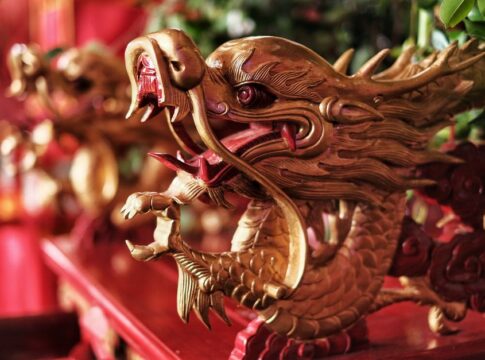
Dragon descriptions vary wildly, but patterns emerge when examining mythology systematically. Chinese dragons traditionally possess specific anatomical features: the head of a camel, horns of a deer, eyes of a rabbit, ears of a cow, neck of a snake, belly of a frog, scales of a carp, claws of an eagle, and paws of a tiger. This composite nature suggests dragons represented the ultimate creature, combining the best attributes of many animals.
European dragons developed their own anatomical standards through medieval bestiaries. Four legs, two bat-like wings, a barbed tail, and reptilian scales became the template. Some scholars suggest this imagery drew inspiration from real animals that medieval Europeans encountered: crocodiles brought back from the Crusades, whale bones misidentified as dragon remains, or even dinosaur fossils unearthed centuries before paleontology existed as a science.
1. Chinese Dragons Have No Wings But Still Fly
One of the most striking features of traditional Chinese dragons is their complete lack of wings despite their renowned ability to soar through the heavens. Unlike their Western counterparts that require massive wings to achieve flight, Chinese dragons move through the air using magical or divine power alone. They’re depicted undulating through clouds as if swimming through water, their serpentine bodies rippling with effortless grace. This wingless flight symbolizes transcendence beyond physical limitations—a creature so powerful it doesn’t need conventional means of movement. The dragon’s ability to travel between sky, earth, and water without changing form represents the interconnectedness of all natural realms in Chinese cosmology.
2. The Original Mesopotamian Dragon Was a Mother Goddess
Tiamat, one of the earliest dragon figures in recorded mythology, appears in the Babylonian creation epic Enuma Elish not as a villain but as a primordial creator goddess. She represented the salt waters of the ocean, and from her union with Apsu (fresh water) came the first gods. Only after her consort’s murder did Tiamat transform into a vengeful dragon figure who waged war against the younger gods. Her eventual defeat by Marduk, who split her body to create heaven and earth, represents a common mythological pattern: newer patriarchal gods overthrowing older maternal deities. The transformation of Tiamat from creator to monster illustrates how dragon mythology often reflected changing religious and political orders.
3. European Dragons Weren’t Always Fire-Breathers
The iconic image of a fire-breathing dragon is surprisingly modern in European mythology. Early dragon tales from Greek and Norse traditions more commonly featured venomous breath, crushing coils, or simply overwhelming physical strength. The dragon Python, slain by Apollo, used no fire. Fafnir, the Norse dragon killed by Sigurd, relied on venom. Fire-breathing became standardized largely through medieval Christian literature and artistic depictions, particularly in stories of dragon-slaying saints. The trait may have been borrowed from earlier chimera legends or represented hell-fire in religious allegory. By the time Tolkien wrote about Smaug in the 20th century, fire-breathing had become so canonical that imagining a European dragon without it seemed impossible.
4. Japanese Dragons Can Shape-Shift Into Human Form
Japanese dragon mythology, influenced by both Chinese traditions and indigenous Shinto beliefs, grants dragons remarkable shape-shifting abilities. These ryu or tatsu can assume human form, often appearing as wise old men or beautiful women. Many Japanese folktales feature dragons who fall in love with humans or take human shape to teach important lessons. The Dragon King of the Sea, Ryujin, rules an underwater palace and controls the tides through magical jewels. His daughters sometimes marry human heroes in stories that blur the line between divine and mortal. This shape-shifting ability distinguishes Japanese dragons from their more static Chinese counterparts and reflects Buddhist concepts of transformation and enlightenment.
5. Wales Features a Dragon on Its National Flag
The red dragon of Wales, Y Ddraig Goch, holds the unique distinction of appearing on a national flag—one of very few mythical creatures to achieve this honor. The symbol dates back at least to the 7th century and possibly earlier, with legends connecting it to King Arthur and the wizard Merlin. According to the tale recorded in the Historia Brittonum, a red dragon and a white dragon fought beneath a hill, with the red dragon’s eventual victory prophesying Welsh triumph over Saxon invaders. The flag was officially recognized in 1959, though the red dragon had represented Wales for over a millennium. This makes the Welsh dragon arguably the most politically successful dragon in world mythology.
6. Dragon Bones Sold in Chinese Medicine Were Dinosaur Fossils
For centuries, Chinese apothecaries sold “dragon bones” as medicinal ingredients, grinding them into powder for treating various ailments. These dragon bones were actually fossilized dinosaur remains, particularly abundant in certain regions of China. The practice inadvertently led to the destruction of countless paleontological specimens before scientists recognized their true nature. Ironically, the widespread discovery of large fossilized bones throughout Asia may have contributed to dragon mythology itself. Ancient peoples finding enormous skeletons without modern paleontological knowledge would naturally invent explanations—and what better explanation than dragons? This creates a fascinating loop where dinosaur fossils both inspired dragon myths and were later sold as dragon remains.
7. Dragons in Ethiopian Mythology Are Serpentine Protectors
Ethiopian dragon mythology features the Arwe, serpentine creatures that differ significantly from both European and Asian traditions. Rather than hoarding treasure or bringing rain, Ethiopian dragons often served as protectors or test-givers in folktales. The most famous dragon story involves the Arwe that demanded human sacrifice until Saint George (in Ethiopian tradition, Abuna Yohannes) defeated it. Ethiopian dragons also appear in connection with the ancient Aksumite civilization, sometimes depicted on coins and royal seals. These African dragon traditions developed independently from European and Asian influences, suggesting that dragon-like mythological creatures emerged separately across multiple continents—perhaps a universal human response to discovering large reptile fossils or encountering dangerous snakes and crocodiles.
8. The Word Dragon Comes From a Greek Term Meaning to See
The English word “dragon” traces back through Latin “draco” to ancient Greek “drakon,” which derived from “derkesthai”—meaning “to see” or “to see clearly.” This etymology suggests ancient Greeks associated these creatures with sharp vision and vigilance, not just destructive power. Many Greek dragons served as guardians: the dragon Ladon watched over the golden apples of the Hesperides, while a dragon guarded the Golden Fleece sought by Jason. The connection between dragons and watchfulness appears across Greek mythology, where these creatures protect sacred spaces and treasures through their ever-wakeful gaze. This linguistic origin reveals that dragons were originally conceived as guardians and sentinels, a role quite different from the marauding monsters of later European tales.
9. Mesoamerican Quetzalcoatl Merged Serpent and Bird
The Mesoamerican feathered serpent deity Quetzalcoatl represents a unique dragon-like figure that developed entirely independently from Old World traditions. Combining serpent and bird imagery, this god appeared across Aztec, Maya, and earlier civilizations as a creator deity associated with wind, learning, and the planet Venus. Unlike the reptilian dragons of Europe and Asia, Quetzalcoatl’s feathers gave it an avian quality that symbolized its connection to the sky realm. The deity’s importance in Mesoamerican religion was profound—Quetzalcoatl was credited with creating humanity, discovering corn, and inventing the calendar. This parallel evolution of dragon-like serpentine deities on a separate continent demonstrates how different cultures independently developed similar mythological archetypes.
Comparing Dragon Traditions Worldwide
| Culture | Primary Symbolism | Physical Form | Typical Role |
|---|---|---|---|
| Chinese | Good fortune, power | Serpentine, wingless, four legs | Benevolent protector, rain-bringer |
| European Medieval | Evil, greed, chaos | Four legs, wings, fire-breathing | Antagonist to be slain by heroes |
| Japanese | Water, wisdom, transformation | Serpentine, often three-clawed | Shape-shifter, sea deity |
| Mesoamerican | Creation, knowledge, wind | Feathered serpent | Creator deity, cultural hero |
Frequently Asked Questions
Why are Eastern dragons considered good while Western dragons are evil?
The difference stems from distinct cultural and religious contexts. Eastern dragons emerged from agricultural societies that revered water-controlling creatures, while Western dragons became associated with pagan monsters and biblical serpents that Christianity depicted as evil. Geography and religious transformation shaped these opposing interpretations.
Did dinosaur fossils inspire dragon myths?
Many scholars believe fossilized dinosaur bones contributed to dragon mythology when ancient peoples discovered them without paleontological context. The widespread geographic distribution of both fossils and dragon myths across Europe, Asia, and other regions supports this connection, though dragons also drew inspiration from real animals like snakes and crocodiles.
What is the oldest recorded dragon myth?
The Mesopotamian goddess Tiamat from the Babylonian Enuma Elish, dating to approximately 2000 BCE, represents one of the earliest recorded dragon figures in world mythology. However, dragon-like serpent imagery appears in even older archaeological contexts, suggesting the archetype predates written records.
Can any modern animals be considered living dragons?
The Komodo dragon earned its name due to its large size and reptilian appearance, though it shares no mythological powers. Flying lizards of Southeast Asia glide using wing-like ribs, and certain beetles can spray boiling chemical compounds, but no animal combines all traditional dragon traits—which makes sense, since dragons are mythological creatures.
Dragons persist in modern imagination not despite their impossibility but because of what they represent: humanity’s attempt to understand natural forces, confront fear, and imagine creatures embodying ultimate power. Every culture that independently developed dragon mythology created a mirror reflecting its own values, fears, and hopes—serpentine or winged, benevolent or destructive, but always magnificent.