
9 Bizarre Facts About Medusa and the Gorgon Sisters
By Trivia Daily, Staff Writer — Published September 23, 2026
Table of Contents
- Key Takeaways
- The First Bizarre Medusa Gorgon Facts: Understanding the Sisters
- The Gorgons’ Truly Monstrous Appearance
- Medusa’s Protective Power in Daily Life
- Nine Distinct Facts About the Gorgon Legend
- Frequently Asked Questions
The story of Medusa and her Gorgon sisters stands as one of Greek mythology’s most enduring tales. But beneath the familiar image of a snake-haired monster lurks a wealth of bizarre medusa gorgon trivia that even mythology enthusiasts rarely discover. From her surprising origins as a beautiful maiden to the peculiar ways ancient Greeks used her image, these facts reveal a far stranger story than most people realize.
The Gorgons weren’t just monsters to be defeated. They represented complex ideas about beauty, power, and protection in the ancient world. Ready to explore some truly surprising truths about these legendary sisters?
Key Takeaways
- Only Medusa was mortal among the three Gorgon sisters, making her the only one who could be killed.
- Ancient Greeks painted Medusa’s face on shields, doors, and ovens as a protective charm called a Gorgoneion.
- Medusa’s severed head retained its petrifying power even after her death, appearing in multiple myths.
- The Gorgons had bronze hands, golden wings, and tusks like wild boars according to ancient descriptions.
- Medusa’s blood possessed opposite properties: one side could kill instantly, the other could resurrect the dead.
- Perseus used his polished shield as a mirror to avoid looking directly at Medusa during their confrontation.
The First Bizarre Medusa Gorgon Facts: Understanding the Sisters
Most people know Medusa as a solo villain, but she was actually one of three sisters. The Gorgons—Medusa, Stheno, and Euryale—were daughters of ancient sea deities Phorcys and Ceto. What makes this family bizarre is the fundamental difference between the siblings. Stheno and Euryale were immortal from birth, blessed (or cursed) with eternal life. Medusa alone was mortal.
This distinction wasn’t arbitrary. It served a critical narrative purpose in Greek mythology: heroes needed killable monsters. The immortal sisters couldn’t be defeated, making them represent unstoppable forces of nature. Medusa’s mortality made her vulnerable, creating the possibility for Perseus’s famous quest. After her death, her immortal sisters mourned her for eternity, forever circling her memory.
The Gorgons’ Truly Monstrous Appearance
Popular culture often depicts Medusa with snake hair and little else changed from human form. Ancient Greek descriptions paint a far more terrifying picture. According to classical sources, the Gorgons possessed bronze hands that could tear through armor and flesh. They had golden wings that allowed them to fly, making escape from them nearly impossible. Their mouths contained boar-like tusks, and their eyes glowed with supernatural intensity.
The snakes weren’t just on their heads, either. Some accounts describe serpents coiling around their waists like belts and hissing from their shoulders. Their skin was sometimes depicted as scaly, and their tongues lolled from their mouths in a perpetual grimace. Early artistic representations showed them as grotesque, almost comic figures designed to ward off evil—far from the tragic beauty often portrayed in modern retellings.
Medusa’s Protective Power in Daily Life
Here’s something truly fascinating: ancient Greeks didn’t just fear Medusa—they invited her into their homes. The Gorgoneion, an image of Medusa’s face, became one of the most popular protective symbols in the ancient Mediterranean world. People painted or carved her visage on shields to frighten enemies in battle. But they also placed her image on coins, temples, ovens, and above doorways.
The logic was simple and brilliant. If Medusa’s gaze could turn enemies to stone, her image could ward off evil spirits, thieves, and bad luck. The apotropaic (evil-averting) function of the Gorgoneion was so powerful that even the goddess Athena placed Medusa’s head on her aegis, the protective breastplate that became her signature attribute. What began as a monster’s face became ancient Greece’s most trusted guardian symbol.
Nine Distinct Facts About the Gorgon Legend
1. Medusa Was Originally Beautiful, Not Monstrous
In the most famous version of her origin story, told by the Roman poet Ovid, Medusa began life as a stunning mortal woman with gorgeous hair. She served as a priestess in Athena’s temple. The god Poseidon assaulted her in that sacred space, violating the temple’s sanctity. Athena, unable or unwilling to punish Poseidon, transformed Medusa into a monster instead. This punishment-of-the-victim narrative has troubled readers for centuries, revealing uncomfortable truths about how ancient cultures viewed assault and blame.
2. Perseus Never Looked Directly at Medusa
The hero Perseus received clever gifts from the gods for his impossible quest. Athena gave him a polished bronze shield that functioned as a mirror. By viewing Medusa’s reflection rather than her actual face, Perseus avoided her petrifying gaze. He crept backward toward her while she slept, watching her reflection, and beheaded her in a single stroke. This myth may have inspired the concept of using indirect methods to confront dangerous problems—a metaphor still used today.
3. Pegasus Was Born from Medusa’s Blood
When Perseus severed Medusa’s head, two extraordinary beings sprang from her neck: Pegasus, the winged horse, and Chrysaor, a giant wielding a golden sword. Both were children of Poseidon, conceived during the assault in Athena’s temple and carried within Medusa throughout her monstrous existence. Pegasus would go on to become one of mythology’s most beloved creatures, serving heroes and eventually carrying Zeus’s thunderbolts. The beautiful from the terrible—a recurring theme in Greek myths.
4. Medusa’s Head Remained Powerful After Death
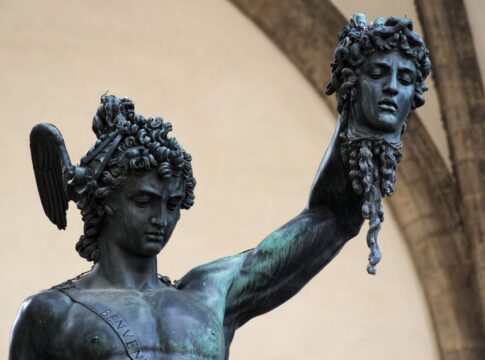
Perseus discovered that Medusa’s severed head retained its petrifying abilities. He used it as a weapon multiple times on his journey home, turning his enemies to stone by revealing the head at critical moments. He transformed the titan Atlas into a mountain range and turned a sea monster to stone to save Andromeda. Eventually, he gave the head to Athena, who mounted it permanently on her shield. Even in death, Medusa protected the goddess who had cursed her.
5. Her Blood Could Kill or Cure
Ancient sources describe a bizarre property of Medusa’s blood. The blood from veins on the left side of her body was deadly poison, capable of killing instantly. Blood from her right side possessed miraculous healing properties and could even resurrect the dead. The physician-hero Asclepius received some of this blood from Athena and used it to bring people back to life—until Zeus struck him down with a thunderbolt for disrupting the natural order. This duality reflected Greek ideas about pharmakon, substances that could heal or harm depending on dosage and application.
6. The Gorgons Lived at the Edge of the World
Greek mythology placed the Gorgons’ home at the far western edge of the known world, near the realm of the dead and beyond the sunset. Some sources located them near the Garden of the Hesperides or in Libya. This geographical positioning wasn’t random. The Greeks placed many monsters and wonders at the boundaries of their maps, in liminal spaces between the civilized world and chaos. The Gorgons guarded these thresholds, representing the dangers that awaited those who ventured too far from home.
7. Coral Was Created by Medusa’s Blood
According to ancient legend, after Perseus beheaded Medusa, he flew over the sea carrying her head. Drops of blood fell into the ocean, and wherever they touched seaweed, the plants hardened into red coral. Ancient peoples prized red coral for jewelry and amulets, believing it retained protective properties from its mythical origin. This myth explained both coral’s stone-like hardness and its organic origins, solving a natural mystery through supernatural storytelling.
8. Medusa May Have Been a Goddess Originally
Some scholars believe Medusa originated as a Libyan goddess before Greek mythology transformed her into a monster. Ancient Libyan women reportedly wore goatskin garments (aegis) and practiced rituals involving serpents. The theory suggests that as Greek culture encountered and dominated these traditions, they reframed the foreign goddess as a defeatable monster. Her name, meaning “guardian” or “protectress,” supports this interpretation. The transformation from goddess to victim to monster to protective symbol traces a complex cultural journey.
9. Three Graeae Sisters Guarded the Gorgons
The Gorgons had three additional sisters called the Graeae, who were born old and gray. These bizarre beings shared a single eye and a single tooth among them, passing these organs back and forth as needed. Perseus had to steal their eye to force them to reveal the Gorgons’ location and how to reach the nymphs who possessed the tools he needed. The Graeae represent another example of Greek mythology’s fascination with shared existence and divided resources among siblings.
Frequently Asked Questions
Could Medusa turn herself to stone by looking in a mirror?
Greek myths don’t address this scenario directly, but the logic suggests no. Her power specifically affected those who looked at her, not herself. The petrification was an outward curse directed at others, not a reflection-based effect that would loop back to harm her.
What happened to Medusa’s immortal sisters after she died?
Stheno and Euryale pursued Perseus after he killed Medusa, but he escaped using Hades’s cap of invisibility. The myths don’t describe what became of them afterward, leaving them in eternal mourning for their slain sister, presumably still dwelling at the edge of the world.
Why did Athena help Perseus kill Medusa if she put Medusa’s head on her own shield?
This apparent contradiction reflects different aspects of Athena’s character. She aided heroes as part of her role as goddess of wisdom and warfare, while also recognizing Medusa’s head as a powerful protective symbol worthy of her aegis. The myths don’t resolve this ethical tension.
Were there male Gorgons in Greek mythology?
No, the Gorgons were exclusively female. Their father Phorcys and brother figures appear in myths, but the Gorgon identity remained female throughout Greek tradition. This gender specificity connected them to other female monster groups like the Harpies and Furies.
The Medusa story continues to fascinate because it contains so many contradictions: victim and villain, beautiful and monstrous, deadly and protective. These nine facts barely scratch the surface of a myth that has evolved for over two millennia. Every generation sees something different in those serpentine locks and petrifying eyes—which might be the most bizarre fact of all.