
7 Bizarre Facts About How Tornadoes Form and Move
By Trivia Daily, Staff Writer — Published August 5, 2026
Table of Contents
- Key Takeaways
- Bizarre Tornadoes Form From Invisible Atmospheric Boundaries
- 1. Anticyclonic Tornadoes Defy the Expected Rotation
- 2. Suction Vortices Pack More Punch Than the Main Funnel
- 3. Tornadoes Can Be Completely Invisible Until Too Late
- 4. A Tornado’s Travel Speed Has Nothing to Do With Its Wind Speed
- 5. The Center of a Tornado Really Is Calm
- 6. Tornadoes Occur on Every Continent Except Antarctica
- 7. Multiple Vortex Tornadoes Can Have Several Funnels at Once
- Frequently Asked Questions
Tornadoes are among nature’s most violent and mesmerizing phenomena, yet the science behind these swirling columns of air remains surprisingly mysterious. While most people know that tornadoes are destructive, few understand the bizarre tornadoes form through a complex dance of atmospheric conditions that scientists are still working to fully decode. These rotating vortices can appear seemingly out of nowhere, defying simple explanations and challenging our understanding of weather patterns. What makes a tornado twist? Why do some storms spawn multiple twisters while others produce none at all?
The truth is stranger than most people imagine. From tornadoes that rotate in unexpected directions to the surprising role of invisible boundaries in the sky, the facts about these atmospheric monsters reveal a world of meteorological curiosity that continues to fascinate researchers and storm chasers alike.
Key Takeaways
- Most tornadoes in the Northern Hemisphere rotate counterclockwise, but approximately 1-2% spin clockwise for reasons scientists don’t fully understand.
- Tornadoes can form without visible funnel clouds, making them invisible killers until they pick up debris.
- The majority of a tornado’s destructive power comes from suction vortices—smaller whirlwinds rotating within the main funnel.
- Tornadoes have been documented on every continent except Antarctica, challenging the myth that they’re exclusive to North America.
- A tornado’s movement across the ground is largely independent of its internal rotation speed.
- The “calm” at a tornado’s center is a real phenomenon, though surviving there is nearly impossible.
Bizarre Tornadoes Form From Invisible Atmospheric Boundaries
The birth of a tornado begins with something you cannot see: invisible boundaries between different air masses. Most people imagine tornadoes simply dropping from dark clouds, but the reality involves a precise choreography of atmospheric layers. Warm, moist air near the ground must meet cool, dry air aloft, creating instability. But that’s not enough.
Wind shear—the change in wind speed and direction with altitude—creates horizontal rotation in the atmosphere. Updrafts within developing thunderstorms tilt this horizontal spin into a vertical orientation. This process, called tilting, transforms a rolling tube of air into the beginnings of a tornado. The National Oceanic and Atmospheric Administration has documented that only about 1% of thunderstorms actually produce tornadoes, despite many having the right ingredients. Scientists still debate why some storms cross this threshold while others don’t, making tornado forecasting an imperfect science.
1. Anticyclonic Tornadoes Defy the Expected Rotation
In the Northern Hemisphere, nearly all tornadoes rotate counterclockwise when viewed from above. This cyclonic rotation follows the expected pattern based on Earth’s rotation and atmospheric physics. But nature has exceptions. Anticyclonic tornadoes—those that spin clockwise—occur in roughly 1-2% of all cases, and they’re genuinely bizarre.
These reverse-spinning twisters often form on the opposite side of a supercell thunderstorm from the main tornado, or they emerge from the same storm system as their counterclockwise cousins. What makes them particularly interesting to meteorologists is that they seem to violate the normal rules. They’re typically weaker than cyclonic tornadoes, but not always. Some anticyclonic tornadoes have reached EF2 intensity, proving that atmospheric dynamics can be more complex than textbook explanations suggest. The mechanisms that allow these tornadoes to form while fighting against the Coriolis effect remain an active area of research.
2. Suction Vortices Pack More Punch Than the Main Funnel
If you examine damage paths from powerful tornadoes, you’ll notice something odd: streaks of complete destruction next to areas of moderate damage, all within the tornado’s track. This pattern reveals one of the most fascinating aspects of tornado structure—suction vortices.
These smaller whirlwinds, typically 10-100 feet in diameter, rotate around the inside of the main tornado like planets orbiting a sun. They move much faster than the parent circulation, combining their own rotational speed with the larger tornado’s winds. When a suction vortex passes over a structure, it can experience wind speeds 100 mph higher than areas just feet away. This explains why one house might be obliterated while its neighbor suffers roof damage. Not all tornadoes develop suction vortices—they’re most common in violent tornadoes rated EF4 or EF5. The violent Joplin, Missouri tornado of 2011 exhibited multiple suction vortices, contributing to its catastrophic damage pattern.
3. Tornadoes Can Be Completely Invisible Until Too Late
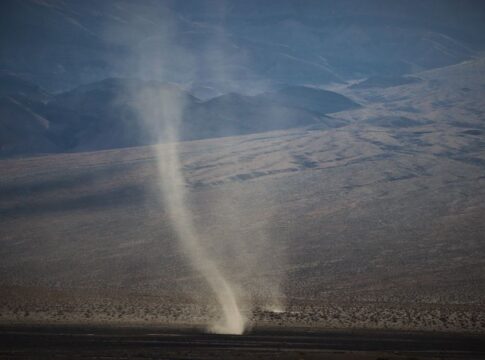
The classic image of a tornado shows a dark, ominous funnel extending from cloud to ground. But tornadoes don’t need visible condensation to exist or cause damage. The rotating column of air is invisible—what we see is water droplets condensing in the low-pressure core or debris being lofted into the air.
In dry climates or during certain atmospheric conditions, tornadoes can touch down and cause significant damage while remaining nearly invisible. These “invisible tornadoes” are particularly dangerous because people don’t realize a tornado is present until debris begins flying. Meteorologists identify these events through Doppler radar, which detects rotation regardless of whether a visible funnel exists. The phenomenon is more common than most people realize, especially with weaker tornadoes in arid regions. Storm spotters are trained to look for other signs: a persistent rotation in the cloud base, flying debris at ground level, or a sudden violent wind shift—all of which can indicate a tornado’s presence even without the telltale funnel.
4. A Tornado’s Travel Speed Has Nothing to Do With Its Wind Speed
People often confuse two completely different aspects of tornado motion: how fast the winds rotate inside the vortex versus how quickly the tornado moves across the landscape. These are independent phenomena. A tornado might have 200 mph winds swirling inside while crawling across the ground at just 10 mph. Conversely, a weaker tornado could race forward at 70 mph.
The tornado’s forward movement is determined by the parent thunderstorm’s motion, which follows the prevailing winds in the mid-levels of the atmosphere. The internal rotation, however, depends on the strength of the updraft and the amount of spin available in the environment. This disconnect creates dangerous situations. A slow-moving violent tornado gives it more time to cause damage in one location, while a fast-moving tornado—even if weaker—can be difficult to escape. The average tornado moves at about 30 mph, roughly matching highway speed limits in residential areas, but the range varies from stationary tornadoes to those clocked at over 70 mph.
5. The Center of a Tornado Really Is Calm
Stories of people surviving inside a tornado’s center aren’t pure myth—the eye of a tornado does experience dramatically reduced winds. Just as hurricanes have calm eyes, tornadoes feature a central core where the violent rotation temporarily ceases. Debris has been observed falling straight down in this area while chaos reigns mere feet away.
However, surviving in this calm zone is extraordinarily rare and shouldn’t be relied upon. The eye is typically only a few feet to perhaps 50 feet across in even large tornadoes, and it passes in seconds. You’d need to be incredibly fortunate to be positioned exactly in the center as the tornado passes, and the violent winds on either side would likely cause fatal injuries before and after the brief calm. The few documented cases of people experiencing this calm involve those trapped in structures that partially collapsed, creating pockets of protection. Atmospheric pressure in the tornado’s core drops significantly—sometimes by 100 millibars or more—which can cause buildings to explode outward due to the pressure difference.
6. Tornadoes Occur on Every Continent Except Antarctica
The United States experiences more tornadoes than any other country—roughly 1,200 annually—leading many to believe tornadoes are primarily an American phenomenon. This is a misconception. Tornadoes have been documented on every continent except Antarctica, from the United Kingdom to Bangladesh, from South Africa to Australia.
The ingredients for tornado formation exist anywhere you have thunderstorms and wind shear. The United Kingdom actually has more tornadoes per square mile than the United States, though they’re typically much weaker. Bangladesh has experienced some of the world’s deadliest tornadoes due to high population density and vulnerable construction. Australia’s tornadoes are often underreported but occur regularly. Even tropical regions that seem too warm and uniform occasionally produce tornadoes, especially in association with tropical cyclones. The global distribution of tornadoes reveals that this phenomenon is truly universal, limited only by the availability of the right atmospheric conditions rather than geography.
7. Multiple Vortex Tornadoes Can Have Several Funnels at Once
Perhaps the most visually bizarre tornado variant is the multiple vortex tornado, where several distinct funnel clouds orbit around a common center. These aren’t separate tornadoes but rather one large tornado with multiple condensation funnels, each marking a suction vortex that has become visible.
Witnesses describe these events as surreal—two, three, or even more funnels dancing around each other, sometimes appearing to merge and separate. The famous Tornado Outbreak of 2011 produced several documented multiple vortex tornadoes, with some exhibiting up to six simultaneous visible funnels. This structure is most common in the strongest tornadoes and contributes to their erratic damage patterns. A building might be hit by multiple vortices in sequence, each strike adding to the destruction. The vortices can have different sizes and intensities, creating a chaotic and unpredictable threat. Doppler radar often shows these as a single strong rotation signature, unable to resolve the individual vortices that storm chasers observe visually.
Frequently Asked Questions
Can tornadoes form over water?
Yes, tornadoes can form over water, where they’re called waterspouts. These come in two varieties: tornadic waterspouts, which are simply tornadoes that happen to be over water, and fair-weather waterspouts, which form in different conditions and are generally weaker.
Why do tornadoes seem to avoid cities?
Tornadoes don’t actually avoid cities—this is a statistical illusion. Cities occupy a tiny fraction of land area, so random tornado touchdowns rarely hit urban centers. When they do, as in the cases of St. Louis, Oklahoma City, and Joplin, the results are devastating and well-documented.
Do tornadoes always travel from southwest to northeast?
While this is the most common direction in the United States due to prevailing wind patterns, tornadoes can move in any direction. They’ve been documented traveling north, south, east, west, and even in loops or erratic paths depending on the parent storm’s movement.
Is it true that opening windows prevents tornado damage?
No, this is a dangerous myth. Opening windows wastes precious time when you should be seeking shelter and provides no protection against tornado damage. The pressure difference across a tornado isn’t what destroys buildings—it’s the extreme winds.
The more scientists study tornadoes, the more they discover just how much remains unknown about these atmospheric enigmas. Each storm season brings new observations that challenge existing theories and reveal unexpected behaviors. For a phenomenon humanity has witnessed for millennia, tornadoes continue to guard their secrets well, reminding us that nature’s most violent displays are also among its most complex.