
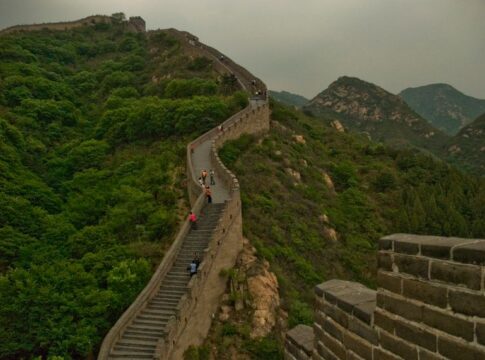
11 Mind-Blowing Facts About the Great Wall of China
By Trivia Daily, Staff Writer — Published August 3, 2026
Table of Contents
- Key Takeaways
- Mind Blowing Wall Mysteries and Surprising Truths
- The Wall’s True Length Defies Imagination
- Frequently Asked Questions
The Great Wall of China stands as one of humanity’s most impressive architectural achievements, stretching across mountains, deserts, and plains. But beyond the postcards and tourist photos lies a collection of mind blowing wall trivia that challenges nearly everything most people think they know about this ancient marvel. From surprising construction materials to myths that refuse to die, the real story of the Great Wall is far more fascinating than the legends.
What you’re about to discover will change how you see this iconic structure forever. The wall isn’t just one wall, it wasn’t built to keep out a single enemy, and no, you definitely can’t see it from space with the naked eye.
Key Takeaways
- The Great Wall is actually many walls built over 2,000 years by different dynasties, not a single continuous structure.
- Sticky rice mortar was used in some sections, creating a bond so strong that parts remain standing after centuries.
- The wall stretches over 13,000 miles when all branches and sections are measured, far longer than most people realize.
- Contrary to popular belief, astronauts cannot see the Great Wall from space without magnification.
- Hundreds of thousands of workers died during construction, with some remains incorporated into the structure itself.
- The wall was largely ineffective at its primary purpose of preventing invasions.
Mind Blowing Wall Mysteries and Surprising Truths
The term “Great Wall” misleads people into imagining a single, unified structure. In reality, the monument comprises multiple walls built, rebuilt, and connected over more than two millennia. Different Chinese dynasties constructed their own defensive barriers, sometimes using existing walls, sometimes building entirely new ones. The Qin Dynasty connected earlier fortifications around 221 BCE, but the Ming Dynasty (1368-1644 CE) built most of what tourists visit today.
This patchwork history means the wall varies dramatically in construction, height, and condition. Some sections stand as impressive stone fortifications with watchtowers. Others have crumbled into barely recognizable earthen mounds. The amazing diversity reflects changing technologies, available materials, and defensive strategies across centuries of Chinese history.
The Wall’s True Length Defies Imagination
When people ask how long the Great Wall is, the answer depends on what you’re measuring. The main wall itself runs about 5,500 miles, already an astounding distance. But when archaeologists include all the branches, secondary sections, and defensive trenches, the total length exceeds 13,000 miles. That’s more than half the Earth’s circumference at the equator.
A 2012 survey by China’s State Administration of Cultural Heritage revealed thousands of miles of previously undocumented wall sections. These discoveries continue to reshape our understanding of the structure’s true scale. Many sections sit in remote regions, far from tourist centers, slowly weathering away without preservation efforts.
1. Sticky Rice Created an Indestructible Mortar
During the Ming Dynasty, builders developed a revolutionary binding agent that modern scientists still study with fascination. They mixed sticky rice soup with standard mortar, creating a composite material of incredible strength and durability. The amylopectin in the rice formed a tight, dense compound when mixed with calcium carbonate from limestone. This organic-inorganic mixture proved more resistant to weathering, earthquakes, and general deterioration than pure lime mortar. Some sections built with this rice mortar have survived centuries better than modern concrete structures in the same regions.
2. The Wall Never Actually Kept Out Invaders
Here’s an interesting truth that bursts a major historical bubble: the Great Wall failed at its primary defensive purpose more often than it succeeded. Mongol forces, the very threat the wall was meant to stop, conquered China anyway in the 13th century. Manchu invaders walked through in 1644 when a traitorous general simply opened the gates. The wall worked better as a customs checkpoint and a way to control trade along the Silk Road than as an impenetrable military barrier. Its real value lay in slowing invaders, allowing time for messages to reach imperial armies, and demonstrating China’s power and organizational capacity.
3. Human Remains Were Used as Building Materials
The construction of the Great Wall exacted a horrifying human cost. Historians estimate that hundreds of thousands of workers died during the various building phases, with some estimates reaching into the millions when counting all dynasties. Workers included soldiers, peasants, and prisoners. Many who died during construction were buried within or near the wall itself. While stories that bodies were deliberately used as structural fill are likely exaggerated, remains were certainly incorporated when workers died on-site. The wall became known in Chinese folklore as “the longest cemetery on Earth.”
4. You Cannot See It From Space With the Naked Eye
This myth refuses to die despite repeated debunking by astronauts and scientists. From low Earth orbit, the Great Wall is essentially invisible to the unaided human eye. It’s too narrow and blends too well with the surrounding landscape. Chinese astronaut Yang Liwei confirmed in 2003 that he couldn’t see it from space. What people often mistake for the wall in satellite photos are actually rivers or other geographical features. The myth likely originated from exaggerated claims in the 18th and 19th centuries, long before anyone had actually been to space to verify.
5. Sections Were Built in Deserts, Not Just Mountains
The iconic images of the wall snaking across mountain ridges represent only part of the story. Significant portions cross the Gobi Desert and other arid regions where stone was scarce. Builders in these areas used whatever materials they could find: rammed earth, tamarisk branches, gravel, and even sand layered with reeds. These desert sections erode much faster than their stone counterparts. Wind and sandstorms have reduced many to low mounds barely distinguishable from the surrounding terrain, yet they once served the same defensive and administrative functions.
6. Watchtowers Served as Ancient Communication Networks
The wall’s watchtowers weren’t just lookout posts; they formed a sophisticated long-distance communication system. Guards used smoke signals during the day and fire signals at night to relay messages about approaching threats. The number of smoke columns or fires indicated the size of the enemy force. This system could transmit warnings across hundreds of miles in just hours, a remarkable achievement for pre-modern technology. Each tower stood within visual range of the next, creating an unbroken chain of communication posts along the entire length.
7. The Wall’s Width Allowed Horses to Travel on Top
Many sections of the wall were built wide enough for five horses to ride side-by-side, or for ten soldiers to march abreast. This wasn’t just for show. The wall served as an elevated military highway, allowing rapid troop movement to threatened areas. Supplies, weapons, and reinforcements could be transported along the top faster than through the difficult terrain below. The width varies considerably by section, with some Ming Dynasty portions reaching 15 to 30 feet across at the base and 12 feet at the top.
8. Different Dynasties Built in Completely Different Locations
The walls built by different dynasties don’t always follow the same route. The Qin Dynasty wall ran further north than the more famous Ming Dynasty sections. Some earlier walls lie hundreds of miles from what modern tourists visit. This means “the Great Wall” is really multiple walls, some parallel to each other, some completely separate. Archaeologists continue discovering remnants of these earlier walls, often in unexpected locations far from the currently preserved sections.
9. Genghis Khan Called It “The Strength of a Nation”
Even though Mongol forces eventually breached it, Genghis Khan reportedly recognized the wall as a symbol of Chinese civilization’s organizational power and determination. The sheer scale of coordinating millions of workers, transporting materials across vast distances, and maintaining construction over generations impressed even China’s enemies. The wall demonstrated state capacity more than military might. It showed that Chinese emperors could mobilize resources and labor on a scale few other civilizations could match.
10. Tourism Is Destroying Parts of the Wall
Modern visitors pose a threat that ancient invaders never managed: erosion through sheer numbers. Popular sections near Beijing see millions of tourists annually, and the constant foot traffic wears down original materials. Graffiti, brick theft, and careless climbing damage fragile sections. Meanwhile, remote portions receive no maintenance and crumble from natural weathering. Preservation efforts struggle to balance accessibility with conservation. Some sections have been heavily restored with modern materials, creating controversy about authenticity versus preservation.
11. The Wall Continues Beyond China’s Modern Borders
Sections of the wall extend into modern-day Mongolia and North Korea, reflecting historical borders that differed from today’s political boundaries. Some of the oldest and least-studied sections lie in these neighboring countries. The wall’s route followed strategic military and geographical considerations, not the political borders that would exist centuries later. This international aspect complicates preservation efforts, as different nations have different priorities and resources for maintaining their portions of this shared cultural heritage.
Frequently Asked Questions
How long did it take to build the Great Wall of China?
The Great Wall was built over approximately 2,000 years, from the 7th century BCE through the 17th century CE, with different dynasties adding, rebuilding, and connecting sections. No single construction period covered the entire structure.
What was the Great Wall originally built to protect against?
The wall was primarily built to defend against invasions from northern nomadic groups, including the Mongols and Xiongnu. It also served to control trade, immigration, and the movement of people along the Silk Road.
How many people died building the Great Wall?
Estimates vary widely, but historians believe hundreds of thousands to possibly over a million workers died during construction across all dynasties. Many deaths resulted from harsh working conditions, accidents, and disease.
Can you walk the entire length of the Great Wall?
Walking the entire wall is practically impossible because many sections have completely deteriorated, some cross extremely remote terrain, and portions lie in restricted areas. A few adventurers have attempted to walk major surviving sections, taking many months to complete the journey.
The Great Wall continues to reveal secrets as archaeologists explore remote sections and apply new technologies to study its construction. Each discovery adds another layer to our understanding of this monument that represents human ambition, ingenuity, and the complex relationship between civilization and the natural world. What other truths might still be buried beneath centuries of sand and stone?