









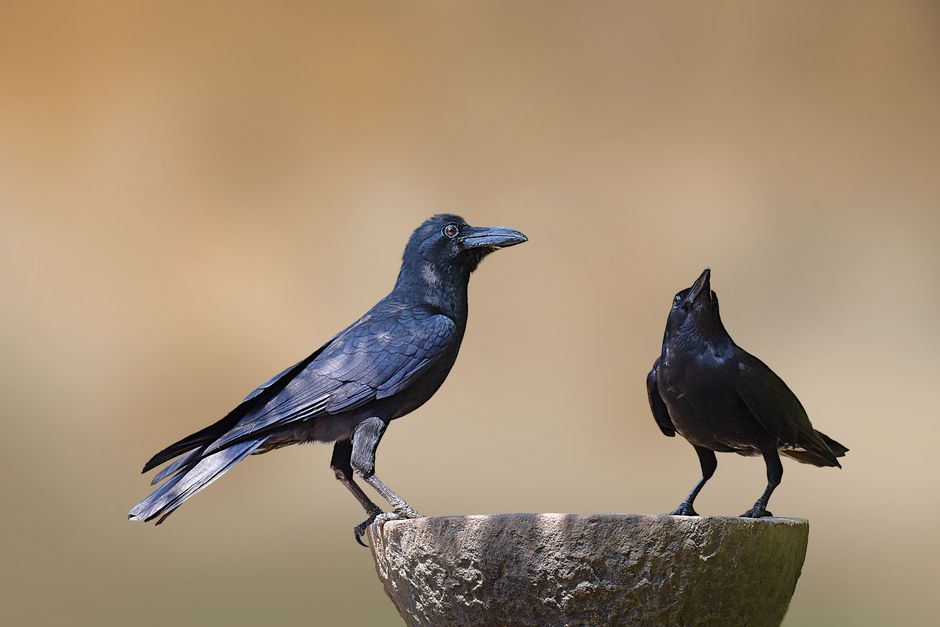
Crows Using Tools: 7 Surprising Facts About Intelligence
By TriviaOwl, Animals Desk — Published August 9, 2026
Table of Contents
- Key Takeaways
- Crows Using Tools in the Wild
- The Science Behind Corvid Cognition
- Comparing Corvid Intelligence Across Species
- Why Crow Intelligence Evolved
- Frequently Asked Questions
When most people think of tool use in the animal kingdom, chimpanzees or dolphins might come to mind. But crows using tools demonstrate a level of problem-solving that rivals some of our closest primate relatives. These sleek black birds don't just stumble upon sticks and rocks—they actively fashion instruments, plan ahead, and even pass knowledge to younger generations. Their behavior in the wild challenges our very definition of intelligence and raises fascinating questions about what other species might be capable of beyond our current understanding.
The New Caledonian crow, native to the remote islands of New Caledonia in the South Pacific, has become the poster child for avian intelligence. But crows across multiple species worldwide exhibit remarkable cognitive abilities that have captivated researchers studying animal behavior and the evolution of intelligence in nature.
Key Takeaways
- New Caledonian crows craft hooked tools from twigs and use them to extract insects from tree bark, showing sophisticated planning abilities.
- Crows can solve multi-step puzzles that require understanding cause-and-effect relationships, a skill once thought unique to primates.
- These birds demonstrate cultural transmission, with different crow populations in various habitats developing distinct tool-making techniques.
- Crows possess episodic-like memory, allowing them to remember where, when, and what they've cached for future use.
- The brain-to-body ratio of corvids rivals that of great apes, packed into a much smaller skull.
- Urban crows have been observed using human-made objects creatively, including dropping nuts onto roads for cars to crack open.
Crows Using Tools in the Wild
The discovery that crows using tools wasn't a fluke but a regular behavior pattern revolutionized our understanding of animal intelligence. New Caledonian crows manufacture several distinct types of tools. They fashion hooked implements from forked twigs, stripping away bark and leaves to create a functional probe. They also craft stepped tools from the serrated edges of pandanus leaves, creating a graduated design that improves grip and extraction efficiency.
What makes this particularly remarkable is the deliberate modification involved. A crow doesn't simply pick up a convenient stick. It selects appropriate materials, removes unnecessary parts, and shapes the tool to suit specific tasks. Some individuals carry their favorite tools from site to site rather than making new ones each time—a behavior that suggests they understand the value of a well-crafted instrument.
In their natural habitat, crows use these tools primarily to extract beetle larvae and other invertebrates from crevices in dead wood. The behavior isn't instinctual in the way a spider spins a web. Young crows must learn tool-making techniques, and they do so by watching experienced adults, suggesting a form of cultural knowledge transmission rare in the animal world outside of primates and cetaceans.
The Science Behind Corvid Cognition
Neuroscientists studying crow brains have uncovered surprising parallels to primate cognition. While bird brains are structured differently from mammalian brains, corvids possess a high density of neurons in their pallium, the avian equivalent of the cerebral cortex. This neural density allows for complex information processing despite the small physical size of their brains.
Researchers have documented crows solving problems that require understanding abstract concepts. In laboratory settings, crows have successfully completed water displacement tasks reminiscent of Aesop's fable—dropping stones into a tube of water to raise the level and access a floating reward. They distinguish between objects that sink and those that float, demonstrating an understanding of physical properties.
Even more impressive, crows can understand analogical reasoning. When presented with matching tasks where they must select items based on relational concepts like "same" or "different," crows perform comparably to primates. This cognitive flexibility suggests their intelligence isn't narrowly specialized but broadly applicable across different problem domains.
1. New Caledonian Crows Fashion Hooks From Memory
Among all tool-using creatures in nature, New Caledonian crows stand out for their ability to create hooked tools without a template in front of them. When researchers removed all naturally hooked materials from an area, these birds bent straight wire into hooks to retrieve food from containers. The famous case of a crow named Betty, studied at Oxford University, demonstrated this ability when she spontaneously bent a straight piece of wire into a hook to lift a bucket containing food from a vertical tube. While some debate exists about whether this was truly innovative or partially learned, subsequent studies have confirmed that hook-making appears across wild populations, suggesting it's a repeatable cognitive skill rather than a one-time accident.
2. Crows Understand Cause-and-Effect Chains
Multi-step problem solving reveals the depth of crow intelligence. In experiments designed to test sequential reasoning, crows have successfully navigated puzzles requiring up to eight distinct steps performed in the correct order. For instance, a crow might need to use one tool to retrieve another tool, which then accesses a third tool, which finally reaches the food reward. This kind of planning requires holding multiple pieces of information in working memory and understanding that intermediate steps, though not immediately rewarding, lead to the ultimate goal. Such behavior demonstrates what scientists call "meta-tool use"—using tools to obtain other tools—a cognitive achievement previously documented only in primates and, more recently, in these remarkable birds.
3. Urban Crows Innovate With Human Infrastructure
City-dwelling crows have adapted their natural intelligence to urban environments in creative ways. Japanese crows in several cities have been observed placing hard-shelled nuts on crosswalks when traffic lights are red, then waiting for cars to run over and crack them during the green light, before safely retrieving the contents when the light turns red again. This behavior shows not only tool use (using cars as nutcrackers) but also an understanding of traffic patterns and timing. Other urban crows have learned to use water fountains to soften dry bread, fashion wire from human litter into probes, and even use anti-bird spikes as nesting material, turning defensive measures against them into resources.
4. Crow Populations Develop Distinct Tool Cultures
Different populations of New Caledonian crows across their island habitat have developed regionally distinct tool designs, much like human cultures develop different technologies. Northern populations favor one style of pandanus leaf tool, while southern groups create different patterns. These variations aren't explained by genetic differences or environmental availability of materials—they represent genuine cultural differences passed down through generations. Young crows learn the local "style" from adults in their area. When researchers transplanted tools from one region to another, local crows ignored the foreign designs and continued making their traditional patterns, demonstrating cultural conservatism. This cultural transmission of knowledge is exceedingly rare in the animal kingdom outside of humans and great apes.
5. Crows Remember Human Faces for Years
The memory capabilities of crows extend beyond tool use into social intelligence. Research at the University of Washington demonstrated that crows remember individual human faces, particularly those associated with negative experiences, for at least five years. When researchers wore masks while trapping and banding crows, the birds subsequently scolded and dive-bombed anyone wearing those specific masks, even years later and in different locations. They also taught this recognition to other crows who weren't present during the original capture, spreading the information socially. This sophisticated facial recognition and long-term memory allow crows to navigate complex social environments and maintain grudges or friendships with specific individuals, whether crow or human.
6. Crows Plan for Future Needs
Planning for the future—mentally projecting into a time when current conditions will be different—was long considered a uniquely human trait. Crows shattered this assumption. In controlled experiments, crows demonstrated the ability to select and save a tool for use the next day, even when no immediate need existed and tempting food rewards were available. They chose the correct tool for a specific apparatus they would encounter 17 hours later, showing they could mentally simulate future scenarios and prepare accordingly. Wild crows also cache food strategically, hiding surplus items in multiple locations and returning to them days or weeks later. They remember not just where they cached food, but what they cached and how long ago, allowing them to prioritize perishable items before they spoil.
7. Crows Understand Water Displacement Physics
The Aesop's fable of a crow dropping stones into a pitcher to raise the water level turns out to be based on real corvid physics comprehension. In systematic experiments, crows quickly learned to drop stones into water-filled tubes to bring floating food within reach. But they went beyond simple trial and error—they preferentially chose solid objects over hollow ones, selected larger stones that displaced more water, and ignored sawdust-filled tubes where dropping objects wouldn't raise the water level. They understood that water, but not sand, would rise when objects were added. Some individuals even learned that dropping objects into a connected tube system would raise water in an adjacent tube, demonstrating understanding of hidden causal mechanisms. This grasp of physical principles allows crows to manipulate their environment in ways few other species can match.
Comparing Corvid Intelligence Across Species
| Species | Tool Use | Problem Solving | Social Complexity |
|---|---|---|---|
| New Caledonian Crow | Manufactures hooked tools, meta-tool use | Multi-step puzzles, causal reasoning | Cultural transmission, facial recognition |
| American Crow | Occasional tool use, urban adaptation | Novel problem solving, cache management | Large communal roosts, cooperative mobbing |
| Raven | Limited tool use, innovative foraging | Advanced planning, deception | Complex vocalizations, pair bonding |
| Rook | Spontaneous tool modification | Cooperative problem solving | Highly social, colonial nesting |
Why Crow Intelligence Evolved
The evolutionary pressures that shaped crow intelligence remain a subject of scientific investigation. One leading theory suggests that their varied diet and opportunistic foraging created selection pressure for flexible problem-solving. Unlike specialists that eat only one type of food, crows are generalists who exploit whatever resources are available in their habitat. This lifestyle rewards individuals who can figure out new extraction techniques, remember productive locations, and adapt to changing conditions.
Social complexity also likely played a role. Crows live in social groups where individuals must track relationships, remember past interactions, and navigate coalitions. This social intelligence may have provided a foundation for the general cognitive abilities we observe in tool use and problem-solving. The long period of parental care in corvids—young crows stay with parents for extended periods—provides time for learning and cultural transmission that shorter-lived species don't enjoy.
Frequently Asked Questions
Are crows smarter than dogs?
Intelligence comparisons across species are complex because different animals excel at different cognitive tasks. Crows demonstrate superior performance in certain areas like tool manufacture and causal reasoning, while dogs outperform crows in social cognition related to human communication. Both species show remarkable intelligence adapted to their ecological niches and evolutionary history.
Can all crow species use tools?
Not all crow species demonstrate the same level of tool use. New Caledonian crows are the most sophisticated tool users, but other corvids including American crows, rooks, and ravens have shown tool-using abilities in various contexts. The capacity appears widespread in the corvid family, though expression varies by species and individual experience.
Do crows teach their young to use tools?
Young crows learn tool use primarily through observation and practice rather than active teaching in the human sense. Juveniles watch adults manipulating tools and attempt to replicate the behavior, gradually refining their technique. Parents may facilitate learning by providing opportunities and tolerating clumsy early attempts, but direct instruction as humans practice it hasn't been conclusively documented.
How long do crows live in the wild?
Wild crows typically live seven to eight years on average, though individuals can survive much longer—up to 20 years in favorable conditions. Their relatively long lifespan for birds of their size provides time to accumulate knowledge and refine skills, which may contribute to their capacity for complex learned behaviors and cultural transmission across generations.
The next time you see a crow perched on a fence or strutting across a parking lot, consider that you're looking at one of nature's great problem-solvers. These birds remind us that intelligence evolved along multiple paths, in bodies and brains vastly different from our own, yet arriving at solutions to challenges that echo our own cognitive strategies in surprising ways.