










1 / 10 Questions
0 Points

Which Giant Ape Scaled The Empire State Building In Movie History?

Planet of the Apes

Mighty Joe Young

Godzilla

King Kong

Points won
0
Correct score
0%

More Questions

7 Bizarre Facts About Humans Glowing in the Dark

Human bioluminescence is real but invisible to the naked eye. Discover 7 strange facts about how and why humans naturally glow in the dark.

The Truth About Sharks: Must They Swim to Breathe

Shark behavior reveals surprising breathing methods. Some species must swim constantly while others rest on the ocean floor. Discover how sharks breathe.

The Truth About Your Stomach Acid Dissolving Razor Blades

Stomach acid is powerful enough to break down food, but can it really dissolve razor blades? Discover what science reveals about your digestive system.

More Articles

Dragon Legends: How Dinosaur Fossils Fueled the Myth

Dragon Legends: How Dinosaur Fossils Fueled the Myth

Dragon Legends: How Dinosaur Fossils Fueled the Myth

By Trivia Daily, Staff Writer — Published August 20, 2026

Table of Contents

Long before paleontology became a science, people stumbled upon enormous bones jutting from cliffsides and riverbeds. Without the framework to understand these remains as ancient animals, cultures around the world wove them into stories of fire-breathing beasts and serpentine monsters. The dragon legends dinosaur fossils inspired weren't mere fantasy—they were attempts to explain real, tangible evidence that demanded interpretation. From China to medieval Europe, these mysterious skeletons shaped mythology in surprising ways, creating a global tapestry of winged terrors and scaled giants that still captivates us today.

The connection between fossilized bones and dragon myths reveals something fascinating about human curiosity: we've always been compelled to explain the world around us, even when the truth lay millions of years beyond our grasp. Let's explore the amazing facts behind this ancient misunderstanding.

Key Takeaways

  • Ancient civilizations regularly discovered dinosaur fossils but interpreted them as evidence of dragons, griffins, and other mythical creatures.
  • The word "dinosaur" wasn't coined until 1842, meaning centuries of fossil discoveries had no scientific framework for interpretation.
  • Chinese dragon legends may have been influenced by abundant dinosaur fossils in regions like the Gobi Desert and Sichuan Province.
  • Griffin myths in Central Asia likely originated from Protoceratops fossils, which have beak-like skulls resembling birds.
  • Medieval Europeans displayed "dragon bones" in churches and castles, which modern analysis reveals were often mammoth, whale, or dinosaur remains.
  • The similar global emergence of dragon myths across disconnected cultures suggests independent discoveries of large fossil remains.

Dragon Legends Dinosaur Fossils Inspired Across Ancient China

China possesses one of the richest fossil records on Earth. The nation's dragon mythology runs deep through thousands of years of culture, art, and tradition. But here's the interesting part: the regions most abundant in dinosaur fossils—particularly Sichuan, Henan, and areas near the Gobi Desert—also produced the most elaborate dragon stories.

Ancient Chinese texts refer to "dragon bones" found in the earth, which were ground into traditional medicine. These weren't metaphorical dragons. Paleontologists have confirmed that many traditional medicine suppliers were literally selling fossilized dinosaur bones. The Chinese word for dinosaur, "konglong," translates directly to "terrible dragon," acknowledging this historical connection.

The physical characteristics of Chinese dragons align remarkably with sauropod anatomy. Long necks, serpentine bodies, and four legs match the basic body plan of dinosaurs like Mamenchisaurus, a long-necked sauropod discovered in China. While Chinese dragons traditionally lack wings, their association with water and sky makes sense when you consider that many fossils erode out of riverbeds and mountain faces—places where earth meets heaven in traditional cosmology.

European Dragons and Prehistoric Misidentification

Medieval Europe had its own encounters with inexplicable bones. Without scientific context, these discoveries fueled beliefs in dragons that terrorized villages and hoarded gold. Church records and local chronicles documented "dragon" remains displayed as proof of biblical monsters or saints' victories over evil.

The city of Klagenfurt, Austria, features a famous dragon fountain built in 1590. The sculptor used a woolly rhinoceros skull found nearby as his model, believing it to be a dragon's head. This wasn't unusual. Many European "dragon skulls" preserved in churches and museums have since been identified as Ice Age megafauna—mammoths, cave bears, and ancient whales whose bones washed ashore.

England's rich Jurassic Coast yielded marine reptile fossils long before scientists understood them. Ichthyosaur and plesiosaur skeletons, with their elongated bodies and fearsome teeth, perfectly matched descriptions of sea dragons in folklore. The famous Loch Ness Monster legend itself may stem from similar prehistoric marine reptile sightings or fossil discoveries.

Why Fossils Looked Like Monsters

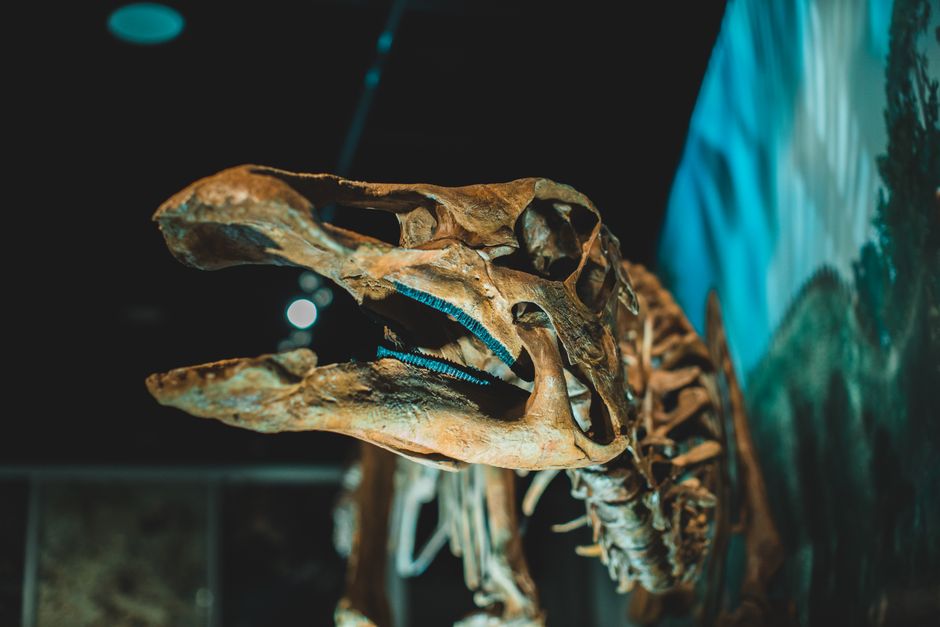
Consider what an untrained eye sees when examining a Tyrannosaurus rex skull. Massive jaws. Serrated teeth the size of daggers. Eye sockets that suggest a creature of enormous scale. Without understanding geological time or extinction, the logical conclusion was that such creatures might still exist in remote places—caves, mountains, or distant lands.

Partial skeletons made interpretation even more creative. A rib cage without context could suggest wings. A long tail might indicate a serpent. Weathered bones scattered across a landscape invited imaginative reconstruction, and human pattern-recognition filled in the gaps with familiar animals—lizards, birds, snakes—scaled up to monstrous proportions.

The Griffin Connection: When Fossils Create New Monsters

Not all fossil-inspired myths resulted in dragons. The griffin—a creature with an eagle's head and a lion's body—may owe its existence to Protoceratops fossils abundant in Central Asia. Ancient gold miners in the Altai Mountains region regularly encountered these dinosaur remains.

Protoceratops skeletons possess a distinctive beak-like structure and four-legged posture. To someone unfamiliar with dinosaurs, the skull resembles a bird's head attached to a quadrupedal body. Ancient Greek historians like Herodotus wrote about griffins guarding gold in the east, precisely where these fossils are common. The correlation is striking.

Modern paleontologist Adrienne Mayor has extensively researched this connection, demonstrating how ancient peoples were sophisticated observers who attempted rational explanations for physical evidence. They weren't inventing pure fantasy—they were theorizing about real objects that demanded explanation.

Comparing Dragon Myths and Dinosaur Fossils Worldwide

Region Dragon/Monster Type Likely Fossil Source Key Matching Features
China Long (Chinese dragon) Sauropod dinosaurs Long neck, serpentine body, four legs
Europe Western dragon Large theropods, marine reptiles Massive jaws, teeth, predatory features
Central Asia Griffin Protoceratops Beaked skull, quadrupedal stance
India Naga (serpent deity) Marine reptiles, large snakes Elongated body, association with water
North America Thunder beings Various large dinosaurs Enormous size, powerful presence

When Science Finally Caught Up

The systematic study of fossils began in earnest during the 18th and 19th centuries. In 1824, William Buckland described Megalosaurus, the first dinosaur formally named by science. Richard Owen coined the term "dinosaur" in 1842, meaning "terrible lizard." Suddenly, there was a framework for understanding these bones as extinct animals rather than mythical monsters.

This shift didn't happen overnight. Many people resisted abandoning dragon explanations for scientific ones. The transition reveals how deeply fossils had embedded themselves in cultural identity. Dragons weren't just stories—they were attempts to understand tangible evidence of Earth's deep history.

Interestingly, some Indigenous cultures maintained oral traditions that more accurately described these creatures as ancient animals rather than supernatural beings. Native American stories sometimes speak of giant creatures that once roamed the earth, a surprisingly accurate interpretation given the available evidence.

Frequently Asked Questions

Did ancient people really think dinosaur fossils were dragon bones?

Yes, many ancient cultures interpreted large fossils as evidence of dragons, giants, or monsters. Without the concept of extinction or geological time, these bones seemed to prove that legendary creatures existed. Chinese texts explicitly refer to medicinal "dragon bones" that were actually fossils.

Which dinosaur fossils most closely resemble dragon descriptions?

Large theropods like Tyrannosaurus rex match European dragon descriptions with massive skulls and teeth, while long-necked sauropods resemble Chinese dragons. Marine reptiles like plesiosaurs align with sea serpent legends. Protoceratops fossils likely inspired griffin myths with their beaked skulls.

Are there any cultures that correctly identified fossils as ancient animals?

Some Indigenous peoples maintained oral traditions describing these remains as ancient creatures rather than living monsters, showing remarkable interpretive accuracy. However, without a framework for deep geological time, most cultures defaulted to mythological explanations for these discoveries.

When did people stop believing fossils were dragon bones?

The transition happened gradually through the 18th and 19th centuries as paleontology developed as a science. The 1842 coining of "dinosaur" by Richard Owen marked a turning point, though popular belief in dragons persisted in some regions well into the 20th century.

The next time you see a dragon in art or film, remember you're looking at humanity's oldest paleontological theory. Those myths weren't born from pure imagination—they emerged from real encounters with evidence that our ancestors lacked the tools to properly interpret. In trying to explain the bones of creatures separated from them by 65 million years, they created stories that still fire our imagination today.
Octopus Intelligence: 9 Facts About Their Problem Solving

Octopus Intelligence: 9 Facts About Their Problem Solving

Octopus Intelligence: 9 Facts About Their Problem Solving

By TriviaOwl, Animals Desk — Published August 14, 2026

Table of Contents

Among the ocean's most remarkable creatures, octopuses stand apart as invertebrate geniuses. With a brain structure utterly unlike our own and neurons distributed throughout their eight arms, these animals demonstrate octopus intelligence problem-solving abilities that continue to astonish researchers. They can navigate mazes, open childproof containers, and even predict sports outcomes—though that last feat might owe more to chance than cognition. What makes these soft-bodied wildlife wonders so remarkably clever?

Their behavior challenges everything we thought we knew about where intelligence emerges in nature. These creatures evolved their smarts along an entirely different path from mammals and birds, making their cognitive abilities a fascinating example of convergent evolution in the animal kingdom.

Key Takeaways

  • Octopuses have nine brains: one central brain and a smaller brain in each of their eight arms, allowing independent limb control.
  • These animals can solve complex puzzles, including unscrewing jar lids and navigating through mazes to reach food rewards.
  • Octopuses demonstrate observational learning by watching other octopuses and mimicking their problem-solving strategies.
  • Their distributed nervous system contains roughly 500 million neurons, with about two-thirds located in their arms rather than their central brain.
  • Some species have been observed using tools, such as carrying coconut shells to create portable shelters.
  • Octopuses possess both short-term and long-term memory, allowing them to remember solutions to problems over extended periods.

Understanding Octopus Intelligence Problem Solving Through Brain Structure

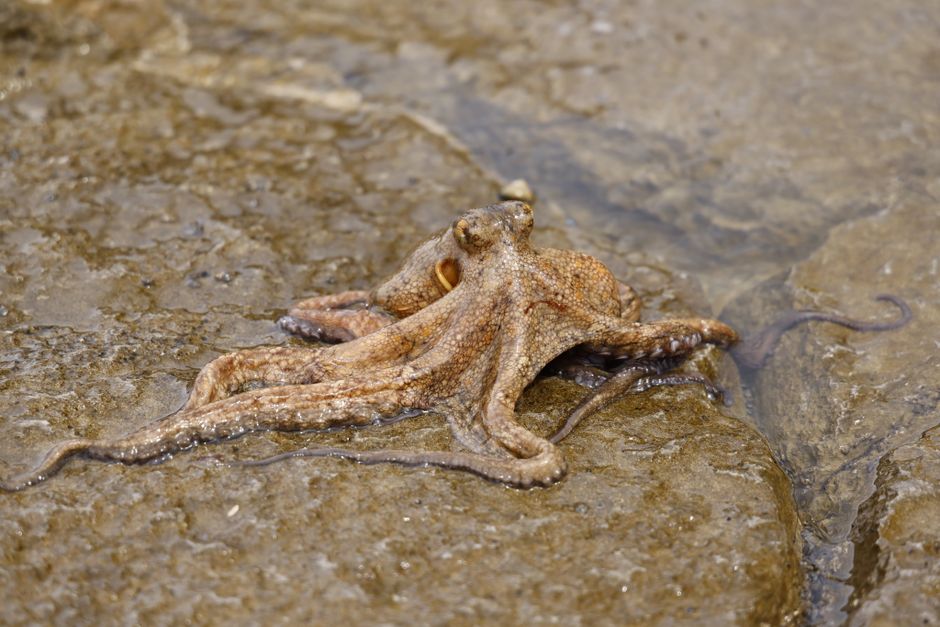
The octopus brain represents one of nature's most unusual neural architectures. Unlike vertebrate animals with centralized nervous systems, octopuses distribute their intelligence across their entire body. Each arm contains enough neural tissue to operate semi-independently, capable of solving simple problems without input from the central brain. This means an octopus arm can explore a crevice, identify prey, and coordinate the complex movements needed to capture it—all while the animal's main brain focuses elsewhere.

This decentralized setup evolved over hundreds of millions of years, allowing these species to process sensory information with remarkable speed. The arms taste and touch simultaneously, sending filtered information to the central brain rather than overwhelming it with raw data. Think of it as having eight highly capable assistants, each handling their own tasks while reporting only the most important findings to management.

Comparing Octopus Intelligence Across Species

Species Notable Behavior Habitat
Giant Pacific Octopus Opens jars, solves complex puzzles, recognizes individual humans North Pacific coastal waters
Common Octopus Uses observational learning, navigates mazes, remembers solutions Mediterranean and Atlantic waters
Coconut Octopus Carries tools (shells, coconuts) for shelter, plans ahead Indo-Pacific tropical waters
Day Octopus Sophisticated camouflage, complex hunting strategies Indo-Pacific reefs and sandy flats

The Nine Most Remarkable Facts About Octopus Problem-Solving

1. They Can Navigate Complex Mazes for Food Rewards

Researchers have tested octopuses with increasingly difficult mazes, and these animals consistently find the shortest path to food after just a few attempts. They remember successful routes and can apply learned strategies to similar but novel maze configurations. This spatial reasoning ability rivals that of many mammals and demonstrates genuine problem-solving rather than simple trial-and-error learning.

2. Octopuses Open Childproof Containers With Ease

Give an octopus a pill bottle with a childproof cap, and it will likely solve the puzzle faster than a toddler. They twist, pull, and manipulate containers with their flexible arms, figuring out mechanical mechanisms through persistent exploration. Aquarium staff have reported octopuses escaping from supposedly secure tanks by unscrewing lids, manipulating valves, and even dismantling filtration equipment. Their dexterity combined with curiosity makes them exceptional escape artists.

3. They Learn by Watching Other Octopuses

Octopuses demonstrate observational learning, a cognitive skill once thought limited to more social animals. When one octopus watches another solve a puzzle—such as choosing between different colored balls to receive food—the observer can replicate the solution without going through trial-and-error itself. This ability is particularly remarkable given that octopuses are largely solitary creatures in their natural habitat, suggesting their intelligence evolved for reasons beyond social interaction.

4. Tool Use Demonstrates Forward Planning

The coconut octopus collects discarded coconut shells and carries them across the ocean floor, later assembling them into protective shelters. This behavior requires the animal to recognize a future need, identify suitable materials, transport them while remaining vulnerable, and then construct the shelter when needed. Such forward planning was once considered a hallmark of advanced intelligence found only in primates and certain bird species.

5. They Possess Both Short-Term and Long-Term Memory

Studies have shown octopuses can remember solutions to problems for weeks or even months. They recall which feeding areas proved most productive, remember individual humans who have interacted with them, and retain learned aversions to unpleasant stimuli. Their memory systems operate despite having a brain structure completely different from vertebrates, suggesting multiple evolutionary paths to sophisticated memory formation.

6. Problem-Solving Improves With Enrichment

Octopuses raised in stimulating environments with puzzles and varied objects demonstrate enhanced problem-solving abilities compared to those in barren tanks. This environmental enrichment effect shows their intelligence isn't purely instinctual but develops through experience and practice. Young octopuses appear particularly adept at learning, though adults continue to solve novel problems throughout their relatively short lives.

7. Individual Octopuses Show Distinct Personalities

Researchers studying captive octopuses have documented consistent individual differences in behavior. Some individuals boldly approach new objects and solve puzzles quickly through aggressive exploration. Others take cautious, methodical approaches. These personality differences affect problem-solving strategies, with bolder individuals sometimes solving puzzles faster but cautious ones making fewer errors. This behavioral variability suggests complex internal processing rather than simple programmed responses.

8. They Can Predict and Exploit Patterns

When presented with predictable feeding schedules or patterned reward systems, octopuses learn to anticipate events and position themselves advantageously. They recognize when certain signals precede food delivery and demonstrate understanding of cause-and-effect relationships. Some aquarium octopuses have learned to splash water at lights above their tanks, apparently understanding that wet lights attract human attention—and attention often leads to feeding.

9. Arm Autonomy Enables Parallel Processing

Because octopus arms can operate independently, these animals essentially solve multiple problems simultaneously. One arm might explore a crevice while others manipulate objects, taste potential food items, or anchor the body. This parallel processing capability gives octopuses a unique approach to problem-solving unavailable to creatures with centralized motor control. Each arm contributes its findings, allowing the central brain to make decisions based on information from eight semi-independent explorers.

Why Octopus Intelligence Matters for Understanding Cognition

Studying octopus cognition reveals that intelligence can emerge through radically different neural architectures. While mammals and birds evolved their smarts through increasingly complex centralized brains, octopuses took a distributed approach. This convergent evolution—arriving at similar cognitive abilities through completely different paths—suggests intelligence may be more common in nature than we previously assumed.

The implications extend beyond pure curiosity. Understanding how octopuses process information with their distributed nervous system could inform robotics and artificial intelligence design. Their flexible problem-solving with decentralized control offers models for creating adaptive machines that don't rely on single processing units.

Frequently Asked Questions

How intelligent are octopuses compared to other animals?

Octopuses rank among the most intelligent invertebrates, with problem-solving abilities comparable to some mammals like rats and certain bird species. Their intelligence is difficult to compare directly to vertebrates due to their fundamentally different brain structure, but they demonstrate learning, memory, and reasoning that clearly surpass simple instinct.

Can octopuses recognize individual humans?

Yes, octopuses can distinguish between individual people, showing preference for those who feed them and avoiding those associated with unpleasant experiences. They appear to use visual cues to make these distinctions and remember individuals over extended periods.

Do octopuses feel emotions?

While we cannot know subjective experiences, octopuses display behaviors suggesting emotional-like states. They show curiosity, apparent boredom in unstimulating environments, and what researchers interpret as playfulness. Whether these behaviors reflect emotions similar to mammalian feelings remains an open scientific question.

Why are octopuses so intelligent despite being solitary?

Scientists hypothesize that octopus intelligence evolved to handle complex hunting strategies and predator avoidance in structurally complicated reef and rocky habitats. Their soft bodies lack protective shells, so behavioral flexibility and learning may have provided survival advantages that evolutionary pressures favored, even without social demands driving intelligence.

The next time you encounter an octopus—whether in an aquarium, documentary, or on your dinner plate—consider the extraordinary mind that once inhabited that form. These creatures represent one of evolution's most successful experiments in building intelligence from an entirely different blueprint than our own, proof that nature finds multiple solutions to the challenge of thinking.