









7 Surprising Facts About How Bees Make Hexagon Honeycombs
By Trivia Owl, Staff Writer — Published September 7, 2026
Table of Contents
- Key Takeaways
- Understanding Why Bees Make Hexagon Patterns
- The Construction Process Revealed
- Comparing Honeycomb to Human Construction
- The Mathematics Bees Never Learned
- Frequently Asked Questions
Honeybees are master architects. Their honeycombs—those perfect arrays of six-sided cells—look like something designed by a mathematician. Yet these tiny insects build them using nothing but instinct, body heat, and beeswax. The precision is so remarkable that scientists have studied bee construction for centuries, trying to understand how bees make hexagon shapes without rulers or blueprints. The answers reveal a beautiful intersection of biology, physics, and efficiency that might just change how you see your next jar of honey.
What seems like deliberate geometry is actually an elegant solution to storage problems. Bees need to pack the maximum amount of honey into the smallest space, using the least amount of precious wax. The hexagon turns out to be nature's answer to an optimization puzzle—and the bees didn't need to do the math.
Key Takeaways
- Bees don't actually build hexagons—they build circles that transform into hexagons through heat and surface tension.
- Hexagonal cells use roughly 40% less wax than round cells while storing the same amount of honey.
- Worker bees maintain hive temperatures around 95°F (35°C) to keep wax pliable during construction.
- The "honeycomb conjecture," a mathematical puzzle about hexagonal efficiency, wasn't proven until 1999.
- Each cell wall is only about 0.003 inches thick—thinner than a human hair.
- Bees tilt honeycomb cells upward by about 13 degrees to prevent honey from dripping out.
Understanding Why Bees Make Hexagon Patterns
The hexagon is one of only three shapes that can tile a flat surface without gaps: triangles, squares, and hexagons. But here's the fascinating part—hexagons hold more space using less perimeter than the other two options. For bees, this translates directly to survival. Wax production is metabolically expensive. A worker bee must consume about eight ounces of honey to secrete just one ounce of wax from special glands on her abdomen. Any shape that minimizes wax while maximizing storage means more honey reserves and better odds of surviving winter.
Mathematicians call this the "honeycomb conjecture." The ancient Roman scholar Pliny the Elder observed that bees seemed to have discovered the most efficient geometry. But proving mathematically that hexagons are the optimal solution for dividing a surface into equal areas with minimal perimeter took until 1999, when mathematician Thomas Hales finally provided the proof. Bees figured it out millions of years earlier through evolutionary trial and error.
The Construction Process Revealed
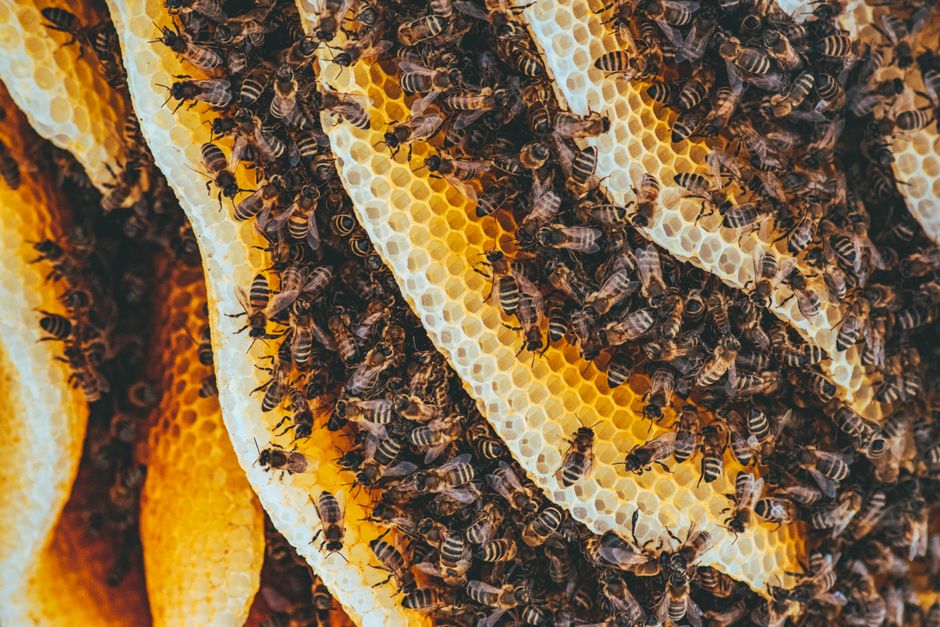
Here's where things get truly interesting. Bees don't actually construct hexagons directly. When worker bees begin building comb, they secrete liquid wax and mold it into roughly circular cells. They work in teams, with many bees clustered together generating body heat. The temperature in the construction zone hovers around 95°F, warm enough to keep the wax soft and pliable.
As the circular cells cool and harden while packed tightly together, physics takes over. Surface tension pulls the wax into the most stable configuration—hexagons. The bees essentially let the laws of physics do the precision work. They provide the raw material and the heat, and geometry handles the rest. It's collaborative construction where instinct and physical forces work in harmony.
1. Bees Start With Circles, Not Hexagons
The first surprising truth is that hexagons aren't the starting point. Young worker bees begin by forming cylindrical cells, pressing and molding warm wax into tubes. These initial structures are circular in cross-section. Only as adjacent cells press against each other and the wax reaches optimal temperature does the transformation occur. The pressure from neighboring cells, combined with the surface tension of the softened wax, naturally deforms circles into hexagons. It's a beautiful example of emergence—complex order arising from simple rules and physical constraints.
2. Heat Is the Secret Construction Tool
Temperature control is everything in honeycomb construction. Worker bees don't just build—they huddle. Groups of bees cluster around construction sites, vibrating their flight muscles to generate heat without actually flying. This collective thermoregulation maintains the wax at precisely the right consistency: soft enough to mold but firm enough to hold shape. Drop the temperature just a few degrees and the wax becomes too brittle. Raise it too high and structures sag. The bees maintain this thermal sweet spot instinctively, adjusting their numbers and activity based on ambient conditions.
3. Honeycomb Cells Aren't Perfectly Horizontal
Look closely at natural honeycomb and you'll notice something unexpected: the cells aren't level. Bees construct each cell at an upward angle of approximately 13 degrees from horizontal. This slight tilt serves a crucial purpose. Honey is a viscous liquid, and even sealed cells can have microscopic openings during construction. The upward angle prevents uncapped honey from flowing out before bees seal the cells with wax caps. It's a simple architectural solution to a gravity problem, built into the design by instinct.
4. Cell Size Varies by Purpose
Not all hexagons in a hive are identical. Bees construct different-sized cells for different functions. Worker bee cells measure about 5.2 to 5.4 millimeters across. Drone cells—used for male bees—are noticeably larger at roughly 6.2 to 6.9 millimeters. Queen cells break the hexagonal pattern entirely, appearing as elongated, peanut-shaped structures that hang vertically. This size differentiation happens automatically as bees adjust their building behavior based on the hive's needs and pheromone signals from the queen and other workers.
5. The Walls Are Impossibly Thin Yet Strong
Honeycomb architecture achieves an incredible strength-to-weight ratio. Each cell wall measures only about 0.003 inches thick—roughly one-thirteenth the thickness of a standard sheet of paper. Yet these paper-thin walls can support 25 times their own weight when filled with honey. The secret lies in the hexagonal geometry itself. The shape distributes weight evenly across all six walls, and the interlocking structure means each cell supports its neighbors. Engineers have borrowed this principle for lightweight, strong materials in aerospace, packaging, and construction.
6. Bees Build in Complete Darkness
The precision of honeycomb construction becomes even more impressive when you realize bees build in total darkness. Inside the hive, worker bees rely on touch and chemical signals rather than vision. They use their antennae to measure angles and distances, feeling their way across the growing comb. Pheromones help coordinate group efforts, ensuring that multiple bees working on different sections create cells that align perfectly. This tactile architecture produces geometric precision that rivals anything built with modern tools and lighting.
7. The Pattern Extends in Three Dimensions
Honeycomb isn't just a flat hexagonal grid—it's a three-dimensional structure with a surprising twist. Each cell is actually a hexagonal prism that tapers to a pyramidal base made of three rhombic plates. This base geometry means cells on opposite sides of the comb nestle into each other's bases, further minimizing wax usage. The back of one cell forms parts of three cells on the opposite side. This interlocking, double-sided construction maximizes structural integrity while eliminating wasted space. It's architectural efficiency that would impress any engineer.
Comparing Honeycomb to Human Construction
| Feature | Bee Honeycomb | Human Hexagonal Structures |
|---|---|---|
| Wall Thickness | 0.003 inches (0.08 mm) | Varies, typically 0.04+ inches |
| Weight Capacity | 25x structure weight | Depends on materials |
| Construction Method | No tools, complete darkness | Precision tools, lighting, measurements |
| Material Efficiency | Minimal wax usage | Often optimized for strength over material |
The Mathematics Bees Never Learned
The honeycomb conjecture fascinated mathematicians for nearly 2,000 years. Why are hexagons optimal? The answer involves isoperimetric problems—finding shapes that enclose the most area with the least perimeter. In two dimensions, circles win that contest. But when you need to tile a plane without gaps, hexagons emerge as the champion. They provide about 10% more storage area than squares and roughly 20% more than triangles, all while using less perimeter material.
Bees arrived at this solution through evolutionary pressure rather than calculation. Colonies that built more efficient combs stored more honey, survived winters more successfully, and produced more offspring. Over millions of years, natural selection refined the instincts that guide construction until bees became living computers solving optimization problems they'll never understand conceptually.
Frequently Asked Questions
Do all bee species make hexagonal honeycombs?
No, only honeybees create the classic hexagonal comb structure. Bumblebees build irregular wax cells that look more like haphazard clusters. Solitary bees often nest in holes or tunnels rather than constructing elaborate combs at all.
How long does it take bees to build a honeycomb?
A strong colony can build a single frame of comb (about 9 inches by 18 inches) in just a few days during peak nectar flow when wax production is high. The exact time depends on colony strength, available resources, and environmental conditions.
Can bees repair damaged honeycomb?
Yes, worker bees constantly inspect and repair comb damage. They'll patch holes, reinforce weak spots, and even reconstruct entire sections if needed. This maintenance work continues throughout the colony's life.
Why is beeswax valuable to humans?
Beeswax has been prized for thousands of years for candles, cosmetics, wood polish, and waterproofing. Its natural properties—non-toxic, water-resistant, and smooth-burning—make it useful across many industries. A single hive might produce only one to two pounds of wax annually.
Next time you see honeycomb, whether in a jar of raw honey or a nature documentary, take a moment to appreciate the invisible forces at work. Those perfect hexagons represent millions of years of evolution, the elegant mathematics of efficiency, and the collaborative genius of thousands of insects building in darkness. It's everyday architecture that still holds secrets scientists are working to fully understand.