
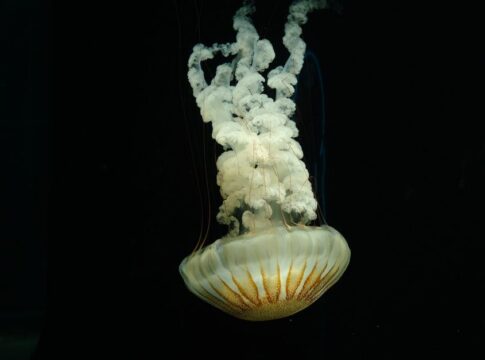
11 Strange Facts About Immortal Jellyfish Aging Backward
By Trivia Daily, Staff Writer — Published November 24, 2026
Table of Contents
- Key Takeaways
- The Science Behind Strange Immortal Jellyfish Transformation
- How the Immortal Jellyfish Compares to Other Long-Lived Species
- Eleven Fascinating Discoveries About Nature’s Most Curious Survivor
- The Ocean’s Tiniest Time Traveler
- Frequently Asked Questions
Deep in the ocean swims a creature that seems to have cracked the code of eternal life. The immortal jellyfish, scientifically known as Turritopsis dohrnii, can reverse its aging process and essentially restart its life cycle. This strange immortal jellyfish has captured the fascination of scientists worldwide, offering surprising insights into cellular biology and the limits of what we consider possible in nature. While most organisms march steadily toward death, this tiny jellyfish discovered a biological loophole that allows it to cheat mortality itself.
The ability to age backward sounds like science fiction, yet this remarkable creature performs this feat routinely when faced with stress, injury, or starvation. These amazing facts about biological immortality challenge our understanding of life and death in the animal kingdom.
Key Takeaways
- The immortal jellyfish can reverse its life cycle from adult back to juvenile polyp stage through cellular transdifferentiation
- This species measures only about 4.5 millimeters in diameter, roughly the size of a pinky fingernail
- The jellyfish originally came from the Caribbean but has now spread to oceans worldwide through ship ballast water
- Individual cells can transform into completely different cell types during the reverse aging process
- Despite biological immortality, these jellyfish still face threats from predators and disease
- Scientists study this species hoping to understand cellular aging and regeneration in humans
The Science Behind Strange Immortal Jellyfish Transformation
Turritopsis dohrnii achieves its remarkable immortality through a process called transdifferentiation. When stressed or injured, the jellyfish can transform its adult cells into younger cells, essentially hitting a biological reset button. This isn’t simply slowing down aging—it’s running the clock backward.
The jellyfish sinks to the ocean floor and converts itself back into a polyp, the earliest stage of jellyfish life. From there, it grows into an adult again. Imagine a butterfly transforming back into a caterpillar, then growing wings once more. That’s the scale of transformation happening here. Marine biologists have observed this process in laboratory settings, confirming that the same individual can cycle through life stages repeatedly.
During transdifferentiation, muscle cells can become nerve cells, or reproductive cells can become digestive cells. This cellular flexibility represents one of the most extraordinary examples of biological plasticity in nature. The genetic mechanisms controlling this process remain a major focus of research, as understanding them could revolutionize regenerative medicine.
How the Immortal Jellyfish Compares to Other Long-Lived Species
| Species | Maximum Lifespan | Special Longevity Feature |
|---|---|---|
| Immortal Jellyfish | Potentially unlimited | Can reverse aging through transdifferentiation |
| Greenland Shark | 400+ years | Extremely slow metabolism and growth rate |
| Ocean Quahog Clam | 500+ years | Low metabolic rate and cold water habitat |
| Bowhead Whale | 200+ years | DNA repair mechanisms and cancer resistance |
| Glass Sponge | 15,000+ years | Simple body structure and minimal metabolism |
Eleven Fascinating Discoveries About Nature’s Most Curious Survivor
1. Size Doesn’t Guarantee Survival
The immortal jellyfish measures a mere 4.5 millimeters across—smaller than your pinky fingernail. Despite its microscopic stature, it has achieved what giant whales and ancient trees cannot: the ability to theoretically live forever. This tiny size actually offers advantages, requiring fewer resources and making it easier to hide from predators. The bell-shaped body contains a bright red stomach visible through translucent tissue, and up to ninety tentacles trail behind as it drifts through the water.
2. Accidental Global Domination
Turritopsis dohrnii originated in the Caribbean Sea but has hitchhiked across the planet in ship ballast water. Today, populations thrive in the Mediterranean, off the coast of Japan, and throughout temperate and tropical waters worldwide. This accidental invasion demonstrates how human shipping activity can redistribute marine species. Unlike many invasive species that disrupt ecosystems, the immortal jellyfish appears to coexist peacefully with native marine life, though scientists continue monitoring its ecological impact.
3. Immortality Comes With Conditions
While the jellyfish can reverse aging, it isn’t invincible. Predators regularly eat these jellyfish, and diseases can kill them before they trigger their transformation. The biological immortality only activates under specific stressors like starvation, physical damage, or sudden environmental changes. In calm, stable conditions with plenty of food, an immortal jellyfish might live and die like any other creature without ever reversing its age. True immortality requires the right—or rather, the wrong—circumstances.
4. The Polyp Stage Holds the Secret
When the jellyfish reverses its life cycle, it doesn’t simply shrink. The entire organism transforms into a blob-like polyp that attaches to a surface. This polyp stage represents the juvenile form from which jellyfish normally develop. The polyp then produces new jellyfish through budding, creating genetic clones. What makes Turritopsis dohrnii unique is that adult medusae can revert to this polyp stage—a transition no other jellyfish species can reliably perform.
5. Genetic Blueprints for Eternal Youth
Scientists have sequenced the immortal jellyfish genome, discovering it contains variations in genes related to DNA repair, cell division, and protection against oxidative stress. These genetic differences appear to enable the dramatic cellular transformations the species undergoes. Researchers compare these genes to those in humans and other organisms, searching for insights into aging and cellular regeneration. The jellyfish genome may hold clues to treating age-related diseases and understanding why human cells lose their ability to regenerate over time.
6. Not All Immortal Jellyfish Are Actually Immortal
Individual variation exists even in this remarkable species. Some specimens reverse their aging more successfully than others, and not every individual in a population demonstrates the same regenerative capacity. Environmental factors, genetic differences, and the specific nature of the stress trigger all influence whether a particular jellyfish successfully completes the transformation. This variability interests researchers because it suggests the immortality mechanism can be enhanced or suppressed—information potentially applicable to other organisms.
7. The Transformation Takes Days, Not Years
The reverse aging process happens relatively quickly. Within about two to three days, an adult jellyfish can regress to the polyp stage. This rapid transformation requires massive cellular reorganization, with cells changing identity and function at remarkable speed. The efficiency of this process suggests highly coordinated genetic programs that activate simultaneously across the organism. Understanding how cells coordinate such dramatic changes could inform research into wound healing and organ regeneration.
8. Memory and Identity Vanish
When the jellyfish transforms back to a polyp, it loses all traces of its previous life. The nervous system dissolves and reforms, meaning any learned behaviors or physiological adaptations disappear. In a philosophical sense, the creature that emerges from the polyp stage might be considered a different individual, even if genetically identical. This raises interesting questions about identity and continuity of consciousness—though jellyfish possess such simple nervous systems that consciousness as we understand it likely doesn’t apply.
9. Laboratory Populations Reveal Unexpected Behaviors
Researchers maintaining colonies of immortal jellyfish in controlled environments have observed that the creatures don’t transform constantly. Given stable conditions with adequate food, they live normal jellyfish lives, reproducing sexually and eventually dying. The transformation appears reserved for genuine emergencies. This suggests the process carries costs or risks that make it a last resort rather than a routine occurrence. Scientists continue studying what specific triggers reliably induce the transformation.
10. Sexual and Asexual Reproduction Coexist
The immortal jellyfish reproduces both sexually as an adult medusa and asexually when in polyp form. Sexual reproduction introduces genetic diversity, while the polyp stage can bud off numerous clones. This dual strategy provides flexibility—genetic mixing when conditions favor it, and rapid cloning when colonizing new areas or recovering from setbacks. The ability to switch between reproductive strategies based on circumstances gives the species remarkable adaptive capacity.
11. Implications for Human Longevity Research
Medical researchers study Turritopsis dohrnii hoping to understand cellular aging in humans. While humans will never transform back into embryos, insights into how jellyfish cells avoid senescence and maintain regenerative capacity could inform treatments for degenerative diseases. The jellyfish demonstrates that aging isn’t an inevitable one-way process at the cellular level. If scientists can identify the key mechanisms that enable transdifferentiation, it might become possible to rejuvenate damaged human tissues or organs without the ethical complications of stem cell research.
The Ocean’s Tiniest Time Traveler
The immortal jellyfish reminds us that nature still holds profound mysteries. This creature doesn’t simply live a long time—it rewrites the rules of biological time entirely. Its translucent body drifting through ocean currents carries secrets that scientists are only beginning to unravel.
Several research institutions, including marine biology departments worldwide, maintain living colonies for study. These populations provide windows into cellular processes that challenge our understanding of what’s possible in biology. Every observation adds another piece to the puzzle of how life, death, and regeneration interconnect at the most fundamental level.
Frequently Asked Questions
Can immortal jellyfish actually live forever?
Theoretically yes, but practically no. While Turritopsis dohrnii can reverse its aging process indefinitely, predators, disease, and environmental hazards kill most individuals long before they demonstrate repeated transformations. No one has documented a single jellyfish living for centuries, though the biological potential exists.
How many times can an immortal jellyfish reverse its age?
Scientists have observed individual jellyfish reversing their life cycle multiple times in laboratory settings, with no apparent limit to the number of transformations. In theory, if protected from predators and disease, a single jellyfish could cycle through maturity and back to polyp form indefinitely.
Are there other immortal animals?
Several organisms demonstrate negligible senescence—showing no increase in mortality with age—including certain flatworms, hydra, and some sponges. However, Turritopsis dohrnii remains unique in its ability to reverse development from adult back to juvenile stage. Other long-lived species simply age very slowly rather than reversing the process.
Could humans ever use the immortal jellyfish’s anti-aging mechanism?
Direct application seems unlikely given the vast differences between jellyfish and human biology. However, understanding the genetic and cellular mechanisms behind transdifferentiation could inform regenerative medicine, potentially leading to treatments that help human tissues repair or rejuvenate themselves more effectively. The research remains in early stages with no immediate medical applications.
The immortal jellyfish continues to drift through the world’s oceans, a living reminder that evolution explores possibilities we’ve barely imagined. Each tiny pulsing bell carries within it the potential to rewrite its own story, beginning again whenever circumstances demand. In a universe where entropy seems inevitable, this minuscule creature found a way to swim against time itself.