
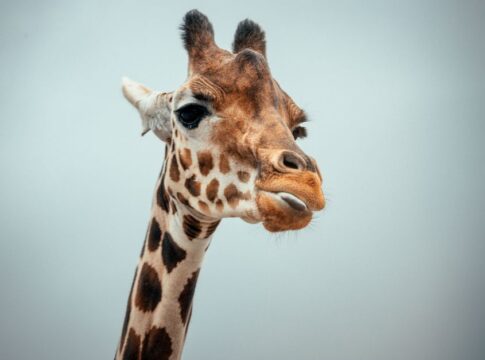
Why Giraffes Have Black Tongues: The Science Revealed
By TriviaOwl, Animals Desk — Published July 30, 2026
Table of Contents
- Key Takeaways
- Why Giraffes Black Tongues Evolved: The Sunscreen Theory
- The Remarkable Anatomy of a Giraffe’s Tongue
- Comparing Tongue Colors Across Wildlife
- Other Protective Adaptations in Giraffes
- The Role of Melanin in Animal Protection
- Frequently Asked Questions
If you’ve ever watched a giraffe at the zoo, you might have noticed something peculiar: that long, prehensile tongue isn’t the typical pink you’d expect. Instead, giraffes sport dark purple-black tongues that look almost otherworldly. This striking coloration isn’t just for show—it’s a brilliant example of how evolution solves very specific problems. The reason giraffes have black tongues is primarily protection from the intense African sun, though the full story involves fascinating animal behavior and survival adaptations that have made these creatures perfectly suited to their habitat.
These towering animals spend up to 12 hours a day feeding, and their tongues are constantly exposed as they strip leaves from thorny acacia trees. That’s a lot of sun exposure for any body part.
Key Takeaways
- Giraffe tongues are dark purple-black or bluish-black, especially on the portions most frequently exposed to sunlight during feeding.
- The dark pigmentation acts as natural sunscreen, protecting the tongue from UV damage during long feeding sessions in the African sun.
- A giraffe’s tongue can reach lengths of 18 to 20 inches, allowing them to grasp vegetation and navigate around sharp thorns.
- The base of the tongue, which remains inside the mouth most of the time, is actually pink—only the working end is darkly pigmented.
- This adaptation is crucial because giraffes spend most of their waking hours with their tongues extended, browsing on acacia trees and other vegetation.
- The tongue’s dark color is caused by melanin, the same pigment that protects human skin from sun damage.
Why Giraffes Black Tongues Evolved: The Sunscreen Theory
The most widely accepted explanation for this unusual coloration involves melanin—the same pigment responsible for skin and hair color in humans and countless other species. Just as melanin protects our skin from harmful ultraviolet radiation, the heavy concentration of this dark pigment in giraffe tongues serves as built-in sunscreen. Given that giraffes inhabit the sun-drenched savannas and woodlands of Africa, this protection is essential.
Think about the giraffe’s daily routine. These animals are browsers, not grazers, meaning they feed on leaves, shoots, and fruits from trees rather than grass. They prefer acacia trees, which grow in open areas with little shade. A giraffe extends its tongue repeatedly throughout the day, wrapping it around branches to strip off leaves. That tongue is out in the blazing sun for hours on end. Without melanin protection, the tissue would be vulnerable to sunburn, blistering, and potentially serious damage that could interfere with feeding—and therefore survival.
Interestingly, only the portions of the tongue most frequently exposed to sunlight are darkly pigmented. The base of the tongue, which stays tucked inside the mouth, remains pink. This gradient of color provides compelling evidence for the UV protection hypothesis: nature doesn’t waste resources pigmenting tissue that doesn’t need protection.
The Remarkable Anatomy of a Giraffe’s Tongue
Beyond color, the giraffe tongue is an engineering marvel. Measuring between 18 and 20 inches long, it’s incredibly muscular and prehensile, meaning the animal can control it with precision to grasp and manipulate objects. This dexterity allows giraffes to navigate around the vicious thorns of acacia trees—some up to three inches long—without injury.
The tongue’s surface is also tough and covered in thick papillae (small bumps), along with sticky saliva that helps protect against thorns and aids in gripping vegetation. The combination of length, strength, and flexibility makes it possible for giraffes to exploit a food source that many other herbivores cannot access as efficiently. This specialized feeding behavior has allowed giraffes to thrive in their ecological niche with relatively little competition from other large wildlife species in their habitat.
The tongue works in concert with the giraffe’s elongated neck—another famous adaptation. Together, these features allow giraffes to browse on foliage up to 18 feet above the ground, a height most other animals cannot reach.
Comparing Tongue Colors Across Wildlife
Giraffes aren’t the only animals with unusually colored tongues, though their dark pigmentation is among the most striking. Different species have evolved tongue colors that serve various purposes in nature.
| Animal | Tongue Color | Primary Function |
|---|---|---|
| Giraffe | Dark purple-black | UV protection during extended sun exposure |
| Okapi (giraffe relative) | Dark blue-black | Similar UV protection; also browses on leaves |
| Chow Chow dog | Blue-black | Genetic trait with no known functional advantage |
| Most mammals | Pink | Standard tissue coloration; less sun exposure |
| Chameleon | Pink to pale | Rapid extension for prey capture; minimal sun exposure per use |
Other Protective Adaptations in Giraffes
The black tongue is just one of many remarkable adaptations that help giraffes survive in their environment. These creatures have evolved a suite of features that work together to make them successful browsers in African ecosystems.
- Thick, sticky saliva: This coating helps protect both the tongue and throat from thorns and may have antiseptic properties that prevent infection from puncture wounds.
- Specialized lips: Giraffes have thick, leathery lips that are also somewhat darkly pigmented and covered in hair-like papillae, providing additional protection when feeding on thorny plants.
- Cardiovascular system: A giraffe’s heart must pump blood up that long neck to the brain, requiring a powerful cardiovascular system with specialized valves to regulate blood pressure.
- Browsing behavior: Giraffes rotate feeding areas and trees, preventing overgrazing and allowing vegetation to recover—a behavior that benefits their entire habitat.
These adaptations demonstrate how evolution fine-tunes every aspect of an animal’s anatomy and behavior to match its ecological niche.
The Role of Melanin in Animal Protection
Melanin is nature’s multipurpose protector, appearing across countless species in various forms. In animals, melanin serves multiple functions beyond just coloration. It absorbs harmful UV radiation, protecting underlying tissues from damage. It also provides structural strength to certain tissues and may play roles in immune function and even hearing in some creatures.
Dark pigmentation appears in many animals that experience high sun exposure. Birds with lighter plumage often have dark skin underneath. Many desert-dwelling reptiles have dark coloration. Marine mammals that surface frequently may have darker tongues or mouth tissue. The principle remains consistent: melanin goes where protection is needed most. In the giraffe, evolution has placed this protection precisely where the animal’s feeding behavior demands it.
Frequently Asked Questions
Are all parts of a giraffe’s tongue black?
No, only the front portion that extends out of the mouth during feeding is dark purple-black. The base of the tongue, which remains inside the mouth, is pink like most mammals’ tongues. This color gradient supports the theory that the dark pigmentation evolved specifically for sun protection.
Do baby giraffes have black tongues too?
Yes, even young giraffes are born with darkly pigmented tongues. This inherited trait is present from birth, ensuring protection as soon as the animals begin browsing on vegetation alongside their mothers.
What other animals are closely related to giraffes?
The okapi, a forest-dwelling animal from Central Africa, is the giraffe’s closest living relative. Okapis also have long, dark-colored tongues—though they’re shorter than giraffes’—and use them similarly to browse on leaves in their rainforest habitat.
How much can a giraffe eat in one day?
An adult giraffe can consume approximately 75 pounds of vegetation daily, though they can survive on much less. They spend most of their waking hours—up to 12 hours or more—feeding, which explains why tongue protection is so critical to their survival.
The next time you observe a giraffe extending that impressive dark tongue to pluck leaves from high branches, you’re witnessing millions of years of evolutionary problem-solving in action. What looks like a simple color difference is actually a sophisticated adaptation that allows these magnificent animals to thrive in one of Earth’s most challenging environments.