
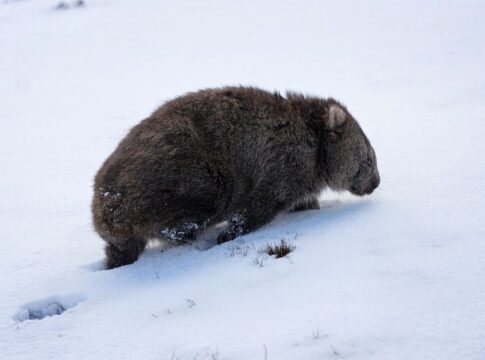
Why Wombat Poop Is Cube-Shaped: The Bizarre Science
By TriviaOwl, Staff Writer — Published August 19, 2026
Table of Contents
- Key Takeaways
- The Wombat Poop Cube Mystery: What Makes It So Unusual
- How the Intestine Sculpts Cubic Feces
- Comparing Wombat Digestion to Other Herbivores
- The Physics Behind Nature’s Only Cubes
- Common Myths About Wombat Droppings
- Frequently Asked Questions
Among the world’s most surprising natural phenomena, wombat poop cube formation ranks near the top. These Australian marsupials produce the only known cube-shaped feces in the animal kingdom—roughly six-sided pellets that stack neatly and resist rolling away. It’s a biological curiosity that has puzzled scientists for decades, and the explanation involves intestinal elasticity, slow digestion, and territorial behavior that makes this unusual shape surprisingly practical.
The discovery of why wombats produce cubic droppings combines anatomy, physics, and ecology into one fascinating package. What seems like nature’s oddest quirk turns out to be an elegant solution to communication challenges in the Australian bush.
Key Takeaways
- Wombats are the only animals known to produce cube-shaped feces, with each pellet measuring about two centimeters per side.
- The cubic shape forms in the last portion of the intestine, where varying elasticity creates flat surfaces and sharp edges during the two-week digestive process.
- Wombats deposit these cubes on rocks and logs to mark territory, and the shape prevents them from rolling off elevated surfaces.
- Researchers from the University of Tasmania and Georgia Institute of Technology discovered that alternating stiff and flexible regions in the wombat intestine sculpt the shape.
- Wombats produce 80 to 100 individual cube-shaped droppings each night during their territorial marking activities.
- The cubic formation doesn’t require special anal sphincter muscles—the shape is set before excretion occurs.
The Wombat Poop Cube Mystery: What Makes It So Unusual
Wombats, stocky burrowing marsupials native to Australia, produce between 80 and 100 droppings per day. Each one emerges as a distinct cube. The shape is consistent across all three wombat species: the common wombat, the southern hairy-nosed wombat, and the northern hairy-nosed wombat.
For years, the cubic shape baffled biologists. Most animal droppings are cylindrical or spherical, shaped by the circular muscles of the digestive tract. Wombat feces defied this pattern. Early theories suggested the shape formed during excretion, perhaps through a uniquely shaped anal opening. That turned out to be wrong.
The real answer lies deep within the wombat’s remarkably long intestinal tract. Wombats have one of the slowest digestive processes of any mammal, taking 14 to 18 days to fully process their fibrous, low-nutrient diet of grasses, roots, and bark. This extended journey allows maximum extraction of nutrients and water—critical adaptations for survival in Australia’s often harsh, dry environments.
How the Intestine Sculpts Cubic Feces
Research teams studying wombat digestive anatomy discovered that the final eight percent of the wombat intestine contains alternating regions of stiff and flexible tissue. These variations in elasticity create differential contraction patterns that gradually mold the digesting material into cubes.
The process works through rhythmic intestinal contractions. Stiffer sections resist expansion, creating flat surfaces. Flexible sections between them bulge slightly, forming the edges and corners. Over the course of the lengthy digestive process, what enters as a cylinder slowly transforms into a stack of cubes—nature’s own geometric manufacturing process.
Scientists confirmed this mechanism by studying intestinal tissue from wombats that had died from natural causes or vehicle collisions. They inflated sections of intestine like balloons and measured how different regions expanded. The pattern matched perfectly with the cubic shape observed in wombat droppings.
Why Evolution Favored This Shape
The cubic form serves a clear ecological purpose. Wombats are territorial animals that communicate through scent marking. They deposit their distinctive droppings on rocks, logs, and other elevated surfaces throughout their territory—sometimes stacking them in small piles.
Round droppings would roll off these surfaces. Cubic ones stay put. This simple geometric advantage means wombat scent markers remain where placed, creating more effective territorial boundaries. The higher the marker, the more visible and olfactorily prominent it becomes to other wombats.
Wombats have relatively poor eyesight but excellent senses of smell. Strategic placement of stable, non-rolling fecal markers allows them to establish clear territorial boundaries without constant maintenance or re-marking.
Comparing Wombat Digestion to Other Herbivores
| Animal | Digestion Time | Fecal Shape | Daily Output |
|---|---|---|---|
| Wombat | 14-18 days | Cubic | 80-100 pellets |
| Rabbit | 4-5 hours | Spherical | 200-300 pellets |
| Koala | 100-200 hours | Oval | 150-200 pellets |
| Cow | 24-48 hours | Irregular patties | 12-15 deposits |
The Physics Behind Nature’s Only Cubes
Creating corners and edges from soft biological material presents a genuine engineering challenge. Most soft materials naturally form curves and spheres when compressed—think of how pizza dough rounds itself or how water droplets form spheres.
The wombat intestine overcomes this tendency through precise control of tissue elasticity. Research published by teams studying biomechanics showed that the ratio of stiff to flexible tissue, combined with the duration of compression, allows the formation of distinct corners with angles approaching 90 degrees.
This discovery has attracted interest from engineers and materials scientists. The principle of using varying elasticity to create specific shapes in soft materials has potential applications in manufacturing, medical devices, and food production. Nature solved a complex engineering problem millions of years before humans began studying geometry.
Common Myths About Wombat Droppings
Several misconceptions about wombat poop cubes persist, despite scientific clarification. One common myth suggests wombats have square anuses that stamp out cubic shapes. Anatomical studies confirm this is false—wombat anal anatomy is unremarkable and similar to other marsupials.
Another misconception claims wombats consciously shape their feces or manipulate them after excretion. The cubes form entirely through passive intestinal processes. Wombats simply deposit them where territorial instinct dictates.
Some sources incorrectly state that wombat feces are perfectly cubic. In reality, they’re approximately cubic, with rounded corners and slight irregularities. The term “cube-shaped” describes their general geometry, not mathematical precision.
Frequently Asked Questions
Are wombats the only animals that produce cube-shaped poop?
Yes, wombats are the only known animals that naturally produce cube-shaped feces. No other mammal, bird, reptile, or invertebrate creates droppings with this distinctive geometry.
Do all wombat species produce cubic droppings?
All three wombat species—common wombats, southern hairy-nosed wombats, and northern hairy-nosed wombats—produce cube-shaped droppings. The trait is universal across the wombat family.
Can you stack wombat poop like building blocks?
While wombat droppings are cube-shaped, they’re not perfectly uniform or stable enough for serious stacking. Wombats themselves sometimes place several cubes together on prominent rocks or logs as territorial markers.
How long does it take for wombat poop to form its cubic shape?
The cubic shape develops gradually over the wombat’s 14 to 18-day digestive process, with the final shaping occurring in the last portion of the intestine during the final days before excretion.
The next time you encounter an unusual natural phenomenon, remember the wombat’s cubic calling card. What seems like biological absurdity often reveals elegant solutions to real survival challenges. Evolution doesn’t waste energy on novelty—even the strangest adaptations serve a purpose, whether that’s marking territory with non-rolling droppings or extracting every possible nutrient from tough Australian grasses. Nature’s toolbox contains stranger instruments than we typically imagine.