
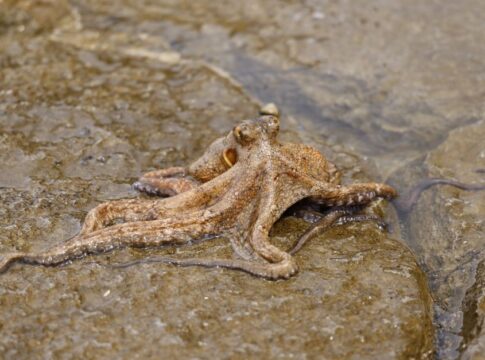
Octopus Intelligence: 9 Facts About Their Problem Solving
By TriviaOwl, Animals Desk — Published August 14, 2026
Table of Contents
- Key Takeaways
- Understanding Octopus Intelligence Problem Solving Through Brain Structure
- Comparing Octopus Intelligence Across Species
- The Nine Most Remarkable Facts About Octopus Problem-Solving
- Why Octopus Intelligence Matters for Understanding Cognition
- Frequently Asked Questions
Among the ocean’s most remarkable creatures, octopuses stand apart as invertebrate geniuses. With a brain structure utterly unlike our own and neurons distributed throughout their eight arms, these animals demonstrate octopus intelligence problem-solving abilities that continue to astonish researchers. They can navigate mazes, open childproof containers, and even predict sports outcomes—though that last feat might owe more to chance than cognition. What makes these soft-bodied wildlife wonders so remarkably clever?
Their behavior challenges everything we thought we knew about where intelligence emerges in nature. These creatures evolved their smarts along an entirely different path from mammals and birds, making their cognitive abilities a fascinating example of convergent evolution in the animal kingdom.
Key Takeaways
- Octopuses have nine brains: one central brain and a smaller brain in each of their eight arms, allowing independent limb control.
- These animals can solve complex puzzles, including unscrewing jar lids and navigating through mazes to reach food rewards.
- Octopuses demonstrate observational learning by watching other octopuses and mimicking their problem-solving strategies.
- Their distributed nervous system contains roughly 500 million neurons, with about two-thirds located in their arms rather than their central brain.
- Some species have been observed using tools, such as carrying coconut shells to create portable shelters.
- Octopuses possess both short-term and long-term memory, allowing them to remember solutions to problems over extended periods.
Understanding Octopus Intelligence Problem Solving Through Brain Structure
The octopus brain represents one of nature’s most unusual neural architectures. Unlike vertebrate animals with centralized nervous systems, octopuses distribute their intelligence across their entire body. Each arm contains enough neural tissue to operate semi-independently, capable of solving simple problems without input from the central brain. This means an octopus arm can explore a crevice, identify prey, and coordinate the complex movements needed to capture it—all while the animal’s main brain focuses elsewhere.
This decentralized setup evolved over hundreds of millions of years, allowing these species to process sensory information with remarkable speed. The arms taste and touch simultaneously, sending filtered information to the central brain rather than overwhelming it with raw data. Think of it as having eight highly capable assistants, each handling their own tasks while reporting only the most important findings to management.
Comparing Octopus Intelligence Across Species
| Species | Notable Behavior | Habitat |
|---|---|---|
| Giant Pacific Octopus | Opens jars, solves complex puzzles, recognizes individual humans | North Pacific coastal waters |
| Common Octopus | Uses observational learning, navigates mazes, remembers solutions | Mediterranean and Atlantic waters |
| Coconut Octopus | Carries tools (shells, coconuts) for shelter, plans ahead | Indo-Pacific tropical waters |
| Day Octopus | Sophisticated camouflage, complex hunting strategies | Indo-Pacific reefs and sandy flats |
The Nine Most Remarkable Facts About Octopus Problem-Solving
1. They Can Navigate Complex Mazes for Food Rewards
Researchers have tested octopuses with increasingly difficult mazes, and these animals consistently find the shortest path to food after just a few attempts. They remember successful routes and can apply learned strategies to similar but novel maze configurations. This spatial reasoning ability rivals that of many mammals and demonstrates genuine problem-solving rather than simple trial-and-error learning.
2. Octopuses Open Childproof Containers With Ease
Give an octopus a pill bottle with a childproof cap, and it will likely solve the puzzle faster than a toddler. They twist, pull, and manipulate containers with their flexible arms, figuring out mechanical mechanisms through persistent exploration. Aquarium staff have reported octopuses escaping from supposedly secure tanks by unscrewing lids, manipulating valves, and even dismantling filtration equipment. Their dexterity combined with curiosity makes them exceptional escape artists.
3. They Learn by Watching Other Octopuses
Octopuses demonstrate observational learning, a cognitive skill once thought limited to more social animals. When one octopus watches another solve a puzzle—such as choosing between different colored balls to receive food—the observer can replicate the solution without going through trial-and-error itself. This ability is particularly remarkable given that octopuses are largely solitary creatures in their natural habitat, suggesting their intelligence evolved for reasons beyond social interaction.
4. Tool Use Demonstrates Forward Planning
The coconut octopus collects discarded coconut shells and carries them across the ocean floor, later assembling them into protective shelters. This behavior requires the animal to recognize a future need, identify suitable materials, transport them while remaining vulnerable, and then construct the shelter when needed. Such forward planning was once considered a hallmark of advanced intelligence found only in primates and certain bird species.
5. They Possess Both Short-Term and Long-Term Memory
Studies have shown octopuses can remember solutions to problems for weeks or even months. They recall which feeding areas proved most productive, remember individual humans who have interacted with them, and retain learned aversions to unpleasant stimuli. Their memory systems operate despite having a brain structure completely different from vertebrates, suggesting multiple evolutionary paths to sophisticated memory formation.
6. Problem-Solving Improves With Enrichment
Octopuses raised in stimulating environments with puzzles and varied objects demonstrate enhanced problem-solving abilities compared to those in barren tanks. This environmental enrichment effect shows their intelligence isn’t purely instinctual but develops through experience and practice. Young octopuses appear particularly adept at learning, though adults continue to solve novel problems throughout their relatively short lives.
7. Individual Octopuses Show Distinct Personalities
Researchers studying captive octopuses have documented consistent individual differences in behavior. Some individuals boldly approach new objects and solve puzzles quickly through aggressive exploration. Others take cautious, methodical approaches. These personality differences affect problem-solving strategies, with bolder individuals sometimes solving puzzles faster but cautious ones making fewer errors. This behavioral variability suggests complex internal processing rather than simple programmed responses.
8. They Can Predict and Exploit Patterns
When presented with predictable feeding schedules or patterned reward systems, octopuses learn to anticipate events and position themselves advantageously. They recognize when certain signals precede food delivery and demonstrate understanding of cause-and-effect relationships. Some aquarium octopuses have learned to splash water at lights above their tanks, apparently understanding that wet lights attract human attention—and attention often leads to feeding.
9. Arm Autonomy Enables Parallel Processing
Because octopus arms can operate independently, these animals essentially solve multiple problems simultaneously. One arm might explore a crevice while others manipulate objects, taste potential food items, or anchor the body. This parallel processing capability gives octopuses a unique approach to problem-solving unavailable to creatures with centralized motor control. Each arm contributes its findings, allowing the central brain to make decisions based on information from eight semi-independent explorers.
Why Octopus Intelligence Matters for Understanding Cognition
Studying octopus cognition reveals that intelligence can emerge through radically different neural architectures. While mammals and birds evolved their smarts through increasingly complex centralized brains, octopuses took a distributed approach. This convergent evolution—arriving at similar cognitive abilities through completely different paths—suggests intelligence may be more common in nature than we previously assumed.
The implications extend beyond pure curiosity. Understanding how octopuses process information with their distributed nervous system could inform robotics and artificial intelligence design. Their flexible problem-solving with decentralized control offers models for creating adaptive machines that don’t rely on single processing units.
Frequently Asked Questions
How intelligent are octopuses compared to other animals?
Octopuses rank among the most intelligent invertebrates, with problem-solving abilities comparable to some mammals like rats and certain bird species. Their intelligence is difficult to compare directly to vertebrates due to their fundamentally different brain structure, but they demonstrate learning, memory, and reasoning that clearly surpass simple instinct.
Can octopuses recognize individual humans?
Yes, octopuses can distinguish between individual people, showing preference for those who feed them and avoiding those associated with unpleasant experiences. They appear to use visual cues to make these distinctions and remember individuals over extended periods.
Do octopuses feel emotions?
While we cannot know subjective experiences, octopuses display behaviors suggesting emotional-like states. They show curiosity, apparent boredom in unstimulating environments, and what researchers interpret as playfulness. Whether these behaviors reflect emotions similar to mammalian feelings remains an open scientific question.
Why are octopuses so intelligent despite being solitary?
Scientists hypothesize that octopus intelligence evolved to handle complex hunting strategies and predator avoidance in structurally complicated reef and rocky habitats. Their soft bodies lack protective shells, so behavioral flexibility and learning may have provided survival advantages that evolutionary pressures favored, even without social demands driving intelligence.
The next time you encounter an octopus—whether in an aquarium, documentary, or on your dinner plate—consider the extraordinary mind that once inhabited that form. These creatures represent one of evolution’s most successful experiments in building intelligence from an entirely different blueprint than our own, proof that nature finds multiple solutions to the challenge of thinking.