
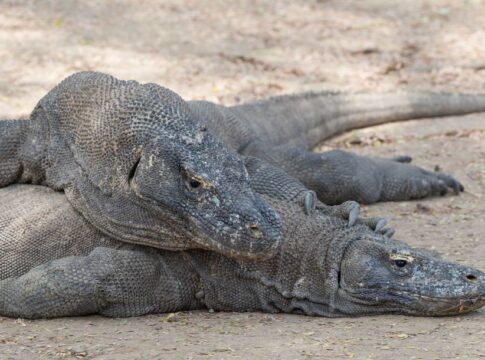
The Truth About Dragons Existing in Komodo Island Today
By Trivia Daily, Staff Writer — Published October 27, 2026
Table of Contents
- Key Takeaways
- The Truth About Dragons Existing: From Myth to Scientific Discovery
- Venom, Not Bacteria: Busting a Common Myth
- Living Giants: Size, Diet, and Behavior
- Reproduction and the Mystery of Virgin Births
- Conservation Status and Modern Threats
- Frequently Asked Questions
Dragons are real. Not the fire-breathing, treasure-hoarding creatures of medieval legend, but living, breathing apex predators that stalk the volcanic islands of Indonesia. The Komodo dragon, discovered by Western science only in the early 20th century, is the world’s largest living lizard and a startling reminder that our planet still harbors surprising megafauna. When you explore the truth about dragons existing on Komodo Island today, you discover a creature whose venom, hunting prowess, and sheer size rival the most amazing beasts of myth.
These massive reptiles can grow to ten feet in length and weigh more than 150 pounds, with serrated teeth and a bite capable of bringing down water buffalo. Their existence proves that sometimes reality delivers creatures as fascinating as any legend.
Key Takeaways
- Komodo dragons are the world’s largest living lizards, reaching lengths of up to ten feet and weights exceeding 150 pounds.
- They hunt using a combination of powerful jaws, serrated teeth, and toxic venom that prevents blood clotting in prey.
- These “dragons” are found only on a handful of Indonesian islands, including Komodo, Rinca, Flores, and Gili Motang.
- Komodo dragons can consume up to 80 percent of their body weight in a single feeding and survive on as few as 12 meals per year.
- Female Komodo dragons are capable of parthenogenesis, reproducing without male fertilization in rare circumstances.
- The species has existed in its current form for millions of years, making it a living link to the age of giant reptiles.
The Truth About Dragons Existing: From Myth to Scientific Discovery
For centuries, sailors and traders brought back tales of enormous lizards inhabiting remote Indonesian islands. Local communities had long known about these creatures, calling them “ora” or “land crocodiles.” Western scientists remained skeptical until the early 1900s, when expeditions confirmed the existence of these remarkable reptiles. The scientific name Varanus komodoensis was assigned, but “Komodo dragon” captured popular imagination and stuck.
The dragon’s range is remarkably limited. These predators inhabit only a few small islands in Indonesia’s Lesser Sunda archipelago, with the largest populations on Komodo and Rinca islands. This restricted habitat makes them vulnerable, and conservation efforts have become critical to their survival. Komodo National Park, established in 1980 and later designated a UNESCO World Heritage Site, protects both the dragons and their island ecosystem.
What makes these creatures so dragon-like extends beyond their size. Their forked tongues flicker constantly, sampling the air for chemical signals. They can detect carrion from several miles away, using their extraordinary sense of smell to locate dead or dying animals. This ability, combined with their patient hunting style, makes them supremely adapted ambush predators.
Venom, Not Bacteria: Busting a Common Myth
For decades, scientists believed Komodo dragons killed primarily through bacterial infection. The theory held that their mouths harbored such virulent bacteria that even survivors of attacks would succumb to sepsis within days. This explanation seemed logical given the dragons’ scavenging habits and the gruesome fates of their prey.
Research published in the early 21st century overturned this long-held belief. Scientists discovered that Komodo dragons possess venom glands in their lower jaws that secrete anticoagulants and compounds that induce shock and prevent blood clotting. The “toxic bite” isn’t from bacteria at all—it’s genuine venom, similar in function to that of some snakes. While bacteria may play a secondary role in some prey deaths, the primary mechanism is sophisticated biochemical warfare.
This discovery elevated Komodo dragons from mere scavengers with dirty mouths to highly evolved venomous predators. The venom allows them to bite prey once, then follow at a leisurely pace as the animal weakens from blood loss and shock. It’s an energy-efficient hunting strategy perfected over millions of years.
Living Giants: Size, Diet, and Behavior
Male Komodo dragons typically outsize females, with the largest verified specimens measuring just over ten feet from snout to tail. Their muscular bodies, covered in rough, armor-like scales embedded with tiny bones called osteoderms, provide both protection and sensory information. The tail, nearly as long as the body, serves as a weapon and counterbalance during pursuit.
These reptiles are opportunistic carnivores with diverse diets. Young dragons hunt insects, small reptiles, and birds, often climbing trees to escape cannibalistic adults. As they grow, their prey size increases dramatically. Adults take deer, wild pigs, water buffalo, and even horses. They’re also enthusiastic scavengers, able to locate and consume carrion across vast distances.
| Characteristic | Komodo Dragon | Comparison |
|---|---|---|
| Maximum Length | 10+ feet (3+ meters) | Longer than most adult humans are tall |
| Maximum Weight | 150+ pounds (70+ kg) | Similar to an adult human |
| Top Speed | 12 mph in short bursts | Faster than most humans can sprint |
| Bite Force | Moderate jaw strength + venom | Strategy over pure power |
| Lifespan | 30+ years in wild | Comparable to many large mammals |
Their metabolism is remarkably efficient. After gorging on a large kill, a Komodo dragon can survive for weeks or even months without eating again. This adaptation suits their island environment, where prey availability fluctuates seasonally.
Reproduction and the Mystery of Virgin Births
Komodo dragons typically reproduce sexually, with males competing violently for mating rights. During breeding season, males engage in ritualized combat, wrestling while standing on their hind legs. The victor earns access to females, while losers retreat to nurse their wounds.
Scientists have documented something truly surprising: female Komodo dragons held in captivity without males have produced viable eggs that hatched into healthy offspring. This process, called parthenogenesis, involves the egg developing without fertilization. Interestingly, parthenogenetic reproduction in Komodo dragons produces only male offspring due to their ZW sex-determination system.
Whether this occurs in wild populations remains uncertain, but the capability represents a potential survival mechanism for isolated individuals. If a single female reaches a new island, she could theoretically establish a population without a mate—though genetic diversity would suffer.
Conservation Status and Modern Threats
Despite their fearsome reputation, Komodo dragons face significant threats. Their limited range makes them vulnerable to habitat loss, natural disasters, and climate change. Rising sea levels pose a particular danger to these low-lying islands. The species is currently classified as Endangered by conservation organizations.
Human-wildlife conflict occasionally occurs when dragons enter villages or attack livestock. Tourism, while providing economic incentive for conservation, must be carefully managed to avoid disturbing breeding populations or habituating dragons to human presence. Park rangers work to balance protection with sustainable tourism that funds conservation efforts.
Illegal poaching and wildlife trafficking remain concerns, though Indonesian law strictly protects the species. International cooperation and local community engagement have proven essential to conservation success. The dragons have become a symbol of Indonesian natural heritage and a flagship species for broader conservation initiatives.
Frequently Asked Questions
Are Komodo dragons actually related to mythological dragons?
No direct relationship exists between Komodo dragons and dragon mythology, which predates their scientific discovery. However, ancient peoples may have encountered similar large reptiles, and fossils of extinct giant lizards could have inspired dragon legends across various cultures.
Can Komodo dragons really kill humans?
Fatal attacks on humans are rare but documented. Komodo dragons are wild predators capable of killing animals much larger than humans, and their venom makes even minor bites medically serious. Park visitors are required to maintain safe distances and follow ranger guidance.
How long have Komodo dragons existed?
Fossil evidence suggests the Komodo dragon lineage extends back roughly four million years, with the species in its modern form existing for at least one million years. They represent an ancient reptilian lineage that has survived numerous climate changes and extinction events.
Why are they found only on a few Indonesian islands?
Komodo dragons likely evolved on these islands or nearby landmasses when sea levels were lower, then became isolated as waters rose. Their limited swimming ability and specific habitat requirements prevented expansion to other regions, making them endemic to this small island chain.
The Komodo dragon stands as proof that Earth still harbors creatures worthy of legend—living dragons that stalk volcanic islands, hunt with venom, and reproduce through means that seem almost magical. In protecting these ancient reptiles, we preserve not just a species, but a living connection to a world where giants once walked, and where the line between myth and reality remains beautifully blurred.