
11 Record-Breaking Facts About Redwood Trees Being Tallest
By Trivia Daily, Staff Writer — Published November 24, 2026
Table of Contents
- Key Takeaways
- Understanding the Record-Breaking Redwood Giants
- Comparing the World’s Tallest Tree Species
- The Science Behind Extreme Height
- Frequently Asked Questions
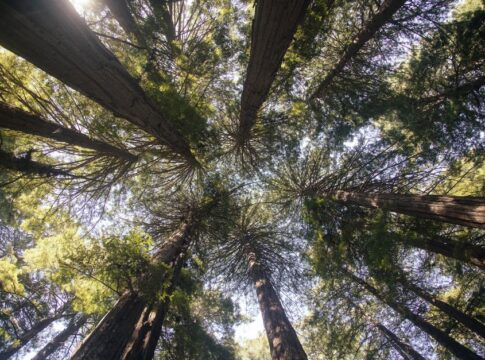
Standing in a grove of coast redwoods feels like stepping into a cathedral built by nature itself. These record-breaking redwood giants tower so high that their crowns disappear into the fog, creating ecosystems hundreds of feet above the forest floor. The tallest trees on Earth, coast redwoods hold secrets that science is only beginning to discover—from their ability to create rain to the complex communities thriving in their canopies.
What makes these ancient sentinels so remarkable isn’t just their height. It’s their resilience, their age, and the surprising ways they’ve adapted to thrive in a narrow coastal strip of California. Let’s explore the amazing facts that make redwoods the undisputed champions of the tree world.
Key Takeaways
- Coast redwoods are the tallest living organisms on Earth, with the current record holder measuring over 380 feet tall.
- These trees can live for more than 2,000 years and continue growing throughout their entire lifespan.
- Redwood bark can grow up to 12 inches thick, providing remarkable fire resistance.
- The tallest redwoods create their own microclimates by capturing fog and producing localized precipitation.
- Complex ecosystems exist in redwood canopies, including species found nowhere else on the forest floor.
- Redwoods can regenerate from their roots and stumps, making them nearly impossible to kill entirely.
Understanding the Record-Breaking Redwood Giants
Coast redwoods (Sequoia sempervirens) occupy a unique ecological niche along California’s foggy coastline. These trees thrive in a narrow band stretching roughly 450 miles from southern Oregon to Big Sur, never extending more than about 50 miles inland. The fog that rolls in from the Pacific Ocean provides essential moisture during California’s dry summers, allowing redwoods to reach heights impossible for trees in other climates.
The species name “sempervirens” means “ever-living,” a fitting description for organisms that can survive millennia. Redwoods belong to the cypress family and are one of three surviving species in the Sequoioideae subfamily, which once covered much of the Northern Hemisphere during warmer prehistoric periods. Today’s coastal redwood forests represent a remnant of that ancient distribution.
1. Hyperion Holds the Current Height Record
The tallest known living tree on Earth is a coast redwood named Hyperion, discovered in 2006 in a remote area of Redwood National Park in California. This giant measures 380.3 feet tall—taller than the Statue of Liberty from ground to torch. Hyperion’s exact location remains undisclosed to protect it from human impact, as foot traffic can compact soil and damage the shallow root systems redwoods depend on. Remarkably, scientists believe Hyperion may have grown even taller if not for woodpecker damage to its crown.
2. Redwoods Continue Growing for Centuries
Unlike most organisms that stop growing after reaching maturity, coast redwoods add height and mass throughout their entire lives. Trees over 1,000 years old still produce new growth each year. This continuous growth pattern means that the tallest redwoods are typically also among the oldest, having had centuries to add ring after ring of wood. Growth rates vary depending on conditions, but mature redwoods can add several feet of height per decade even in their later centuries.
3. Their Root Systems Are Surprisingly Shallow
For trees that reach heights exceeding 350 feet, redwoods have remarkably shallow root systems, typically extending only 10 to 13 feet deep into the soil. Instead of depth, these trees rely on breadth—their roots spread outward up to 100 feet from the trunk, intertwining with neighboring trees to create a mutually supportive network. This interconnected root system helps the giants withstand powerful coastal winds that would topple trees with conventional root structures.
4. Fog Provides Up to 40% of Their Water Needs
Redwoods have evolved an ingenious method of water collection that contributes to their record-breaking heights. Their needles capture moisture directly from fog, a process called foliar uptake. This captured water drips down the trunk and branches, providing hydration during California’s dry summer months when rainfall is scarce. Scientists estimate that fog contributes between 30 and 40 percent of the water these trees need annually, making them dependent on coastal fog patterns for survival.
5. The Tallest Trees Create Rain
The very tallest redwoods actually modify their local climate in measurable ways. As fog condenses on their needles and branches, the resulting drip creates a form of precipitation beneath the canopy even when no rain falls. A single large redwood can precipitate thousands of gallons of water onto the forest floor annually through fog drip. This self-created moisture sustains the lush understory plants and helps maintain the humid conditions the trees themselves require.
6. Canopy Ecosystems Exist Hundreds of Feet Up
The upper reaches of the tallest redwoods host complete ecosystems that function independently from the forest floor. Scientists have discovered soil deposits up to three feet deep accumulated in large branch crotches, supporting ferns, huckleberry bushes, and even small trees growing hundreds of feet above ground. Salamanders, insects, and other creatures spend their entire lives in these aerial habitats, never descending to the ground. These canopy communities remain largely unexplored due to the difficulty and danger of accessing them.
7. Fire Actually Helps Them Thrive
Redwood bark contains virtually no resin or pitch, making it remarkably fire-resistant. The bark itself can grow up to 12 inches thick, insulating the living tissue beneath from all but the most intense fires. Periodic low-intensity fires actually benefit redwood forests by clearing competing vegetation, recycling nutrients into the soil, and creating gaps in the canopy where young redwoods can germinate. Many ancient redwoods bear fire scars from multiple blazes over their lifetimes, yet continue thriving.
8. They Can Regenerate From Stumps
When a coast redwood is cut down or damaged, it responds by sending up new shoots from its root crown and stump. These sprouts, called basal sprouts, can grow rapidly—up to several feet per year in ideal conditions. This regenerative ability means that redwood groves can persist even after logging, with circles of younger trees surrounding old stumps. Some of these fairy rings, as they’re called, contain dozens of genetically identical trees all sprouting from a single ancient root system.
9. The Tallest Trees Are Relatively Young
Surprisingly, the very tallest coast redwoods are not the oldest specimens. Most record-breaking redwoods are between 600 and 800 years old—ancient by most standards, but young compared to the species’ maximum lifespan. Trees over 1,500 years old often show slowed height growth or crown damage from storms and lightning. The tallest specimens tend to be those that grew rapidly in ideal conditions during their early centuries and have avoided major damage in their middle age.
10. Lightning Poses a Serious Threat
The extreme height that makes redwoods record-breakers also makes them lightning rods. Many of the tallest trees bear scars from lightning strikes that shattered tops or burned vertical channels down their trunks. Some strikes are powerful enough to kill even these resilient giants. The discovery of Hyperion came partly from searching for tall trees that had somehow escaped major lightning damage—a rare combination of ideal growing conditions and fortunate avoidance of strikes over centuries.
11. Only a Fraction of Original Forests Remain
Before large-scale logging began in the 1850s, approximately two million acres of old-growth coast redwood forest covered California’s coastal regions. Today, less than five percent of that original forest remains, with most protected in national and state parks. The tallest redwoods survived only because they grew in remote, difficult-to-access locations that loggers couldn’t reach economically. Every record-breaking specimen represents not just biological achievement but also historical luck—these are the trees that escaped the saw.
Comparing the World’s Tallest Tree Species
| Species | Maximum Height | Location | Notable Characteristic |
|---|---|---|---|
| Coast Redwood | 380+ feet | California/Oregon Coast | Tallest living organism |
| Mountain Ash (Eucalyptus) | 330 feet | Tasmania/Australia | Tallest flowering plant |
| Coast Douglas Fir | 320 feet | Pacific Northwest | Tallest conifer after redwood |
| Sitka Spruce | 315 feet | Pacific Northwest | Tallest spruce species |
The Science Behind Extreme Height
Tree height faces physical limitations that even redwoods cannot overcome. Gravity and water transport create a ceiling for how tall any tree can grow. Water must travel from roots to leaves through tiny tubes in the wood, and this journey becomes increasingly difficult as height increases. At extreme heights, the force required to pull water to the crown approaches the physical limits of what the tree’s vascular system can achieve.
Scientists estimate that the theoretical maximum height for any tree is approximately 400 to 425 feet, based on the physics of water transport and the structural strength of wood. The tallest redwoods are already approaching this limit. Interestingly, the very tops of the tallest trees show signs of water stress, with smaller needles and slower growth compared to lower branches—evidence that these giants are pushing against nature’s boundaries.
Frequently Asked Questions
How long does it take a redwood to grow to record-breaking height?
A coast redwood typically requires 400 to 800 years to reach heights exceeding 300 feet, depending on growing conditions. The tallest specimens grew rapidly during their first few centuries in ideal locations with abundant fog, minimal competition, and freedom from major damage.
Are redwoods the same as giant sequoias?
No, coast redwoods (Sequoia sempervirens) and giant sequoias (Sequoiadendron giganteum) are different species. Redwoods are taller, while giant sequoias are more massive by volume. Sequoias grow in the Sierra Nevada mountains, while redwoods grow along the coast.
Can you visit the tallest redwood tree?
The exact location of Hyperion and other record-holding redwoods is kept secret to protect them from damage. However, visitors can experience equally impressive old-growth redwoods in accessible areas of Redwood National and State Parks, Humboldt Redwoods State Park, and other protected forests.
Do redwoods have any natural predators or diseases?
Mature redwoods have few natural threats due to their thick, rot-resistant bark and natural pest resistance. However, they can be affected by fungal infections if damaged, and sudden oak death (a pathogen) has impacted some redwood forest ecosystems by killing associated plant species.
The next time you crane your neck to glimpse the crown of a coast redwood, remember that you’re looking at the result of centuries of growth, countless adaptations, and remarkable resilience. These record-breaking giants aren’t just impressive statistics—they’re living connections to an ancient world, still reaching skyward after all these years.