
The Hidden Story of Why Medusa Had Snakes for Hair
By Trivia Daily, Staff Writer — Published November 28, 2026
Table of Contents
- Key Takeaways
- The Hidden Story of Medusa’s Transformation
- The Three Gorgon Sisters
- Perseus and the Quest for Medusa’s Head
- The Power That Outlived Death
- Comparing Ancient Sources on Medusa
- Medusa’s Legacy in Art and Culture
- Frequently Asked Questions
Most people recognize Medusa as the monster with venomous serpents sprouting from her scalp, a creature so terrifying that one glance would turn you to stone. But the hidden story of Medusa reveals something far more surprising: she wasn’t always a monster. According to ancient Greek mythology, Medusa began her life as a beautiful mortal woman, and her transformation into a snake-haired Gorgon was the result of a tragic punishment. This fascinating trivia about one of mythology’s most iconic figures uncovers layers of meaning that ancient audiences understood but modern retellings often overlook.
The myth of Medusa has captivated imaginations for thousands of years, but the details of her origin story contain amazing facts that challenge our assumptions about heroes and monsters. What you’re about to discover might change how you view this legendary figure forever.
Key Takeaways
- Medusa was originally a beautiful mortal woman, not born as a monster, according to the Roman poet Ovid’s account in Metamorphoses.
- The goddess Athena transformed Medusa’s hair into snakes as punishment after Poseidon violated Medusa in Athena’s temple.
- Medusa was the only mortal among the three Gorgon sisters; her sisters Stheno and Euryale were immortal from birth.
- The hero Perseus killed Medusa while she slept, using her reflection in his polished shield to avoid her petrifying gaze.
- From Medusa’s severed neck sprang Pegasus, the winged horse, and Chrysaor, a giant wielding a golden sword—both fathered by Poseidon.
- Even after death, Medusa’s head retained its power to turn living creatures to stone, which Perseus used as a weapon.
The Hidden Story of Medusa’s Transformation
The most interesting aspect of Medusa’s myth is that her monstrous appearance wasn’t her natural state. In the version recorded by Ovid in the first century CE, Medusa was a stunning maiden with particularly beautiful hair—her most celebrated feature. She served as a priestess in the temple of Athena, the virgin goddess of wisdom and war. Her beauty caught the attention of Poseidon, god of the sea, who assaulted her within Athena’s sacred temple.
Rather than punishing Poseidon, Athena directed her fury at Medusa. The goddess transformed Medusa’s lovely hair into a writhing mass of serpents and cursed her with a gaze that would petrify any living thing that looked directly at her. This punishment effectively isolated Medusa from all human contact. She became a monster through no fault of her own—a victim punished for being victimized.
This version of the myth raises thought-provoking questions about justice and power in ancient Greek religion. The gods operated by different rules than mortals, and their actions often reflected the harsh realities of ancient society rather than modern concepts of fairness.
The Three Gorgon Sisters
Medusa didn’t suffer alone. She had two sisters, Stheno and Euryale, who were also Gorgons—winged creatures with snakes for hair and petrifying gazes. But here’s a curious fact: unlike Medusa, her sisters were born immortal and monstrous. They never experienced transformation or mortality.
The three sisters lived together in a remote location, often described as being at the edge of the world near the land of the Hesperides or in Libya. Their isolated existence kept them away from human civilization, which was fortunate given their deadly appearance. The Gorgons were often depicted with bronze hands, sharp fangs, and golden wings, making them formidable guardians of their territory.
Medusa’s mortality made her the vulnerable one. While her sisters would live forever, she could be killed—a weakness that the hero Perseus would eventually exploit.
Perseus and the Quest for Medusa’s Head
The hero Perseus received what seemed like an impossible task: bring back the head of Medusa. King Polydectes of Seriphos demanded this feat, hoping Perseus would die in the attempt so the king could pursue Perseus’s mother without interference. But Perseus had divine ancestry—his father was Zeus—and the gods provided him with remarkable tools for the job.
Athena gave Perseus a polished bronze shield that worked like a mirror. Hermes provided winged sandals for flight and a sword sharp enough to cut through Medusa’s neck. The hero also received Hades’s cap of invisibility and a special bag to safely carry the severed head. Armed with these divine gifts, Perseus approached the Gorgons while they slept.
Using the reflection in his shield to navigate, Perseus avoided looking directly at Medusa and beheaded her with a single stroke. From her neck sprang two offspring: Pegasus, the famous winged horse, and Chrysaor, a warrior born holding a golden blade. Both were Poseidon’s children, conceived during the assault in Athena’s temple and carried within Medusa until her death released them.
The Power That Outlived Death
Even severed from her body, Medusa’s head retained its petrifying power. Perseus wielded it as a weapon throughout his adventures, turning enemies to stone simply by revealing the head from its protective bag. He used it to rescue his future wife Andromeda from a sea monster and later to punish King Polydectes and his followers who had threatened Perseus’s mother.
Eventually, Perseus gave the head to Athena, who mounted it on her shield, the aegis. This made Athena’s already fearsome battle gear even more terrifying. Some ancient Greek shields and temple decorations featured images of Medusa’s face, called a Gorgoneion, which was believed to offer protection by frightening away evil spirits and enemies.
The symbolism of Medusa’s head as both weapon and protective charm reveals the complex way ancient Greeks thought about power and danger. The same force that could destroy could also defend, depending on who wielded it.
Comparing Ancient Sources on Medusa
| Source | Time Period | Medusa’s Origin |
|---|---|---|
| Hesiod’s Theogony | ~700 BCE | Born as a monster, daughter of sea deities Phorcys and Ceto |
| Ovid’s Metamorphoses | ~8 CE | Beautiful maiden transformed by Athena after Poseidon’s assault |
| Apollodorus’s Library | ~1st-2nd century CE | Focuses on Perseus’s quest; minimal detail on Medusa’s origin |
These varying accounts show how myths evolved over centuries. Earlier Greek sources often portrayed Medusa as inherently monstrous, while later Roman interpretations emphasized her tragic transformation. Both versions influenced art and literature for millennia.
Medusa’s Legacy in Art and Culture
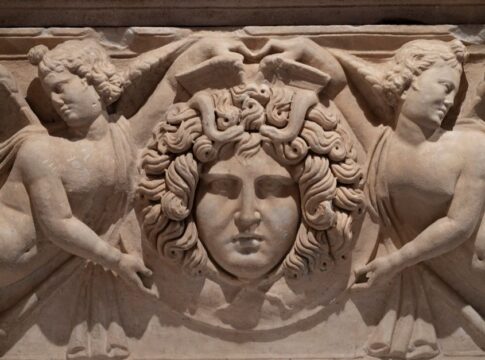
Medusa’s image has appeared in art for over 2,500 years. Ancient Greek pottery, temple sculptures, and mosaics frequently depicted her face, sometimes terrifying and sometimes surprisingly beautiful. The famous sculpture by Benvenuto Cellini, Perseus with the Head of Medusa, created in the 16th century, shows the dramatic moment of her beheading and remains on display in Florence, Italy.
In modern times, Medusa has been reinterpreted as a symbol of female rage and survival. Some feminist scholars view her as a victim of divine injustice who was blamed and punished for violence committed against her. This reading transforms her from a simple monster into a complex figure whose story raises questions about power, punishment, and victimization that remain relevant today.
The Medusa symbol appears in unexpected places, from fashion logos to medical imagery. The caduceus, sometimes confused with the Rod of Asclepius, features intertwined serpents that echo Medusa’s snake-covered head, though the symbols have different origins and meanings.
Frequently Asked Questions
Why did Athena punish Medusa instead of Poseidon?
Ancient Greek mythology often depicted gods as acting according to power dynamics rather than justice. Athena couldn’t directly punish her uncle Poseidon, a major Olympian deity, so she punished the mortal Medusa instead—a reflection of how ancient societies often blamed victims rather than powerful perpetrators.
Could Medusa control her petrifying power?
According to most ancient sources, Medusa’s gaze automatically turned any living creature to stone upon direct eye contact. She had no ability to turn this power off, which made her curse particularly isolating—she couldn’t look at any living being without destroying it.
What happened to Medusa’s sisters after Perseus killed her?
Stheno and Euryale pursued Perseus after he killed Medusa, but he escaped using Hades’s cap of invisibility and Hermes’s winged sandals. Being immortal, the two sisters continued to live, though they largely disappeared from mythology after this event.
Why do snakes specifically represent Medusa’s curse?
Serpents held powerful symbolic meaning in ancient Greek culture, representing both danger and divine power. Snakes were associated with chthonic (underworld) deities and transformation, making them a fitting symbol for Medusa’s cursed state between mortal and monster, beautiful and terrifying.
The myth of Medusa continues to fascinate because it operates on multiple levels—as an adventure story, a tragedy, and a meditation on power and punishment. Whether you see her as a monster slain by a hero or a victim of divine cruelty, her snake-crowned head remains one of mythology’s most enduring and thought-provoking images. The next time you encounter Medusa in art or literature, you’ll recognize the hidden depths beneath those writhing serpents.