
7 Record-Breaking Facts About the Amazon Rainforest
By Trivia Owl, Staff Writer — Published November 18, 2026
Table of Contents
- Key Takeaways
- Record-Breaking Amazon Facts and Trivia
- Comparing the Amazon to Other Major Rainforests
- The Amazon’s Role in Global Climate Systems
- Surprising Creatures That Call the Amazon Home
- Frequently Asked Questions
The Amazon rainforest produces roughly 20 percent of Earth’s oxygen and spans an area so vast that the United Kingdom and Ireland could fit inside it 17 times. Yet despite its fame, this record-breaking Amazon ecosystem continues to surprise scientists with discoveries that challenge what we thought we knew about our planet. From its hidden rivers flowing beneath the forest floor to the sheer number of species still unknown to science, the Amazon holds secrets that make it one of the most fascinating places on Earth.
These amazing facts reveal why the Amazon isn’t just the world’s largest rainforest—it’s a living laboratory of extremes that rewrites the rules of biology, climate, and geography.
Key Takeaways
- The Amazon River discharges more water than the next seven largest rivers combined, creating a freshwater plume visible from space.
- Scientists estimate that one in ten known species on Earth lives in the Amazon rainforest, with thousands yet to be discovered.
- A massive underground river system flows beneath the Amazon, moving water through porous rock layers thousands of feet below the surface.
- The Amazon’s tree canopy is so dense that raindrops can take ten minutes to reach the forest floor.
- Indigenous peoples have lived in the Amazon for at least 11,000 years, cultivating parts of the forest in ways that increased biodiversity.
- The rainforest generates its own rainfall through a process called evapotranspiration, recycling moisture up to six times before it reaches the Atlantic.
Record-Breaking Amazon Facts and Trivia
1. The Amazon River Moves More Water Than Any River System on Earth
The Amazon River doesn’t just hold records—it shatters them. This mighty waterway discharges approximately 209,000 cubic meters of water per second into the Atlantic Ocean, which is more than the next seven largest rivers combined. During the wet season, the river can swell to widths exceeding 30 miles in some sections, and its mouth is so wide that the island of Marajó, sitting in the delta, is roughly the size of Switzerland. The river’s freshwater plume extends up to 100 miles into the Atlantic, lowering the ocean’s salinity and creating a unique brackish ecosystem visible from satellites. With over 1,100 tributaries, 17 of which are themselves longer than 1,000 miles, the Amazon River system drains nearly 40 percent of South America’s landmass.
2. An Underground River Flows Beneath the Amazon Rainforest
Beneath the world’s most famous river lies another watery giant. Scientists have identified a massive underground flow system moving through porous rock layers approximately 13,000 feet below the Amazon River. This subterranean system, which follows a similar path to the surface river, moves water much more slowly—taking centuries to travel distances the Amazon River covers in weeks. The discovery challenges traditional understanding of how water cycles through the Amazon basin. While technically groundwater flow rather than a river with banks and a bed, this hidden system plays a crucial role in the region’s hydrology, affecting everything from the forest’s water supply to the chemical composition of the main river above.
3. The Rainforest Contains One-Tenth of All Species on Earth
The Amazon’s biodiversity reaches almost incomprehensible levels. Scientists estimate that approximately 10 percent of all known species on Earth live within this single ecosystem. The numbers are staggering: roughly 40,000 plant species, 1,300 bird species, 3,000 types of fish, 430 mammals, and 2.5 million insect species call the Amazon home. A single tree in the Amazon can harbor more ant species than exist in all of the British Isles. What’s more remarkable is that scientists believe thousands of species remain undiscovered—new species are documented regularly, with some years seeing hundreds of new plants, animals, and insects added to the scientific record. This extraordinary diversity stems from the Amazon’s age, size, and the complex mosaic of microhabitats created by its rivers, canopy layers, and varied terrain.
4. The Forest Canopy Creates Its Own Rain
The Amazon doesn’t just receive rain—it manufactures it. Through a process called evapotranspiration, trees release water vapor through their leaves, which rises, cools, and forms clouds that produce rainfall. The forest is so efficient at this that a single drop of water can be recycled five to six times as it moves from the Atlantic coast westward toward the Andes. Scientists estimate that the Amazon releases approximately 20 billion tons of water into the atmosphere daily. This self-sustaining system means the western Amazon actually receives more rainfall than weather patterns alone would deliver. The canopy is so dense that it can take ten minutes for a raindrop to work its way through the layers of leaves and branches to reach the forest floor, arriving as a fine mist rather than distinct drops.
5. Indigenous Management Shaped the Forest’s Biodiversity
The Amazon wasn’t an untouched wilderness before European contact—it was a cultivated landscape. Archaeological evidence reveals that indigenous peoples have lived in the Amazon for at least 11,000 years, and their land management practices actually increased the forest’s biodiversity in many areas. Communities created “forest islands” of useful trees, enriched soil through a technique that produced terra preta (nutrient-rich black earth), and managed plant populations in ways that scientists are only now beginning to understand. Researchers have found that many areas once thought to be pristine wilderness show signs of ancient cultivation, with higher concentrations of useful tree species than would occur naturally. Some estimates suggest that up to 12 percent of the Amazon’s tree species were at least partially domesticated by pre-Columbian peoples. This discovery has reshaped our understanding of both the forest’s history and the relationship between humans and ecosystems.
6. The Amazon Basin Holds One-Fifth of Earth’s Flowing Fresh Water
When it comes to fresh water, the Amazon dominates global statistics. The Amazon basin contains approximately 20 percent of all the flowing fresh water on Earth’s surface. This isn’t just about the main river—the entire network of waterways, wetlands, and seasonal floodplains creates a hydrological system unmatched anywhere on the planet. During the rainy season, water levels can rise more than 30 feet, transforming vast areas of forest into flooded ecosystems where fish swim among tree trunks and aquatic life explodes. These seasonal floods deposit nutrient-rich sediment across the floodplain, fertilizing the forest and creating unique habitats. The sheer volume of water in the system moderates regional climate, influences Atlantic Ocean currents, and provides habitat for species found nowhere else on Earth, including the Amazon river dolphin and the giant arapaima fish.
7. A Single Hectare Can Contain More Tree Species Than All of North America
The Amazon’s plant diversity reaches its most extreme expression in individual plots of forest. Researchers have documented single hectares—areas roughly the size of two American football fields—containing more than 300 tree species. To put that in perspective, all of North America north of Mexico contains approximately 650 native tree species total. This hyper-diversity occurs because the Amazon’s stable, warm, wet climate has allowed species to evolve and specialize over millions of years without the interruption of ice ages that reset ecosystems in temperate regions. The result is a forest where nearly every tree might be a different species, creating an almost impossibly complex web of interactions between plants, pollinators, seed dispersers, and countless other organisms. This diversity also means the forest is remarkably resilient—with so many species filling similar ecological roles, the loss of one doesn’t necessarily collapse the system.
Comparing the Amazon to Other Major Rainforests
| Rainforest | Approximate Area | Primary Location | Biodiversity Ranking |
|---|---|---|---|
| Amazon | 2.1 million square miles | South America (9 countries) | Highest on Earth |
| Congo | 700,000 square miles | Central Africa | Second highest |
| Southeast Asian | Fragmented, ~1 million square miles total | Indonesia, Malaysia, others | Extremely high |
| Atlantic Forest | ~50,000 square miles remaining | Brazil’s eastern coast | High endemism |
The Amazon’s Role in Global Climate Systems
The Amazon functions as a massive climate regulator for the entire planet. Beyond producing oxygen and storing carbon, the rainforest influences weather patterns across South America and beyond. The moisture released through evapotranspiration doesn’t stay local—atmospheric rivers carry this water vapor south, delivering rainfall to agricultural regions in Brazil, Paraguay, and Argentina. Scientists call these “flying rivers,” and they transport more water through the air than the Amazon River moves through its channel.
The forest stores an estimated 150 to 200 billion tons of carbon in its trees and soil. This carbon sequestration helps moderate global temperatures by keeping greenhouse gases out of the atmosphere. When trees are cut down or burned, this stored carbon is released, contributing to climate change. The relationship works both ways: as global temperatures rise and rainfall patterns shift, the Amazon itself faces increasing stress from drought, making its future a matter of international concern.
Surprising Creatures That Call the Amazon Home
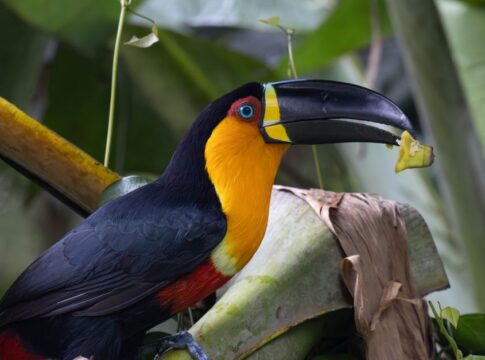
The Amazon’s record-breaking biodiversity includes some of Earth’s most unusual creatures. The electric eel, which isn’t actually an eel but a type of knifefish, can generate shocks of up to 600 volts—enough to stun a horse. The poison dart frog, no bigger than a paperclip, carries toxins so potent that indigenous peoples used them to tip hunting arrows. The giant river otter grows up to six feet long and lives in family groups that work cooperatively to fish.
In the canopy, three-toed sloths move so slowly that algae grows on their fur, providing camouflage and nutrients for moths that live in their coat. The harpy eagle, one of the world’s largest and most powerful raptors, plucks monkeys and sloths from treetops with talons the size of grizzly bear claws. And in the river, the arapaima—one of the world’s largest freshwater fish—can grow to over 10 feet and breathe air, allowing it to survive in oxygen-poor water where other fish cannot.
Frequently Asked Questions
Is the Amazon rainforest really the lungs of the Earth?
The Amazon produces significant oxygen, but it also consumes most of it through decomposition and respiration. The “lungs of the Earth” metaphor is misleading—oceans and phytoplankton are actually the planet’s primary oxygen source. The Amazon’s true importance lies in carbon storage, biodiversity, and climate regulation.
How many countries does the Amazon rainforest span?
The Amazon rainforest extends across nine countries: Brazil (containing about 60 percent), Peru, Colombia, Venezuela, Ecuador, Bolivia, Guyana, Suriname, and French Guiana. Brazil’s portion is by far the largest, with the states of Amazonas and Pará containing vast expanses of forest.
Are new species still being discovered in the Amazon?
Yes, scientists regularly discover new species in the Amazon. Between 2014 and 2015 alone, researchers documented an average of one new species every two days. Many discoveries are insects, plants, and small vertebrates, but occasionally larger animals previously unknown to science are found.
How old is the Amazon rainforest?
The Amazon rainforest has existed for at least 55 million years, having survived climate changes that transformed much of the planet. During ice ages, the forest contracted but never disappeared entirely, allowing species to persist and evolve over an extraordinary span of time.
The Amazon continues to reveal surprises that reshape scientific understanding of ecology, climate, and evolution. As research techniques improve and previously inaccessible areas become explorable, who knows what other record-breaking discoveries await in the world’s greatest rainforest?