
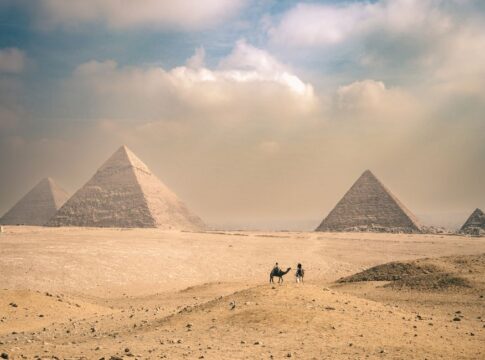
9 Surprising Facts About Cleopatra Living After Pyramids
By Trivia Daily, Staff Writer — Published September 16, 2026
Table of Contents
- Key Takeaways
- Understanding the Vast Timeline of Ancient Egypt
- Cleopatra and the Ancient Tourist Attractions
- 9 Facts That Put Cleopatra’s Timeline in Perspective
- Why Our Perception of Ancient History Gets Compressed
- Comparing Ancient Civilizations’ Timelines
- Frequently Asked Questions
When you picture ancient Egypt, Cleopatra and the Great Pyramids probably come to mind together. But here’s a mind-bending fact: Cleopatra lived closer in time to the moon landing than to the construction of those iconic pyramids. The last pharaoh of Egypt ruled from 51 to 30 BCE, while the Great Pyramid of Giza was completed around 2560 BCE—a gap of more than 2,500 years. This astonishing timeline reveals just how vast ancient Egyptian civilization truly was, and how our mental map of history can sometimes compress millennia into a single “ancient” blur.
These fascinating facts about Cleopatra living after the pyramids were already ancient monuments will change how you think about history. Let’s explore the surprising truths that make this timeline so remarkable.
Key Takeaways
- Cleopatra lived approximately 2,500 years after the Great Pyramid of Giza was built, making her closer to our time than to the pyramid’s construction.
- The pyramids were already ancient tourist attractions during Cleopatra’s reign, complete with guides and graffiti from Greek and Roman visitors.
- Cleopatra was actually Greek, not ethnically Egyptian, descended from one of Alexander the Great’s generals.
- She was the first ruler in her dynasty to actually learn the Egyptian language, despite her family ruling Egypt for nearly 300 years.
- Mammoths still walked the Earth when the pyramids were built, but had been extinct for thousands of years by Cleopatra’s time.
- Ancient Egyptian civilization spanned roughly 3,000 years—longer than the entire span from Cleopatra’s death to today.
Understanding the Vast Timeline of Ancient Egypt
Ancient Egypt wasn’t a single moment frozen in time. The civilization flourished for approximately three millennia, beginning around 3100 BCE with the unification of Upper and Lower Egypt and ending with Cleopatra’s death in 30 BCE. To put this in perspective, ancient Egypt existed longer than the span between the fall of Rome and today. The Egyptians themselves viewed their own history as ancient—scribes during the New Kingdom studied Old Kingdom texts the way modern scholars study medieval manuscripts.
The Great Pyramid was built during Egypt’s Old Kingdom, often called the “Age of the Pyramids.” By the time Cleopatra ascended to the throne, Egypt had already experienced the Middle Kingdom, the New Kingdom, and several intermediate periods of upheaval and foreign rule. The Egypt she governed looked nothing like the Egypt of the pyramid builders. Different gods rose and fell in importance, the capital moved multiple times, and the written language had evolved so much that reading Old Kingdom hieroglyphs required specialized training.
Cleopatra and the Ancient Tourist Attractions
During Cleopatra’s lifetime, the pyramids at Giza were already considered ancient wonders. Greek and Roman tourists traveled to Egypt specifically to see these mysterious monuments, much as modern travelers do today. Ancient graffiti from Greek visitors has been found on various Egyptian monuments, showing that even 2,000 years ago, people couldn’t resist leaving their mark on famous landmarks.
Tour guides in Cleopatra’s era told stories about the pyramids—some accurate, many fanciful. The Greek historian Herodotus, who visited Egypt about 400 years before Cleopatra, recorded elaborate (and often incorrect) tales about how the pyramids were built. By Cleopatra’s time, the true methods and purposes of pyramid construction had been lost to legend. The Sphinx was already partially buried in sand, a mysterious relic from an incomprehensibly distant past.
9 Facts That Put Cleopatra’s Timeline in Perspective
1. The Great Pyramid Was Already 2,500 Years Old
The Great Pyramid of Giza, built around 2560 BCE for Pharaoh Khufu, was completed roughly 2,530 years before Cleopatra was born in 69 BCE. To put this in modern terms, Cleopatra is closer to us today than she was to the pyramid builders. If you imagine the entire span of time from the pyramid’s construction to now as a single day, Cleopatra would appear around 5:30 PM—much closer to midnight (our present) than to dawn (the pyramid’s completion).
2. Woolly Mammoths Outlived Pyramid Construction
While the Great Pyramid was being built, small populations of woolly mammoths still survived on remote Arctic islands. These isolated mammoths persisted on Wrangel Island until approximately 2000 BCE—about 500 years after the Great Pyramid’s completion. By Cleopatra’s time, however, mammoths had been extinct for nearly two millennia. This fact illustrates how our mental chronology can mislead us: pyramids feel “prehistoric” while Cleopatra feels “historical,” yet pyramids and mammoths actually overlapped.
3. She Was Greek, Not Egyptian
Cleopatra belonged to the Ptolemaic dynasty, founded by Ptolemy I Soter, one of Alexander the Great’s Macedonian generals who took control of Egypt after Alexander’s death in 323 BCE. The Ptolemies were Greek in language, culture, and ancestry. They ruled Egypt as foreign monarchs for nearly three centuries, maintaining Greek customs and even marrying within their own family to preserve the bloodline. Cleopatra herself was the product of generations of sibling marriages, a practice the Ptolemies adopted from earlier Egyptian pharaohs but took to extreme lengths.
4. First of Her Dynasty to Speak Egyptian
Despite ruling Egypt for almost 300 years, the Ptolemaic rulers before Cleopatra never bothered to learn the Egyptian language. They governed through Greek administrators and kept Greek as the language of the court. Cleopatra broke with this tradition, becoming the first—and likely only—member of her dynasty to master Egyptian. She reportedly spoke as many as nine languages, including Egyptian, Greek, Hebrew, Aramaic, and several others, giving her a direct connection to her subjects that her ancestors lacked.
5. Ancient Egypt Lasted Longer Than Most Modern Nations
From the unification of Egypt around 3100 BCE to Cleopatra’s death in 30 BCE, Egyptian civilization lasted approximately 3,070 years. In comparison, the entire span from Cleopatra’s death to today is only about 2,050 years. The Roman Empire, often thought of as incredibly long-lived, lasted roughly 500 years in the West and 1,500 years if you count the Byzantine Empire. Ancient Egypt’s longevity is unmatched in recorded history, making it one of humanity’s most enduring civilizations.
6. Oxford University Is Older Than the Aztec Empire
While not directly about Cleopatra, this fact helps calibrate our historical perspective. Teaching existed at Oxford by 1096 CE, while the Aztec capital of Tenochtitlan was founded in 1325 CE. Similarly, Cleopatra’s Egypt fell to Rome in 30 BCE—over a millennium before Oxford began—yet we often mentally group “ancient civilizations” together. The timeline of human history contains surprising overlaps and gaps that challenge our assumptions about what was contemporary with what.
7. The Last Pyramids Were Built 1,000 Years Before Cleopatra
While the Great Pyramids date to the Old Kingdom (roughly 2686–2181 BCE), smaller pyramids continued to be built during the Middle Kingdom, with the last significant pyramid construction occurring around 1650 BCE. Even these “late” pyramids were ancient history by Cleopatra’s time—about 1,600 years old. By her era, Egyptian royal tombs were hidden in the Valley of the Kings, and pyramid-building was a long-forgotten art. The shift from pyramids to hidden tombs occurred because pyramids, despite their grandeur, proved too easy for tomb robbers to find and plunder.
8. Cleopatra’s Egypt Was Already Multicultural
The Egypt Cleopatra ruled was dramatically different from the Egypt of the pyramid age. Alexandria, her capital, was one of the ancient world’s great cosmopolitan cities, with significant Greek, Jewish, and Egyptian populations. The famous Library of Alexandria housed texts from across the known world. Greek philosophy, Egyptian religion, and Roman political influence all mixed in Cleopatra’s court. This multicultural reality contrasts sharply with the more culturally unified Egypt of earlier dynasties, when Egyptian language, religion, and customs dominated without significant foreign influence.
9. She Witnessed the Transition from Republic to Empire
Cleopatra lived during one of history’s great turning points. She witnessed and participated in the transformation of Rome from a republic into an empire. Her relationships with Julius Caesar and Mark Antony placed her at the center of Roman civil wars that would ultimately establish the Roman Empire under Augustus. When Cleopatra died in 30 BCE, the ancient world was ending and the classical world was beginning. Within a generation, Jesus would be born, and the Mediterranean world would be unified under Roman imperial rule for centuries to come.
Why Our Perception of Ancient History Gets Compressed
The human brain struggles with deep time. We naturally compress distant events into a single “long ago” category, losing the vast spans that separated them. This psychological quirk explains why many people imagine Cleopatra and the pyramids as contemporary, or why we think of dinosaurs and cavemen as coexisting (they were separated by about 65 million years). Educational systems often present ancient history as a series of civilizations—Egyptians, Greeks, Romans—without emphasizing the enormous timescales involved.
Ancient Egypt’s exceptional length makes this compression particularly misleading. The civilization persisted through dramatic changes in climate, technology, language, and religion. An Egyptian living during Cleopatra’s reign would have viewed the pyramid builders the way we view medieval knights—as figures from a distant, almost mythical past. Recognizing these vast timescales helps us appreciate both the achievements of ancient peoples and the incredible scope of human history.
Comparing Ancient Civilizations’ Timelines
| Civilization | Approximate Duration | Key Timeframe |
|---|---|---|
| Ancient Egypt | ~3,000 years | 3100 BCE – 30 BCE |
| Roman Empire (West) | ~500 years | 27 BCE – 476 CE |
| Byzantine Empire | ~1,100 years | 330 CE – 1453 CE |
| Ancient Greece (Classical) | ~300 years | 500 BCE – 323 BCE |
| Mesopotamian Civilizations | ~3,200 years | 3500 BCE – 539 BCE |
Frequently Asked Questions
How long after the pyramids was Cleopatra born?
Cleopatra was born approximately 2,500 years after the Great Pyramid of Giza was completed. The pyramid was finished around 2560 BCE, while Cleopatra was born in 69 BCE, making her closer in time to the present day than to the pyramid’s construction.
Did Cleopatra ever visit the pyramids?
While no definitive historical record confirms Cleopatra visiting the pyramids, it’s highly likely she did. The pyramids were located relatively close to Memphis, an important city in her kingdom, and were already famous tourist attractions. As Egypt’s ruler, she would have had both opportunity and reason to visit these monuments from her nation’s distant past.
Why do people think Cleopatra and the pyramids were from the same era?
People compress ancient history mentally because both Cleopatra and the pyramids are associated with “ancient Egypt.” Educational materials often present ancient civilizations as single units without emphasizing the thousands of years they spanned. Additionally, Hollywood films and popular culture frequently depict ancient Egypt as a single timeless period, reinforcing this misconception.
What language did Cleopatra speak?
Cleopatra was remarkably multilingual, reportedly speaking nine languages including Greek (her native language), Egyptian, Hebrew, Aramaic, and several others. She was the first Ptolemaic ruler to learn Egyptian, despite her dynasty ruling Egypt for nearly 300 years before her.
The next time you think of Cleopatra reclining on her barge along the Nile, remember that the pyramids looming in the distance were already more ancient to her than the Roman Colosseum is to us. History’s timeline stretches far deeper than our intuition suggests, filled with civilizations that rose, flourished, and became legends to the civilizations that followed.