
The Hidden Story of Why Elephants Cannot Jump at All
By Trivia Daily, Animals Desk — Published November 25, 2026
Table of Contents
- Key Takeaways
- The Hidden Story of Elephants: Anatomy Over Athletics
- How Elephants Compare to Other Large Animals
- Evolution’s Trade-Offs in Wildlife Behavior
- What Elephants Can Do: Surprising Agility
- The Biomechanics of Not Jumping
- Frequently Asked Questions
Among all the creatures that roam the Earth, elephants stand out for many reasons—their intelligence, their complex social bonds, their remarkable memory. But here’s a fact that surprises most people: elephants are the only mammals that cannot jump. Not even a little hop. While nearly every other land mammal, from tiny shrews to massive rhinos, can lift all four feet off the ground simultaneously, elephants remain firmly planted. The hidden story of elephants and their inability to jump reveals fascinating insights into animal anatomy, evolution, and the trade-offs that nature makes when designing bodies for specific habitats and behaviors.
This isn’t a matter of laziness or lack of effort. The reason elephants cannot jump is rooted in their skeletal structure, muscle composition, and sheer body mass. Understanding why these magnificent animals stay grounded opens a window into how evolution shapes species for survival in their natural environments.
Key Takeaways
- Elephants are the only mammals incapable of jumping due to their unique skeletal structure and immense body weight.
- An adult elephant can weigh between 5,000 and 14,000 pounds, making the biomechanical demands of jumping nearly impossible.
- Elephant leg bones are positioned almost vertically, like pillars, to support massive weight rather than to generate explosive upward force.
- Despite not jumping, elephants are surprisingly agile and can move quickly when needed, reaching speeds of up to 25 miles per hour.
- Many other large animals, including hippos and rhinos, can briefly lift all four feet off the ground, making elephants truly unique.
- This limitation hasn’t hindered elephants’ success as a species across diverse wildlife habitats in Africa and Asia.
The Hidden Story of Elephants: Anatomy Over Athletics
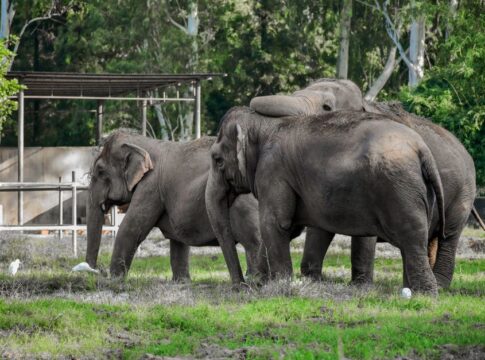
The elephant’s skeletal system tells the story. Their leg bones are structured differently from most mammals. In animals built for jumping—like cats, kangaroos, or even horses—the leg bones are angled and the joints are positioned to act like springs, storing and releasing energy. Elephants, by contrast, have legs designed as supportive columns. Their bones stack almost vertically beneath their bodies, optimized for bearing tremendous weight rather than generating lift.
The ankle and knee joints in elephants have limited flexibility compared to other mammals. This rigid structure provides stability and prevents injury when supporting several tons of body mass, but it eliminates the ability to crouch down and then explosively extend the legs—the fundamental motion required for jumping. Think of it this way: elephant legs are engineered like the support pillars of a bridge, not like the suspension springs of a car.
Body mass plays a crucial role. An adult African elephant can weigh up to 14,000 pounds. To jump, an animal must generate enough force to lift its entire body weight off the ground. The amount of muscle power required increases exponentially with size. While a mouse can jump many times its own body length with ease, scaling up that same jumping ability to elephant proportions would require impossibly large and powerful muscles. The elephant’s body plan simply doesn’t allocate resources that way.
How Elephants Compare to Other Large Animals
Elephants aren’t the only massive land animals, but they are unique in their complete inability to become airborne. Here’s how they stack up against other heavyweight species:
| Animal | Average Adult Weight | Can Jump? | Notable Movement Ability |
|---|---|---|---|
| African Elephant | 8,000–14,000 lbs | No | Can run up to 25 mph |
| White Rhinoceros | 4,000–6,000 lbs | Yes (briefly) | Can charge at 30 mph |
| Hippopotamus | 3,000–4,000 lbs | Yes (when running) | Can gallop at 19 mph on land |
| Giraffe | 1,800–2,600 lbs | Yes (small hop) | Can run up to 35 mph |
Even rhinos and hippos, despite their bulk, can achieve brief moments where all four feet leave the ground during a fast gallop. Elephants never do. Their gait, even at top speed, keeps at least one foot on the ground at all times—a fast walk rather than a true run.
Evolution’s Trade-Offs in Wildlife Behavior
Evolution doesn’t create perfect creatures. It creates creatures suited to their environment and lifestyle. For elephants, the inability to jump isn’t a flaw—it’s the result of evolutionary trade-offs that favored other advantages. Their massive size offers protection from predators. Few animals in nature dare challenge a full-grown elephant. Their strength allows them to push over trees to access food, dig for water during droughts, and reshape their habitat in ways that benefit entire ecosystems.
Elephants don’t need to jump to escape danger or catch prey. They’re herbivores who feed on vegetation that’s either on the ground or within reach of their versatile trunks. Their survival strategy centers on intelligence, social cooperation, and raw power—not agility or vertical leap. In their natural habitat, whether African savannas or Asian forests, the ability to jump would offer minimal survival benefit compared to the advantages their current body plan provides.
Their feet are uniquely adapted too. Elephant feet contain a fatty pad that acts as a cushion, distributing their enormous weight and allowing them to walk almost silently despite their size. This same adaptation, while excellent for quiet movement and weight distribution, further limits the explosive force generation needed for jumping.
What Elephants Can Do: Surprising Agility
Just because elephants can’t jump doesn’t mean they’re clumsy. These animals display remarkable coordination and surprising grace for their size. They can:
- Navigate steep, rocky terrain with careful foot placement
- Swim powerfully across rivers and lakes, sometimes for miles
- Stand on their hind legs to reach high branches
- Move through dense forest vegetation with minimal noise
- Perform complex manipulations with their trunks, which contain over 40,000 muscles
Young elephants are particularly playful and agile, engaging in behaviors that showcase their coordination even if they never leave the ground. They’ll spin, mock-charge, and engage in wrestling matches with their peers. The absence of jumping doesn’t limit their behavioral repertoire or their success as a species across diverse wildlife regions.
The Biomechanics of Not Jumping
From a physics perspective, the forces involved in elephant locomotion are staggering. When an elephant walks, each footfall generates ground reaction forces several times their body weight. These forces are absorbed and distributed through their columnar leg structure. If an elephant attempted to jump, the landing impact would be catastrophic. The force of hitting the ground after even a small jump could easily fracture bones or damage joints designed for steady compression, not sudden shock loads.
Scientists studying animal biomechanics have calculated that the muscle power required for an elephant to jump would be impractical. The leg muscles would need to be proportionally much larger than they are, which would require even more body mass to support, creating a vicious cycle. Nature solved this problem by simply not building elephants to jump.
Frequently Asked Questions
Are baby elephants able to jump?
No, even baby elephants cannot jump. While calves are more playful and energetic than adults, they share the same basic skeletal structure and body proportions that prevent jumping. From birth, their legs are designed as weight-bearing columns rather than spring-loaded levers.
Can any other mammals not jump at all?
Elephants are unique among land mammals in their complete inability to jump. While sloths rarely jump and hippos don’t jump often, they are technically capable of brief airborne moments. Elephants are the only mammals that never achieve full airborne status.
How do elephants cross obstacles if they can’t jump?
Elephants navigate obstacles by going around them, stepping over them carefully, or using their strength to remove them. They can step over barriers up to about three feet high and will kneel or use their trunks to test uncertain terrain before committing their weight.
Do elephants know they can’t jump?
While we can’t know what elephants “know” in human terms, their behavior suggests they understand their physical limitations. Elephants rarely attempt to cross gaps or obstacles that would require jumping, instead finding alternative routes or using their problem-solving abilities to create solutions.
The elephant’s grounded nature is a testament to evolution’s ingenuity. These creatures traded aerial acrobatics for stability, strength, and longevity. In doing so, they became some of the most successful large mammals on Earth, shaping ecosystems and inspiring human wonder for millennia. Next time you see an elephant, remember: those massive, pillar-like legs that keep them earthbound are the very same structures that allow them to thrive as the gentle giants of the animal kingdom.