
7 Record-Breaking Facts About the Great Wall of China
By Trivia Owl, Staff Writer — Published November 15, 2026
Table of Contents
- Key Takeaways
- The Record-Breaking Wall Spans an Astonishing Distance
- Construction Timeline Breaks Records for Duration
- 1. The Wall Uses Sticky Rice as a Secret Ingredient
- 2. It’s Not Actually Visible from Space
- 3. Multiple Walls, Not One Continuous Structure
- 4. The Wall Served as an Ancient Highway System
- 5. Significant Portions Have Disappeared Forever
- 6. It Failed to Keep Out Invaders
- 7. It Attracts More Visitors Than Any Other Historic Site
- Comparison of Great Wall Sections
- Frequently Asked Questions
The Great Wall of China stands as one of humanity’s most ambitious architectural achievements, snaking across mountains, deserts, and grasslands for thousands of miles. This record-breaking wall holds secrets that go far beyond its impressive length, revealing surprising truths about ancient engineering, human determination, and the myths we’ve come to believe. From the materials used in its construction to the misconceptions about its visibility from space, the Great Wall continues to fascinate researchers and travelers alike with facts that challenge what we thought we knew.
What makes this ancient fortification truly remarkable isn’t just its size—it’s the incredible stories hidden within its stones and the records it continues to break even today. Let’s explore the amazing trivia that makes the Great Wall one of the world’s most interesting historical monuments.
Key Takeaways
- The Great Wall stretches over 13,000 miles when all branches and sections are measured, making it the longest wall ever constructed.
- Construction spanned more than 2,000 years, involving multiple dynasties and millions of workers across Chinese history.
- Contrary to popular belief, the Great Wall is not visible from space with the naked eye—a myth debunked by astronauts.
- Rice flour was used as a binding agent in the mortar, creating a surprisingly durable construction material that has lasted centuries.
- The wall served multiple purposes beyond defense, including border control, trade regulation, and communication via signal towers.
- Approximately 30% of the wall has disappeared due to natural erosion and human activity over the centuries.
The Record-Breaking Wall Spans an Astonishing Distance
When people ask about the Great Wall’s length, the answer depends on what you’re measuring. The most commonly cited figure of approximately 5,500 miles refers to the main Ming Dynasty wall built between the 14th and 17th centuries. However, when archaeologists include all the branches, secondary sections, and walls built by different dynasties throughout history, the total length reaches an astounding 13,170 miles according to a comprehensive survey conducted by China’s State Administration of Cultural Heritage.
This makes it the longest human-made structure ever built. To put that in perspective, if you could straighten out all sections of the Great Wall, it would stretch more than halfway around Earth’s equator. The wall traverses fifteen Chinese provinces and autonomous regions, crossing dramatically diverse terrain from sea level to mountain peaks over 5,000 feet high. No other defensive fortification in human history comes close to this scale.
Construction Timeline Breaks Records for Duration
The Great Wall holds another impressive record: it took longer to build than any other construction project in history. Work began during the 7th century BCE when various Chinese states built defensive walls around their territories. The famous Qin Dynasty emperor Qin Shi Huang ordered these separate walls connected and extended around 221 BCE, creating the first unified defensive system.
But construction didn’t stop there. Successive dynasties continued building, rebuilding, and extending the wall for over 2,000 years, with the last major construction occurring during the Ming Dynasty (1368-1644 CE). This means the Great Wall was under construction for longer than the entire span of time from the fall of Rome to the present day. Millions of workers contributed to this massive undertaking over the centuries, including soldiers, peasants, and prisoners. The human cost was enormous, with countless workers perishing during construction—though specific numbers remain disputed by historians.
1. The Wall Uses Sticky Rice as a Secret Ingredient
One of the most surprising facts about the Great Wall involves an unexpected construction material: sticky rice. During the Ming Dynasty, builders discovered that mixing rice flour into their mortar created an incredibly strong and durable binding agent. This organic compound, called amylopectin, chemically bonded with the calcium carbonate in the lime mortar, producing a composite material stronger than either component alone.
Modern scientific analysis has confirmed what ancient engineers knew through experimentation—this rice mortar is so effective that it’s more resistant to earthquakes and erosion than many modern concrete mixtures. Sections of the wall built with this technique have survived hundreds of years of weathering with minimal damage. The discovery demonstrates the sophisticated understanding of materials science that Chinese builders possessed centuries before modern chemistry explained why their methods worked so well.
2. It’s Not Actually Visible from Space
Perhaps the most persistent myth about the Great Wall claims it’s the only human-made structure visible from space with the naked eye. Astronauts have repeatedly debunked this popular misconception. While satellites can photograph the wall using magnification, astronauts in low Earth orbit cannot see it without assistance.
Chinese astronaut Yang Liwei specifically stated he couldn’t see the Great Wall during his 2003 space mission, disappointing many who believed the legend. From the International Space Station, which orbits about 250 miles above Earth, the wall’s width of approximately 20-30 feet makes it virtually impossible to distinguish from the surrounding landscape. Highways, airports, and cities are far more visible than the ancient fortification. This myth likely originated from a 1938 claim made before any human had actually been to space—proving that even widely-believed “facts” deserve scrutiny.
3. Multiple Walls, Not One Continuous Structure
Calling it “the” Great Wall is somewhat misleading. The structure consists of numerous walls, some running parallel to each other, built by different dynasties over different time periods using different materials. The earliest walls were constructed from rammed earth—layers of soil compressed between wooden frames. Later dynasties used stone and brick for more permanent fortifications.
Some sections never connected to others at all, serving regional defensive purposes rather than forming a continuous barrier. The famous brick-and-stone sections that tourists visit today represent only a small fraction of the total structure, mostly dating from the Ming Dynasty. Many earlier sections have crumbled into barely recognizable earth mounds. This complex history means the Great Wall is less a single monument and more a collection of defensive systems built and modified across two millennia.
4. The Wall Served as an Ancient Highway System
Beyond its defensive purpose, the Great Wall functioned as an elevated highway for moving troops and supplies quickly across difficult terrain. The wide top surface of many sections allowed soldiers and horses to travel efficiently along the wall’s length, bypassing obstacles that would slow ground-level movement. Watchtowers positioned at regular intervals served as communication relay stations, using smoke signals by day and fire signals by night to transmit messages across hundreds of miles in just hours.
This communication network represented one of the most sophisticated long-distance messaging systems of its time. Guards could alert distant garrisons about enemy movements faster than messengers could travel on horseback through the countryside. The wall also controlled trade along the Silk Road, with fortified gates serving as customs checkpoints where authorities regulated commerce and collected taxes. This economic function proved as important as military defense in many periods.
5. Significant Portions Have Disappeared Forever
Time has not been kind to the Great Wall. Experts estimate that approximately 30% of the structure has vanished entirely, with another significant portion in severe disrepair. Natural erosion from wind, rain, and sandstorms has worn away many sections, particularly those built from rammed earth rather than stone. In desert regions, some sections have been nearly buried by shifting sands.
Human activity has accelerated the destruction. Local residents have quarried the wall for building materials for centuries, dismantling sections to construct homes and roads. During China’s Cultural Revolution, some portions were deliberately destroyed. Even today, unchecked tourism and urban development threaten remaining sections. Conservation efforts face the enormous challenge of protecting thousands of miles of ancient structure, much of it in remote locations. The race to preserve what remains has become urgent as more sections deteriorate beyond recovery each year.
6. It Failed to Keep Out Invaders
Despite its massive scale, the Great Wall often failed at its primary defensive purpose. The Mongols breached it in the 13th century, establishing the Yuan Dynasty. The Manchus crossed it in the 17th century, founding the Qing Dynasty. These invasions succeeded not because the wall itself was ineffective, but because defenders were undermanned, poorly supplied, or—in some cases—opened the gates themselves through bribery or political maneuvering.
Military historians note that static fortifications only work when adequately garrisoned and maintained. The Great Wall required hundreds of thousands of soldiers to defend effectively, a resource drain that few dynasties could sustain continuously. Gaps in coverage, particularly at mountain passes, provided opportunities for determined invaders. The wall’s psychological impact as a symbol of Chinese power may have exceeded its practical military value, though this interpretation remains debated among scholars.
7. It Attracts More Visitors Than Any Other Historic Site
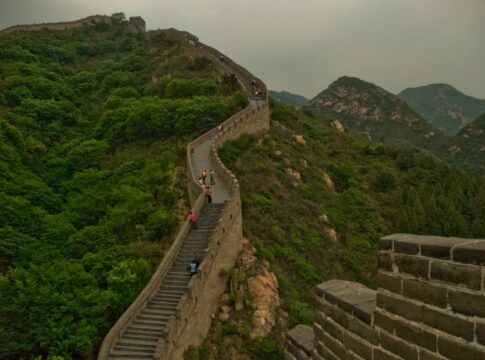
The Great Wall receives approximately 10 million visitors annually, making it one of the world’s most visited tourist attractions. The most popular section at Badaling, located about 50 miles from Beijing, can see over 70,000 visitors on peak days. This massive tourism industry brings economic benefits but also creates conservation challenges, as foot traffic accelerates erosion and wear on ancient stones.
UNESCO designated the Great Wall a World Heritage Site in 1987, recognizing its cultural significance and the need for international cooperation in preservation efforts. The site represents a powerful symbol of Chinese civilization and human engineering capability. For many visitors, walking along sections that have stood for centuries provides a tangible connection to history that few other monuments can match. Balancing public access with preservation remains an ongoing challenge for Chinese authorities managing this irreplaceable cultural treasure.
Comparison of Great Wall Sections
| Section | Dynasty | Primary Material | Current Condition |
|---|---|---|---|
| Badaling | Ming | Brick and stone | Fully restored |
| Mutianyu | Ming | Granite blocks | Well preserved |
| Jinshanling | Ming | Brick | Partially restored |
| Jiankou | Ming | Stone | Unrestored, rugged |
| Qin sections | Qin | Rammed earth | Mostly eroded |
Frequently Asked Questions
How long did it take to build the Great Wall of China?
Construction spanned over 2,000 years, beginning in the 7th century BCE and continuing through the Ming Dynasty (1368-1644 CE). Different dynasties built and modified sections throughout this extended period, making it the longest construction project in human history.
Can you really see the Great Wall from the moon?
No, this is a myth. The Great Wall is not visible from the moon or even from low Earth orbit with the naked eye. Astronauts have confirmed that highways and cities are far more visible than the wall from space.
What was the Great Wall actually built to defend against?
The wall primarily defended against invasions from northern nomadic groups, including the Mongols and various other tribes. It also served to control trade, regulate borders, and enable rapid military communication across vast distances.
How many people died building the Great Wall?
While exact numbers are unknown and disputed, historians estimate that hundreds of thousands of workers died during construction over the centuries. Many were buried near or within the wall itself, though specific figures remain unverifiable due to limited historical records.
The Great Wall continues to reveal new secrets as archaeologists discover previously unknown sections and historians reexamine ancient records. Each finding adds depth to our understanding of this record-breaking monument, reminding us that even the most studied landmarks still hold mysteries waiting to be uncovered.