
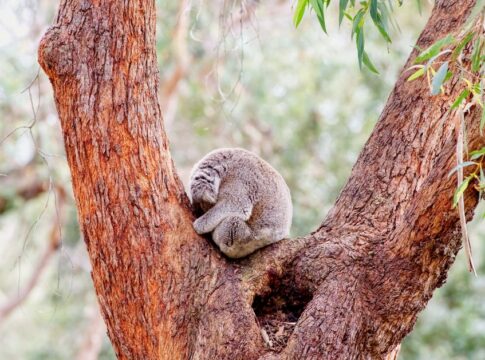
Why Koalas Sleep 22 Hours a Day: The Science Behind It
By TriviaOwl, Staff Writer — Published August 1, 2026
Table of Contents
- Key Takeaways
- The Eucalyptus Diet: A Nutritional Challenge
- Toxic Defense Mechanisms
- The 22 Facts Behind Koalas’ Sleep Hours
- Comparing Nature’s Champion Sleepers
- Frequently Asked Questions
Koalas hold the record as one of nature’s champion sleepers, and this surprising fact about how many hours koalas sleep each day—up to 22 hours—has fascinated scientists and animal lovers alike. These tree-dwelling marsupials spend nearly their entire lives in a state of rest, making them one of the most lethargic creatures on Earth. But there’s nothing lazy about this behavior. The answer lies in their unique diet, metabolic adaptations, and evolutionary survival strategies that make this extreme sleep schedule not just normal, but essential.
Discover the amazing science behind why these adorable Australian icons need so much rest, and explore the interesting trivia that reveals how their low-energy lifestyle is actually a masterclass in efficiency.
Key Takeaways
- Koalas sleep 18 to 22 hours daily due to their extremely low-nutrition eucalyptus diet
- Eucalyptus leaves contain toxic compounds that require significant energy to detoxify
- Their metabolic rate is roughly half that of most other mammals of similar size
- Koalas have one of the smallest brain-to-body ratios among mammals, conserving energy
- This sleep pattern is an evolutionary adaptation, not a sign of laziness or illness
- Only about 4 to 6 hours each day are spent eating, grooming, and moving between trees
The Eucalyptus Diet: A Nutritional Challenge
Koalas are specialist feeders, consuming only eucalyptus leaves from a select number of species. This dietary choice presents an enormous challenge. Eucalyptus leaves contain very little protein and virtually no fat—the two nutrients most animals rely on for energy. A koala must consume roughly one kilogram of leaves daily just to meet its basic nutritional needs, and those leaves deliver only about half the calories that other herbivores extract from their food sources.
The leaves are also incredibly fibrous and difficult to digest. Koalas have evolved a specialized digestive system with an exceptionally long cecum—a pouch connected to the intestine—that can reach up to two meters in length. This organ houses bacteria that help break down the tough cellulose fibers, but the process is slow and energy-intensive. Every calorie saved by sleeping is a calorie that can be devoted to this demanding digestive work.
Toxic Defense Mechanisms
Eucalyptus trees have evolved powerful chemical defenses to deter herbivores, including phenolic compounds, tannins, and cyanide-based toxins. These substances would be lethal to most mammals. Koalas have developed a remarkable liver enzyme system that can detoxify these compounds, but neutralizing poisons requires tremendous metabolic energy. The more active a koala is, the faster its metabolism runs, and the more toxins accumulate in its system faster than it can process them.
By sleeping most of the day, koalas keep their metabolic rate exceptionally low, allowing their liver to work through the toxins at a manageable pace. This survival strategy transforms what appears to be extreme laziness into sophisticated biochemical management. The koala essentially sleeps to avoid poisoning itself.
The 22 Facts Behind Koalas’ Sleep Hours
1. Their Brain Uses Minimal Energy
Koalas have one of the smallest brains relative to body size of any mammal, weighing only about 19 grams. The brain is an energy-hungry organ in most animals, consuming up to 20 percent of total energy in humans. By having a smaller, smoother brain with fewer folds, koalas dramatically reduce their baseline energy requirements, making extended sleep periods metabolically feasible.
2. Body Temperature Drops During Rest
While sleeping, koalas can lower their body temperature slightly to conserve energy, similar to a mild form of torpor. This thermoregulation strategy reduces the calories needed to maintain normal body functions. On hot days, they may drape themselves along branches to maximize heat dissipation, further reducing metabolic demands.
3. Sleep Positions Vary by Weather
Koalas adjust their sleeping posture based on temperature. During cold weather, they curl into tight balls to conserve heat. In summer, they sprawl across branches with limbs dangling to increase airflow and cooling. These position changes demonstrate that their sleep is an active part of temperature regulation, not mere unconsciousness.
4. They’re Nocturnal Feeders
Most of a koala’s limited waking hours occur at night when temperatures are cooler and humidity is higher. Eucalyptus leaves contain more moisture in the evening, providing better hydration. This nocturnal feeding pattern means koalas are often asleep during daylight hours when human observers see them, reinforcing their reputation as perpetual sleepers.
5. Digestion Happens While Sleeping
The breakdown of eucalyptus leaves in a koala’s digestive system can take up to 200 hours—more than eight days. This extraordinarily slow digestion continues around the clock, meaning that sleeping koalas are actually hard at work internally, processing their fibrous meals through fermentation and microbial action.
6. Energy Conservation Is Genetic
Research suggests that koalas have genetic adaptations that promote energy conservation at the cellular level. Their mitochondria—the powerhouses of cells—appear to operate at lower efficiency than those of other mammals, producing less energy from the same amount of nutrients but also generating less metabolic waste heat.
7. Water Intake Is Minimal
The name “koala” likely derives from an Aboriginal word meaning “no drink.” Koalas obtain most of their water from eucalyptus leaves and rarely descend to ground level to drink. This water-conservation strategy reduces the need for energy-expensive trips down and up trees, allowing them to remain stationary and sleeping for longer periods.
8. Muscle Mass Is Reduced
Compared to similarly sized mammals, koalas have relatively low muscle mass. Muscles require constant energy to maintain, even at rest. By minimizing muscle tissue and maximizing their grip strength in just their limbs, koalas reduce their basal metabolic rate while still maintaining the ability to cling securely to branches during their marathon sleep sessions.
9. REM Sleep Is Limited
Studies indicate that koalas spend less time in REM (rapid eye movement) sleep than most mammals. REM sleep is metabolically expensive, requiring nearly as much energy as waking consciousness. By spending more time in deep, slow-wave sleep, koalas maximize energy conservation while still obtaining necessary rest.
10. They’re Not Hibernating
Despite sleeping up to 22 hours daily, koalas are not hibernating. Hibernation involves dramatic physiological changes including severe drops in body temperature and heart rate. Koalas maintain normal body functions during sleep and can wake quickly if threatened, distinguishing their behavior from true hibernation.
11. Young Koalas Sleep Even More
Joey koalas, particularly those still in the pouch or recently emerged, may sleep even longer than adults—sometimes up to 23 hours daily. This extended rest supports rapid growth and development while their digestive systems gradually adapt to processing eucalyptus leaves after weaning from their mother’s milk.
12. Metabolic Rate Is Half Normal
Scientific measurements show that koalas have a basal metabolic rate approximately 50 percent lower than would be predicted for a mammal of their size. This dramatic reduction means they need far fewer calories to survive, making their nutrient-poor diet viable when combined with extensive rest periods.
13. Tree Selection Affects Sleep Quality
Koalas show preferences for certain eucalyptus species and specific trees within those species. Trees with more horizontal branches provide better sleeping platforms, and koalas will travel to find ideal resting spots. A comfortable sleeping position reduces the muscle tension needed to avoid falling, further conserving energy.
14. Social Interaction Is Minimal
Koalas are largely solitary animals, and social interactions require energy. By avoiding complex social structures and spending most of their time asleep, they eliminate the energetic costs associated with territoriality, mating displays outside breeding season, and social grooming common in more active mammals.
15. Climate Change Impacts Sleep Patterns
Rising temperatures and changing rainfall patterns affect eucalyptus leaf quality and moisture content. Drier, less nutritious leaves may force koalas to eat more or travel farther between trees, potentially reducing their available sleep time and creating additional stress on their finely-tuned energy budget.
16. Gut Bacteria Require Stability
The specialized bacteria in a koala’s digestive system that break down eucalyptus toxins are sensitive to stress and dietary changes. Extended sleep periods help maintain stable internal conditions—consistent temperature, pH, and movement—that keep these crucial microbes healthy and functioning efficiently.
17. Predator Avoidance Through Stillness
Historically, koalas faced predation from dingoes, large pythons, and eagles. Remaining motionless high in trees for extended periods serves as effective camouflage. Movement attracts predators’ attention, so sleeping koalas are safer koalas, turning their low-energy lifestyle into a defensive strategy.
18. Hearing Remains Active
Even during deep sleep, koalas maintain acute hearing to detect approaching threats. Their large, fuzzy ears can rotate independently to pinpoint sounds without the animal needing to move or fully wake. This allows them to remain vigilant while expending minimal energy.
19. Grip Strength Persists During Sleep
Koalas possess specialized tendons and muscles in their limbs that allow them to maintain a vice-like grip on branches without conscious effort. This adaptation prevents them from falling during sleep and eliminates the need to periodically wake to adjust their position, enabling truly uninterrupted rest.
20. Seasonal Variations Occur
During breeding season, male koalas may reduce their sleep time slightly to vocalize, patrol territories, and seek mates. Females with dependent young also experience reduced sleep as they nurse and care for joeys. However, even during these active periods, koalas still sleep 16 to 18 hours daily.
21. Comparison to Other Sleepy Animals
Koalas share the podium for longest sleepers with sloths and certain bat species. Brown bats may sleep up to 20 hours daily, while sloths average 15 to 20 hours. These animals share common traits: specialized diets, slow metabolisms, and evolutionary strategies that prioritize energy conservation over activity.
22. Sleep Isn’t a Sign of Poor Health
A common misconception is that koalas sleeping extensively indicates illness or depression. In healthy koalas, this behavior is completely normal and represents millions of years of evolutionary optimization. A koala sleeping 22 hours a day in the wild is demonstrating perfect adaptation to its ecological niche, not suffering from any ailment.
Comparing Nature’s Champion Sleepers
| Animal | Daily Sleep Hours | Primary Reason |
|---|---|---|
| Koala | 18–22 | Low-nutrition eucalyptus diet, toxin processing |
| Brown Bat | 19–20 | Nocturnal hunting, energy conservation |
| Giant Armadillo | 18–19 | Low metabolic rate, insect diet |
| Sloth | 15–20 | Extremely slow metabolism, leaf diet |
| Opossum | 18–19 | Omnivorous diet, nocturnal lifestyle |
Frequently Asked Questions
Do koalas ever sleep for a full 24 hours?
No, healthy koalas always wake periodically to feed, even if only for brief periods. They require regular intake of eucalyptus leaves to maintain their digestive process and prevent starvation, so continuous 24-hour sleep never occurs naturally.
Are koalas drunk or high from eucalyptus?
This is a persistent myth, but koalas are neither intoxicated nor experiencing euphoria from eucalyptus. The compounds in the leaves are toxic, not psychoactive, and koalas have simply evolved to tolerate and detoxify them efficiently.
How do koalas sleep without falling from trees?
Koalas have specialized tendons in their forelimbs that lock their grip around branches without requiring muscular effort. This anatomical feature, combined with their low center of gravity and preference for stable branch forks, prevents falls during sleep.
Can koalas survive on less sleep in captivity?
Even in zoos with optimized diets and controlled environments, koalas maintain similar sleep patterns to their wild counterparts. Their need for extensive rest is hardwired into their biology and cannot be significantly altered through environmental changes alone.
The koala’s extraordinary sleep schedule reveals that evolution doesn’t always favor the busy and active. Sometimes, the most successful strategy is simply knowing when to do absolutely nothing at all.