
9 Surprising Facts About How Honeybees Make Hexagons
By Trivia Daily, Staff Writer — Published August 7, 2026
Table of Contents
- Key Takeaways
- How Honeybees Make Hexagons: The Construction Process
- The Mathematical Perfection Behind the Pattern
- Frequently Asked Questions
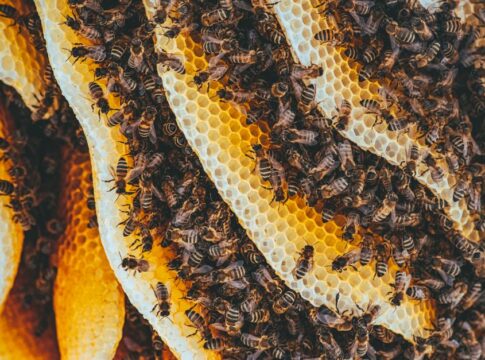
The honeycomb is one of nature’s most elegant architectural achievements. When honeybees make hexagons, they’re not just building storage—they’re solving an ancient mathematical puzzle with remarkable precision. These tiny insects, working without blueprints or rulers, create structures so geometrically perfect that mathematicians and engineers have studied them for centuries. What’s even more amazing? The bees don’t actually build hexagons at all, at least not in the way you might think.
From the physics of beeswax to the collective genius of the hive, the story of honeycomb construction reveals surprising truths about evolution, efficiency, and the hidden mathematics of the natural world.
Key Takeaways
- Honeybees don’t deliberately construct hexagons—the shape emerges naturally from circular cells through heat and surface tension.
- Hexagonal cells use roughly 40% less wax than other shapes while maximizing storage space, making them incredibly efficient.
- Worker bees maintain hive temperatures around 95°F (35°C) to keep wax pliable during construction.
- The hexagon mystery puzzled scientists for over 2,000 years before being mathematically proven in 1999.
- Each cell wall is only about 1/80th of a millimeter thick—thinner than a human hair.
- Bees tilt their cells slightly upward to prevent honey from dripping out before it’s capped.
How Honeybees Make Hexagons: The Construction Process
Worker bees secrete beeswax from special glands on their abdomens. These eight wax-producing glands release tiny flakes of wax, which the bees then chew and mold with their mandibles. The process is metabolically expensive—bees must consume approximately eight pounds of honey to produce just one pound of wax. This high cost makes efficiency crucial.
When construction begins, bees work in teams. They cluster together, generating body heat that warms the wax to about 95°F, the temperature at which beeswax becomes soft and pliable. Multiple bees work simultaneously on adjacent cells, pressing and shaping the wax with their bodies and legs. The hexagonal pattern emerges not from deliberate hexagon-building, but from the physical properties of the wax itself and the way circular cells pack together under heat.
The Mathematical Perfection Behind the Pattern
The honeycomb represents an elegant solution to what mathematicians call the “honeycomb conjecture.” This problem asks: what’s the most efficient way to divide a surface into equal areas with the least total perimeter? Hexagons provide the answer. They tile perfectly with no gaps, unlike circles, and use less perimeter than squares or triangles of equal area.
Ancient scholars, including the Greek mathematician Pappus of Alexandria, observed this efficiency nearly 2,000 years ago. But the honeycomb conjecture wasn’t mathematically proven until 1999, when mathematician Thomas Hales finally demonstrated what bees had been doing instinctively for millions of years. The hexagonal structure allows bees to store the maximum amount of honey and pollen while using the minimum amount of precious wax.
1. Bees Start With Circles, Not Hexagons
Here’s the surprising truth: honeybees don’t set out to build hexagons. When construction begins, each bee creates a roughly circular cell. As multiple bees work side-by-side on adjacent cells, these circles naturally press against each other. The heat generated by the clustered bees keeps the wax soft enough to flow and reshape. Surface tension and the physical pressure from neighboring cells cause the walls to flatten where they meet, automatically forming the characteristic hexagonal pattern. It’s geometry by physics, not by design.
2. The Walls Are Impossibly Thin Yet Incredibly Strong
Each cell wall measures approximately 0.073 millimeters thick—about 1/80th of a millimeter, or roughly 1/350th of an inch. That’s thinner than a typical human hair, which ranges from 0.07 to 0.10 millimeters in diameter. Despite this remarkable thinness, the hexagonal structure distributes weight so efficiently that a single comb can support many times its own weight in honey. The geometry itself provides the strength, allowing bees to minimize material use without sacrificing structural integrity.
3. Temperature Control Is Critical to Construction
Honeybees are master thermodynamicists. During comb construction, worker bees maintain the hive temperature at a precise 95°F (35°C). This isn’t arbitrary—it’s the exact temperature at which beeswax becomes soft and workable without being too fluid. Bees achieve this control through collective behavior, clustering together to generate heat through muscle vibrations or fanning their wings to cool the hive. If temperatures drop too low, the wax becomes brittle and unworkable. Too high, and the comb can melt and collapse.
4. Each Cell Has a Slight Upward Tilt
Look closely at natural honeycomb, and you’ll notice the cells aren’t perfectly horizontal—they tilt upward at an angle of approximately 13 degrees from horizontal. This seemingly minor detail serves a crucial purpose: it prevents uncapped honey from dripping out due to gravity. The slight incline, combined with honey’s viscosity, keeps the liquid gold safely stored until bees seal the cell with a wax cap. This architectural detail demonstrates the sophisticated engineering embedded in honeycomb design.
5. Different Cells Have Different Sizes
Not all hexagons in a hive are created equal. Worker bee cells measure about 5.2 millimeters across, while drone (male bee) cells are larger, measuring roughly 6.2 millimeters. The bees construct these different-sized cells in specific areas of the comb, with worker cells dominating most of the space and drone cells appearing in smaller patches. Queen cells break the pattern entirely—they’re elongated, peanut-shaped structures that hang vertically from the comb. This variation shows that bees can modify their construction techniques based on the intended purpose of each cell.
6. The Three-Dimensional Structure Is Even More Complex
Honeycomb isn’t just a flat pattern of hexagons—it’s a sophisticated three-dimensional structure. Each cell has a base composed of three rhombic (diamond-shaped) plates that meet at a point. These plates are angled at precise 120-degree angles, creating a pyramidal bottom that interlocks with cells on the opposite side of the comb. This back-to-back construction means both sides of the comb share a common wall structure, further minimizing wax usage while maximizing strength and storage capacity.
7. Bees Can Repair Damaged Comb With Remarkable Precision
When honeycomb becomes damaged—whether from predators, weather, or human interference—worker bees quickly mobilize to make repairs. They assess the damage, remove debris, and rebuild missing sections, seamlessly integrating new construction with old. The repaired sections maintain the same hexagonal precision as the original structure. This repair capability demonstrates that the geometric pattern isn’t just a happy accident of initial construction but a maintained feature that bees can reproduce as needed.
8. The Hexagon Pattern Appears in Multiple Bee Species
Honeybees aren’t the only insects to discover the efficiency of hexagons. Several species of social bees and wasps build hexagonal cells, though the materials differ. Paper wasps create hexagonal nests from chewed wood fibers, while bumblebees use wax for their smaller colonies. This convergent evolution—different species independently arriving at the same solution—suggests that hexagonal construction represents a fundamental optimization in nature. The physics and mathematics work the same way regardless of whether the builder is a honeybee in Europe or a wasp in South America.
9. Scientists Use Honeycomb Design in Modern Engineering
Engineers have borrowed the honeycomb’s elegant efficiency for countless applications. Honeycomb-structured materials appear in aircraft wings, where they provide exceptional strength-to-weight ratios. Race car chassis, packaging materials, and even some architectural panels use hexagonal core structures. The aerospace industry particularly values honeycomb panels because they’re incredibly rigid yet remarkably light. What honeybees evolved over millions of years now helps humans build everything from satellites to Formula One cars, proving that nature’s solutions often surpass human ingenuity.
Frequently Asked Questions
Why do honeybees use hexagons instead of other shapes?
Hexagons tile perfectly with no gaps and use less perimeter than squares or triangles of equal area, allowing bees to store maximum honey while using minimum wax. The shape emerges naturally from circular cells pressed together under heat, making it both mathematically optimal and physically inevitable.
How long does it take bees to build honeycomb?
A strong colony can build a substantial amount of comb in just a few days during peak nectar flow, when resources are abundant. The speed depends on colony size, available nectar, and environmental conditions, but motivated bees are remarkably fast builders when conditions are right.
Can bees build comb without a foundation?
Yes, wild honeybees naturally build comb without any human-provided foundation, creating the hexagonal pattern entirely on their own. Beekeepers often provide embossed wax or plastic foundation sheets to guide construction and speed up the process, but it’s not necessary for the bees.
Do all honeycomb cells have exactly six sides?
While the vast majority of cells are perfect hexagons, bees occasionally create irregular cells, particularly in transition zones between worker and drone cells or when repairing damage. These irregular cells still function for storage but demonstrate that bees can adapt their construction when needed.
The next time you see a piece of honeycomb, remember you’re looking at millions of years of evolutionary problem-solving crystallized into wax. Those perfect hexagons weren’t drawn on blueprints or calculated on computers—they emerged from the collective work of thousands of insects following simple rules, creating something far greater than the sum of its parts. Nature, it turns out, was doing advanced mathematics long before humans invented the subject.