
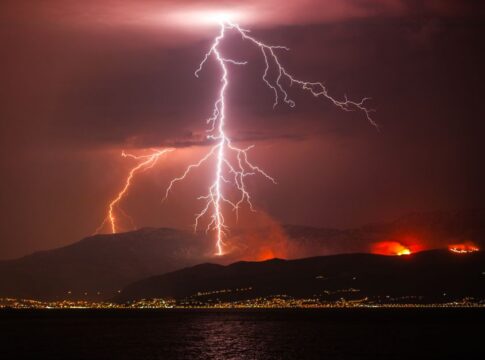
The Secret of Lightning Striking Earth 100 Times per Second
By Trivia Owl, Staff Writer — Published October 21, 2026
Table of Contents
- Key Takeaways
- The Secret Lightning Striking Mechanism: How Nature Creates 100 Strikes Per Second
- Surprising Lightning Trivia That Defies Common Myths
- Types of Lightning: More Than Meets the Eye
- The Science of Lightning Detection and Safety
- Lightning’s Role in Earth’s Nitrogen Cycle
- Frequently Asked Questions
Every single second, roughly 100 lightning bolts strike the surface of our planet. That’s about 8.6 million strikes each day, illuminating the sky and rattling windows across every continent. The secret lightning striking Earth so frequently lies in the constant dance between electrical charges in storm clouds and the ground below—a phenomenon so powerful it can heat the air to temperatures five times hotter than the surface of the Sun. This amazing natural spectacle isn’t random chaos but follows predictable patterns that scientists have only recently begun to fully understand.
Most people witness lightning only a few times each year during local thunderstorms, never realizing that at any given moment, approximately 2,000 thunderstorms are raging somewhere on Earth. This interesting fact transforms lightning from a rare event into one of the planet’s most common atmospheric occurrences, yet one that remains both beautiful and deadly.
Key Takeaways
- Lightning strikes Earth approximately 100 times every second, totaling around 8.6 million strikes daily across the globe.
- A single lightning bolt can reach temperatures of about 30,000 Kelvin (53,540°F), roughly five times hotter than the surface of the Sun.
- About 75% of all lightning never reaches the ground—it occurs within clouds or between clouds.
- The Empire State Building is struck by lightning an average of 23 times per year, making tall structures natural lightning magnets.
- Lightning can travel at speeds up to 220,000 miles per hour during the return stroke, the visible flash we see.
- Contrary to popular belief, lightning can and does strike the same place repeatedly, especially tall or isolated objects.
The Secret Lightning Striking Mechanism: How Nature Creates 100 Strikes Per Second
The process begins inside towering cumulonimbus clouds, where updrafts and downdrafts create a massive separation of electrical charges. Ice particles and water droplets collide within the storm, stripping electrons and creating positive charges near the cloud’s top and negative charges near its base. When the electrical potential difference becomes large enough—typically around 100 million volts—the air’s natural resistance breaks down.
What we call a lightning bolt is actually a multi-step process. A stepped leader—an invisible channel of ionized air—descends from the cloud in a jagged path, seeking the path of least resistance. When it nears the ground, positively charged streamers reach upward from tall objects, trees, and even people. The moment they connect, a massive electrical current rushes upward in what’s called the return stroke. This is the brilliant flash we see, traveling at about one-third the speed of light.
The global lightning frequency of 100 strikes per second isn’t evenly distributed. Central Africa, particularly the Democratic Republic of Congo, experiences the highest lightning density on Earth. Lake Maracaibo in Venezuela holds the record for the most lightning activity in a single location, with storms occurring up to 260 nights per year. These regional hotspots contribute disproportionately to the global total, driven by unique combinations of geography, heat, and moisture.
Surprising Lightning Trivia That Defies Common Myths
The old saying “lightning never strikes the same place twice” ranks among the most persistent weather myths. In reality, lightning preferentially strikes the same locations repeatedly. The reason is simple: the conditions that made a spot attractive to lightning—height, isolation, conductivity—don’t change between strikes. Park rangers at Sequoia National Park have documented individual trees struck dozens of times over the years.
Another common misconception involves personal safety. Rubber-soled shoes and car tires do not protect you from lightning through insulation. A car is safe during a lightning storm because it acts as a Faraday cage—the metal shell conducts the electricity around the outside of the vehicle and into the ground. Standing under a tree, conversely, is one of the most dangerous places to be, as the lightning current can jump from the tree to nearby people through a side flash.
Here’s a curiosity that surprises many: lightning doesn’t always travel downward. Positive lightning, which originates from the top of storm clouds, can strike the ground as far as 10 miles away from the storm itself—a phenomenon called a “bolt from the blue.” These strikes are particularly dangerous because they occur under seemingly clear skies, giving no warning to those below.
Types of Lightning: More Than Meets the Eye
| Lightning Type | Characteristics | Frequency |
|---|---|---|
| Cloud-to-Ground | Most dangerous type; visible strikes from cloud to Earth | ~25% of all lightning |
| Intra-Cloud | Occurs within a single cloud; causes sheet lightning | ~50-60% of all lightning |
| Cloud-to-Cloud | Travels between separate storm systems | ~10-15% of all lightning |
| Positive Lightning | Originates from cloud top; extremely powerful | ~5% of cloud-to-ground strikes |
| Ball Lightning | Rare spherical phenomenon; poorly understood | Extremely rare |
Ball lightning remains one of nature’s most puzzling phenomena. Witnesses describe glowing spheres that float through the air, sometimes passing through windows or walls before dissipating. Despite thousands of reported sightings, scientists have struggled to recreate or study it in laboratory conditions, making it one of the last great mysteries of atmospheric electricity.
The Science of Lightning Detection and Safety
Modern lightning detection networks use a combination of ground-based sensors and satellite technology to track strikes in real time. The National Lightning Detection Network in the United States can pinpoint a strike’s location to within about 500 meters and determine whether it carried a positive or negative charge. This data proves invaluable for weather forecasting, wildfire detection, and power grid management.
The 30-30 rule provides a simple safety guideline: when you see lightning, count the seconds until you hear thunder. If that count is 30 seconds or less, the storm is within six miles and you should seek shelter immediately. After the last lightning flash, wait at least 30 minutes before resuming outdoor activities. This conservative approach accounts for the fact that lightning can strike from storms several miles away.
Indoor safety during thunderstorms requires more than simply being inside. You should avoid:
- Using corded phones (cell phones are safe)
- Taking showers or baths, as plumbing can conduct electricity
- Touching electrical equipment or cords
- Standing near windows, doors, or concrete walls with metal reinforcement
- Leaning against metal appliances like refrigerators or stoves
Lightning’s Role in Earth’s Nitrogen Cycle
Beyond its dramatic appearance, lightning performs an essential ecological function. The intense heat of a lightning bolt—about 30,000 Kelvin—breaks apart nitrogen molecules in the atmosphere. These nitrogen atoms then combine with oxygen to form nitrogen oxides, which rain down to Earth and fertilize soil. Scientists estimate that lightning produces between 2 and 20 million tons of usable nitrogen compounds annually, making it a significant natural fertilizer source that has sustained plant life for millions of years.
This natural fertilization process helped early Earth develop the rich nitrogen cycle that supports all terrestrial life today. Before humans invented industrial nitrogen fixation in the early 20th century, lightning and certain bacteria were the only mechanisms that could convert atmospheric nitrogen into forms plants could absorb.
Frequently Asked Questions
Can lightning really strike the same place twice?
Absolutely. Lightning frequently strikes the same locations multiple times, especially tall or isolated structures. The Empire State Building gets hit about 23 times annually, and some individual trees have been struck dozens of times over their lifetimes.
Why is thunder always after lightning?
Light travels at 186,000 miles per second, while sound travels at only about 767 miles per hour. You see the lightning flash almost instantly, but the sound takes approximately five seconds to travel each mile, creating the delay we experience as thunder following lightning.
What makes lightning bolts zigzag instead of going straight down?
Lightning follows the path of least resistance through the air, which constantly varies due to differences in air density, humidity, and temperature. The stepped leader searches for the easiest route downward, creating the characteristic branching, zigzag pattern we observe.
Is it true that you can be struck by lightning on a clear day?
Yes, through a phenomenon called “bolts from the blue.” Positive lightning can travel horizontally for up to 10 miles from a storm cloud before striking the ground, potentially hitting areas where the sky appears clear and people assume they’re safe.
The next time you watch a thunderstorm from the safety of your home, remember that you’re witnessing just one of 2,000 simultaneous storms painting electrical masterpieces across our planet. Somewhere, right now as you read this, another hundred bolts have just found their way to Earth.