
The Truth About Lightning: Hotter Than the Sun’s Surface
By Trivia Daily, Staff Writer — Published September 1, 2026
Table of Contents
- Key Takeaways
- The Truth About Lightning’s Hotter-Than-the-Sun Temperature
- Comparing Nature’s Extreme Temperatures
- The Electrical Power Behind the Heat
- Lightning Myths and Misconceptions
- Frequently Asked Questions
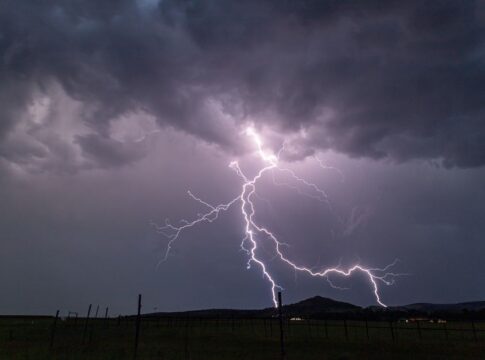
When a bolt of lightning tears through the sky, it creates temperatures that dwarf the heat you’d experience standing on the surface of our own star. This surprising truth about lightning reveals one of nature’s most extreme phenomena: a lightning strike can reach temperatures around 30,000 Kelvin (roughly 53,540 degrees Fahrenheit), while the Sun’s surface hovers at a comparatively cool 5,800 Kelvin. For a fraction of a second, the air channel through which lightning travels becomes five times hotter than the solar surface. It’s an amazing fact that transforms how we understand these electrifying displays.
This incredible heat happens in an instant, lasting only milliseconds, but it’s enough to trigger the explosive expansion of air we hear as thunder. The discovery of lightning’s extreme temperature helps explain why these bolts can split trees, fuse sand into glass, and leave permanent scars on anything they strike.
Key Takeaways
- Lightning strikes reach temperatures around 30,000 Kelvin, approximately five times hotter than the Sun’s surface temperature of 5,800 Kelvin.
- The extreme heat causes air to expand explosively, creating the shock wave we recognize as thunder.
- A typical lightning bolt carries about 15,000 amperes of electrical current and transfers roughly one billion volts.
- Earth experiences approximately 100 lightning strikes every single second, totaling about 8.6 million strikes per day.
- Lightning can create fulgurites—hollow tubes of glass—when it strikes sandy soil, fusing silica particles together instantly.
- The rapid heating and cooling cycle happens so quickly that a lightning channel returns to ambient temperature within microseconds.
The Truth About Lightning’s Hotter-Than-the-Sun Temperature
How does a fleeting atmospheric discharge outpace the nuclear furnace at the heart of our solar system? The answer lies in understanding what we mean by “the Sun’s temperature.” The Sun isn’t uniformly hot throughout. Its core burns at roughly 15 million Kelvin, where nuclear fusion transforms hydrogen into helium. But the visible surface—the photosphere—maintains a temperature of about 5,800 Kelvin.
Lightning’s channel, by contrast, is a narrow conduit of superheated plasma typically only an inch or two wide. When electrons surge through this channel during a strike, they collide violently with air molecules. These collisions transfer kinetic energy into thermal energy at an extraordinary rate. Within microseconds, the air heats to around 30,000 Kelvin.
This temperature doesn’t last. It can’t. The surrounding cooler air acts as a massive heat sink, absorbing the thermal energy almost as quickly as it’s generated. The entire heating and cooling cycle completes in less time than it takes to blink. But for that brief moment, the lightning channel truly outshines the Sun’s surface.
Why Lightning Produces Thunder
The connection between lightning’s heat and the thunder that follows is direct and dramatic. When air molecules heat to 30,000 Kelvin, they expand violently—faster than the speed of sound. This creates a shock wave that propagates outward from the lightning channel. We perceive this shock wave as thunder.
Because light travels much faster than sound, you see the lightning before you hear its accompanying thunder. Counting the seconds between flash and rumble, then dividing by five, gives you the approximate distance to the strike in miles. This simple calculation works because sound travels roughly one mile every five seconds through air at typical temperatures and pressures.
Comparing Nature’s Extreme Temperatures
| Phenomenon | Temperature (Kelvin) | Temperature (Fahrenheit) |
|---|---|---|
| Lightning bolt channel | ~30,000 K | ~53,540°F |
| Sun’s core | ~15,000,000 K | ~27,000,000°F |
| Sun’s surface (photosphere) | ~5,800 K | ~9,980°F |
| Sun’s corona | ~1,000,000 K | ~1,800,000°F |
| Lava from volcano | ~1,200 K | ~1,700°F |
| Candle flame | ~1,800 K | ~2,800°F |
The Electrical Power Behind the Heat
Lightning’s temperature stems from its enormous electrical power. A typical lightning strike carries a current of about 15,000 amperes—roughly a thousand times the current that flows through a household electrical outlet. The voltage can exceed one billion volts as the bolt bridges the gap between cloud and ground.
Yet despite this impressive power, a lightning strike doesn’t carry as much total energy as you might expect. Most of the electrical discharge lasts only a few ten-thousandths of a second. The entire energy content of a typical bolt equals roughly 250 kilowatt-hours—enough to power a 100-watt light bulb for about three months. Capturing and storing this energy remains impractical because of the brief, unpredictable nature of strikes.
Physical Evidence of Lightning’s Heat
The intense temperature of lightning leaves behind tangible proof. When lightning strikes sandy soil or certain rocks, it can create fulgurites—branching, hollow tubes of natural glass. The heat fuses silica particles together in the shape of the lightning’s path through the ground. Some fulgurites extend several feet into the earth, preserving a permanent record of the strike.
Trees struck by lightning often show a spiral pattern of damage along their trunks. The superheated sap and moisture inside the tree expand explosively, blowing bark outward in a characteristic twisting pattern. Metal objects can melt or weld together. Clothing can catch fire. The heat is real, immediate, and devastating.
Lightning Myths and Misconceptions
Many people believe lightning never strikes the same place twice. This is demonstrably false. Tall structures like the Empire State Building receive dozens of strikes annually. Any prominent feature in a landscape—a tree, tower, or building—can be struck repeatedly because it remains the most electrically attractive path to ground.
Another common misconception holds that rubber tires protect you from lightning while in a car. The tires provide no meaningful insulation. Instead, a car’s metal frame creates a Faraday cage effect, channeling the electrical current around the exterior of the vehicle and into the ground. The occupants remain safe inside this protective shell, not because of the rubber below, but because of the metal around them.
Some believe that lightning only occurs during rainstorms. Dry thunderstorms, common in arid regions, produce lightning without significant precipitation reaching the ground. These strikes pose particular danger because they can ignite wildfires in dry vegetation.
Frequently Asked Questions
Is lightning really hotter than the Sun?
Lightning is hotter than the Sun’s visible surface (photosphere) but not hotter than the Sun’s core. A lightning channel reaches about 30,000 Kelvin, while the solar surface maintains roughly 5,800 Kelvin—making lightning about five times hotter than the Sun’s surface.
How long does lightning’s extreme heat last?
The peak temperature of a lightning strike lasts only microseconds to milliseconds. The channel heats and cools so rapidly that the entire thermal cycle completes faster than a human eye can perceive, though the light we see can persist slightly longer due to afterglow effects.
Can lightning create glass from sand?
Yes, when lightning strikes sandy soil, it can create fulgurites—hollow tubes of natural glass formed when the intense heat fuses silica particles together. These structures preserve the branching path of the lightning bolt through the ground and can extend several feet deep.
How many lightning strikes occur on Earth each day?
Scientists estimate that Earth experiences approximately 100 lightning strikes every second, totaling roughly 8.6 million strikes per day or about 3 billion strikes annually. The majority occur over land in tropical regions where thunderstorm activity is most frequent.
The next time you witness a thunderstorm, remember that each brilliant flash briefly outshines our Sun’s surface in sheer temperature. These atmospheric fireworks represent some of the most extreme conditions naturally occurring on our planet, all compressed into channels narrower than your thumb and lasting less time than a heartbeat. Nature rarely demonstrates its raw power more vividly than in these fleeting moments when Earth touches temperatures normally reserved for stellar surfaces.