
The Truth About Medusa Being Based on Ancient Temples
By Trivia Daily, Staff Writer — Published October 30, 2026
Table of Contents
- Key Takeaways
- The Truth Medusa Based on Temple Architecture: Examining the Evidence
- How Temple Art Shaped the Monster’s Image
- The Function of Fear in Sacred Spaces
- Comparing Gorgon Representations Across Time
- Myths, Monsters, and Meaning
- Frequently Asked Questions
The Gorgon Medusa—with her serpentine hair and petrifying gaze—remains one of Greek mythology’s most recognizable monsters. But a surprising theory has captivated scholars and trivia enthusiasts alike: could this legendary creature have been inspired by architectural features found in ancient temples? The truth about Medusa being based on temple designs reveals a fascinating intersection of art, architecture, and storytelling that challenges our understanding of how myths develop. While Medusa’s origins are complex and multifaceted, exploring the architectural connection offers amazing insights into ancient Greek culture.
The theory centers on temple decorations called gorgoneia—carved stone faces of Gorgons that adorned temples, shields, and buildings throughout the ancient Mediterranean world. These weren’t just random monster faces. They served as protective symbols, warding off evil spirits and enemies from sacred spaces. The question that sparks curiosity: did the myth inspire the architecture, or did temple decorations help shape the monster’s evolving image?
Key Takeaways
- Gorgoneion faces (stone Gorgon heads) were common architectural features on Greek temples, serving as protective apotropaic symbols to ward off evil.
- The earliest depictions of Medusa show her with a round face, prominent teeth, and snakes, resembling temple pediment decorations from the 6th century BCE.
- Archaeological evidence suggests the visual representation of Medusa evolved alongside architectural styles, with temple art possibly influencing popular conceptions of the monster.
- The Temple of Artemis on Corfu features one of the oldest surviving stone Gorgon pediments, dating to around 580 BCE.
- Medusa’s transformation from monstrous to beautiful in later art reflects broader shifts in Greek aesthetic values and storytelling traditions.
The Truth Medusa Based on Temple Architecture: Examining the Evidence
Ancient Greek temples weren’t subtle about their protective symbols. Builders placed gorgoneia—large carved faces of Gorgons—prominently on pediments, roof tiles, and friezes. The Temple of Artemis at Corfu preserves one of the most impressive examples: a massive limestone Gorgon measuring over nine feet tall, positioned at the center of the western pediment. Her face is round and fierce, with bulging eyes, a wide mouth revealing prominent teeth, and snakes coiling around her waist and head.
This architectural tradition dates back to at least the 7th century BCE, roughly contemporary with the earliest written accounts of Medusa in Greek literature. The timing raises interesting questions. Did architects draw from existing myths, or did these imposing temple faces help cement visual expectations of what a Gorgon should look like? The answer likely involves both directions of influence—a cultural feedback loop between storytelling and stone carving.
What makes this connection particularly intriguing is the function of these architectural elements. Gorgoneia served as apotropaic devices—protective charms meant to frighten away evil forces through their terrifying appearance. The word “apotropaic” comes from the Greek “apotrepein,” meaning “to turn away.” Just as Medusa’s gaze could turn enemies to stone in myth, her image on temples was believed to petrify evil intentions before they could harm sacred spaces.
How Temple Art Shaped the Monster’s Image
Early artistic representations of Medusa show remarkable consistency with architectural gorgoneia. She appears with a frontal face—unusual in Greek art, which typically showed profiles—broad features, protruding tongue, and prominent teeth. Snakes writhe from her head or wrap around her body. These characteristics appear across multiple media: pottery, sculpture, coins, and temple decorations.
The frontal face deserves special attention. Most figures in Greek art were shown in profile, which was easier to carve and paint. The direct, confrontational stare of the Gorgon was distinctive and deliberate. It created visual impact on temple pediments, where the face could dominate the triangular space and catch the eye of anyone approaching. This same frontal orientation appears in vase paintings and other depictions of Medusa, suggesting architectural conventions influenced artistic traditions more broadly.
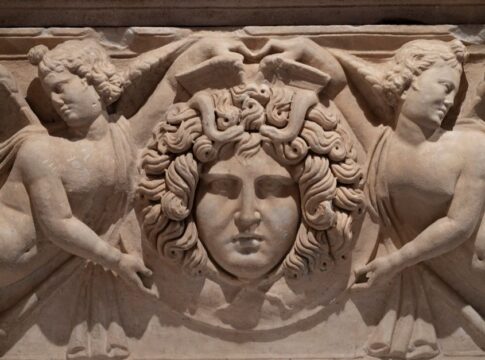
Over centuries, Medusa’s appearance evolved dramatically. By the Hellenistic period (323-31 BCE), she transformed from monstrous to beautiful—a shift reflected in both free-standing sculpture and architectural decoration. This evolution tracked broader changes in Greek aesthetics, which increasingly valued idealized beauty even in depicting dangerous or supernatural beings.
The Function of Fear in Sacred Spaces
Understanding why temples featured such frightening imagery requires examining ancient Greek religious practices. Temples weren’t community gathering spaces like modern churches. They were houses for divine statues, accessed primarily by priests. The exterior decorations communicated messages to everyone who passed by.
Protective symbols were essential. Greeks believed in the evil eye—the power of jealous or malicious gazes to cause harm. A Gorgon’s face, with its own powerful gaze, could deflect such threats. The logic was sympathetic magic: fight scary with scary. Place a terrifying face on your temple, and malevolent forces would think twice before approaching.
This practical function may have reinforced Medusa’s mythological role. In the most famous story, the hero Perseus uses Medusa’s severed head as a weapon, turning enemies to stone by showing them her face. The goddess Athena then places the head on her aegis (a protective garment or shield). The myth mirrors the architectural practice: a frightening face becomes a protective device.
Comparing Gorgon Representations Across Time
| Period | Appearance | Common Features | Primary Context |
|---|---|---|---|
| Archaic (7th-6th century BCE) | Monstrous, round face | Bulging eyes, protruding tongue, prominent teeth, beard-like snakes | Temple pediments, shields, pottery |
| Classical (5th-4th century BCE) | Transitional, less grotesque | Still fierce but more humanized features, snakes in hair | Sculpture, coins, architectural metopes |
| Hellenistic (3rd-1st century BCE) | Beautiful but dangerous | Idealized feminine beauty, serpents as hair ornament | Free-standing sculpture, decorative art |
| Roman | Tragic beauty | Sorrowful expression, elegant features, minimal monstrosity | Mosaics, cameos, decorative sculpture |
Myths, Monsters, and Meaning
The relationship between Medusa and temple architecture illustrates how myths develop through cultural interaction. Stories don’t emerge fully formed. They evolve through retelling, influenced by visual art, religious practices, and social needs. Temple decorations both reflected and shaped popular understanding of mythological figures.
Some scholars argue that gorgoneia may have even older origins, possibly connected to ancient Near Eastern protective demons or Egyptian deities. The Greeks were enthusiastic cultural borrowers, adapting and transforming ideas from civilizations they encountered through trade and colonization. A frightening protective face was a concept with broad appeal across Mediterranean cultures.
What remains certain is that by the 6th century BCE, Medusa and architectural gorgoneia were firmly intertwined in Greek visual culture. Whether the myth inspired the architecture or vice versa becomes less important than recognizing their mutual reinforcement. Each medium—stone carving and oral storytelling—strengthened the other, creating a powerful cultural symbol that has endured for millennia.
Frequently Asked Questions
Was Medusa a real person in ancient history?
No, Medusa was a mythological figure, not a historical person. She appears in Greek myths as one of three Gorgon sisters, the only mortal one, who was slain by the hero Perseus.
Why did Greek temples have scary faces on them?
Gorgon faces and other frightening imagery served as apotropaic symbols—protective charms believed to ward off evil spirits, the evil eye, and malicious forces from sacred spaces. The terrifying appearance was meant to scare away threats.
When did Medusa change from ugly to beautiful in art?
The transformation occurred gradually during the Classical period (5th-4th century BCE) and became pronounced in Hellenistic art (3rd-1st century BCE), reflecting changing Greek aesthetic values that favored idealized beauty even for dangerous figures.
What is the oldest known image of a Gorgon?
Among the oldest surviving large-scale Gorgon images is the limestone pediment from the Temple of Artemis at Corfu, dating to approximately 580 BCE, though smaller Gorgon images on pottery and metalwork appear even earlier in the 7th century BCE.
The stone Gorgons that once glared from ancient temple pediments have weathered into museum pieces, but their cultural power persists. Every time we encounter Medusa in modern retellings, we’re seeing echoes of those protective faces that guarded sacred Greek spaces—a reminder that our monsters often begin as guardians, and our myths are carved as much in stone as they are told in words.