
Medusa Myth: What Ancient Greeks Really Feared
By TriviaOwl, Staff Writer — Published August 13, 2026
Table of Contents
- Key Takeaways
- The Medusa Myth Ancient Greeks Actually Told
- What the Petrifying Gaze Really Represented
- The Aftermath: A Severed Head That Kept Its Power
- Comparing Medusa Across Greek Sources
- Hidden Fears in the Myth
- Frequently Asked Questions
The medusa myth ancient Greeks told around their fires wasn’t just a monster story. It was a mirror reflecting deep anxieties about power, gender, and the gaze itself. While most people know Medusa as the snake-haired woman who turned onlookers to stone, the original myth carries layers of meaning that ancient audiences understood instinctively. This fascinating tale reveals surprising truths about what terrified one of history’s most influential civilizations.
Medusa wasn’t always a monster. Discover how this transformation story became one of mythology’s most enduring symbols, and explore the amazing facts behind a figure who still captivates our curiosity today.
Key Takeaways
- Medusa was the only mortal among three Gorgon sisters, making her uniquely vulnerable to Perseus despite her terrifying powers.
- Earlier Greek traditions depicted Gorgons as protective symbols on shields and temples, not purely evil creatures.
- The myth encoded ancient Greek fears about female power, divine punishment, and the dangerous act of looking where one shouldn’t.
- Medusa’s severed head retained its petrifying power even after death, becoming a weapon for both Perseus and Athena.
- The story reflects real anxieties about vision and vulnerability that resonated deeply in ancient Greek culture.
- Modern interpretations have reclaimed Medusa as a symbol of survival and feminine rage against violation.
The Medusa Myth Ancient Greeks Actually Told
Most retellings begin with Medusa as a monster, but the complete narrative is more complex. According to later Roman poet Ovid’s version, Medusa was once a beautiful maiden who served as a priestess in Athena’s temple. The sea god Poseidon violated her in that sacred space. Rather than punishing Poseidon, Athena transformed Medusa into a creature so hideous that anyone who looked directly at her turned to stone.
This version raises uncomfortable questions about divine justice. Why punish the victim? Ancient audiences might have understood this as Athena protecting Medusa by making her dangerous, though modern readers often see it differently. The transformation gave Medusa power, however terrible. No one could harm her without facing petrification.
Medusa lived in exile with her immortal sisters, Stheno and Euryale, at the edge of the known world. All three had brass hands, golden wings, and serpents for hair. But only Medusa could die. This detail matters. The hero Perseus could only succeed because one Gorgon was mortal. He used Athena’s polished shield as a mirror, approaching Medusa while she slept and severing her head without meeting her gaze directly.
What the Petrifying Gaze Really Represented
The Greeks were obsessed with looking and being looked at. Their culture valued public life, rhetoric, and visible achievement. To be turned to stone by a gaze was to lose everything that made someone human in Greek society—movement, speech, action.
Stone in Greek thought represented permanence but also death. Statues honored the dead or commemorated heroes frozen in idealized moments. Medusa’s power inverted this: she created unwilling monuments, trapping victims in their final moment of terror. The myth warned against forbidden sight. Some knowledge was too dangerous to witness directly.
Interestingly, Medusa imagery appeared on Greek shields, temple pediments, and even ovens. The apotropaic (evil-averting) use of her face suggests Greeks believed the Gorgon could protect as well as destroy. Her image scared away threats. This dual nature—protective and deadly—makes Medusa more nuanced than a simple villain.
The Aftermath: A Severed Head That Kept Its Power
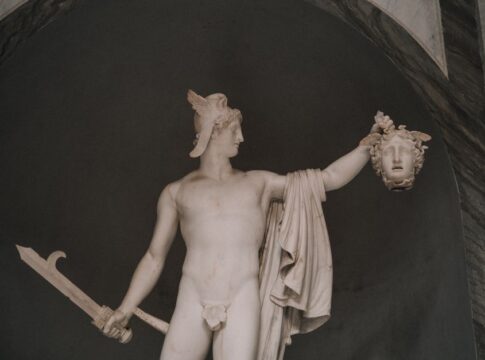
Death didn’t end Medusa’s story. Perseus carried her head in a special bag, using it as a weapon. When the sea monster Cetus threatened Andromeda, Perseus revealed Medusa’s face and turned the creature to stone. Later, he used it against his enemies at King Polydectes’ court, petrifying them all.
Eventually, Perseus gave the head to Athena, who mounted it on her aegis—the divine shield or breastplate. This made Athena even more fearsome in battle. The goddess who transformed Medusa now wore her face as armor. From Medusa’s blood, according to myth, sprang both the winged horse Pegasus and the giant Chrysaor. Even in death, she generated new mythic life.
This persistent power after decapitation fascinated ancient audiences. It suggested that some forces, once unleashed, can never be fully contained or destroyed. The head became a talisman, a reminder that danger could be harnessed and redirected.
Comparing Medusa Across Greek Sources
| Source Period | Medusa’s Origin | Moral Focus |
|---|---|---|
| Archaic Greek (8th-6th century BCE) | Born monstrous; Gorgon sister | Heroic achievement through cleverness |
| Classical Greek (5th-4th century BCE) | Primarily protective symbol | Apotropaic magic; warding evil |
| Roman (Ovid, 1st century CE) | Beautiful woman transformed | Divine punishment; tragic victim |
Hidden Fears in the Myth
What did ancient Greeks really fear when they told Medusa’s story? Several anxieties intertwine:
- Female autonomy: A woman who could destroy men with her gaze represented power outside male control.
- Sexual violation: The Ovid version acknowledges rape but displaces consequences onto the victim, reflecting uncomfortable social realities.
- Divine capriciousness: Gods punished mortals for divine crimes, reminding Greeks of their vulnerability to forces beyond understanding.
- The limits of heroism: Even Perseus needed divine help—Athena’s shield, Hades’ cap of invisibility, Hermes’ winged sandals—to succeed.
- Mortality itself: Medusa died because she was mortal, unlike her sisters, highlighting the fragility of human existence.
These themes made the myth endlessly retellable. Each generation found new meanings in the snake-haired figure whose glance meant death.
Frequently Asked Questions
Was Medusa always depicted as evil in Greek mythology?
No. Early Greek art often showed Gorgons as protective figures on shields and temples, warding off evil rather than embodying it. The purely villainous interpretation developed gradually, particularly through later heroic narratives focused on Perseus.
Why could Perseus kill Medusa but not her immortal sisters?
Medusa was the only mortal Gorgon among the three sisters. Greek myths often featured this pattern—one vulnerable member in an otherwise invincible group—to make heroic victory possible while maintaining the threat’s supernatural power.
What happened to people who looked at Medusa’s reflection?
According to the myth, viewing Medusa indirectly through a reflection, like Perseus did with his polished shield, allowed someone to see her without being petrified. Only direct eye contact triggered the transformation to stone.
Did ancient Greeks believe Medusa was a real creature?
Greeks understood myths as meaningful stories rather than literal history. Medusa existed in their cultural imagination as a symbol and cautionary tale, much like modern audiences understand fictional characters as “real” within their narrative worlds without believing they walked the earth.
The medusa myth endures because it touches something primal: the fear of being seen, the power of the gaze, and the tragedy of transformation. What ancient Greeks feared in Medusa’s story still resonates—the vulnerability of being looked at, judged, and frozen in someone else’s perception. Perhaps that’s the most petrifying power of all.