
Medusa Origins: The Real Story Behind the Snake-Haired Gorgon
By TriviaOwl, Staff Writer — Published August 18, 2026
Table of Contents
- Key Takeaways
- Medusa Origins Real History: From Beauty to Beast
- The Gorgon Sisters: Why Medusa Stood Apart
- The Perseus Quest: Divine Tools and Clever Strategy
- Comparing the Gorgon Sisters
- The Gorgoneion: Ancient Protective Symbol
- Cultural Symbolism: What Medusa Represented
- Frequently Asked Questions
The image is unforgettable: a woman whose hair writhes with venomous serpents, whose gaze turns living flesh to stone. Medusa remains one of Greek mythology’s most recognizable monsters, yet the Medusa origins real story reveals surprising layers that most people never discover. Far from being born a monster, this Gorgon’s tale intertwines tragedy, divine punishment, and ancient Greek anxieties about female power. What you think you know about Medusa may only scratch the surface of a myth that has evolved dramatically over thousands of years.
The earliest versions of her story differ radically from later Roman interpretations. These fascinating facts about Medusa’s transformation from beautiful maiden to cursed creature reveal how myths adapt to reflect the values—and fears—of the cultures that tell them.
Key Takeaways
- Medusa was originally one of three Gorgon sisters, but she alone was mortal while her siblings Stheno and Euryale were immortal.
- In early Greek sources, Medusa was born monstrous; the tragic backstory of her transformation appeared centuries later in Roman poet Ovid’s work.
- The hero Perseus killed Medusa by using his polished shield as a mirror to avoid her petrifying gaze.
- From Medusa’s severed neck sprang two offspring: the winged horse Pegasus and the warrior Chrysaor, both fathered by the god Poseidon.
- Ancient Greeks used images of Medusa’s head, called a Gorgoneion, as protective amulets on shields, buildings, and jewelry.
- The myth likely originated from real anxieties about female sexuality and the dangerous power attributed to the “evil eye” in Mediterranean cultures.
Medusa Origins Real History: From Beauty to Beast
The transformation narrative most people recognize comes from Ovid’s Metamorphoses, written around 8 CE. According to this Roman account, Medusa began life as a stunning maiden renowned for her beautiful hair. She served as a priestess in Athena’s temple, bound by vows of chastity. When Poseidon, god of the sea, assaulted her within the sacred temple walls, the virgin goddess Athena punished not the perpetrator but the victim. She transformed Medusa’s lovely locks into hissing serpents and cursed her with a gaze that petrified anyone who looked directly at her.
But here’s the interesting twist: this sympathetic origin story doesn’t appear in earlier Greek sources. Hesiod’s Theogony, composed around 700 BCE, describes Medusa and her sisters as primordial monsters born to the ancient sea deities Phorcys and Ceto. No transformation. No tragedy. Just three terrifying Gorgons dwelling at the edge of the known world, beyond the realm of mortals. Medusa was always monstrous in this version—a creature of chaos representing forces that civilization needed to overcome.
The evolution from born-monster to cursed-maiden reflects changing cultural attitudes. Ovid’s Roman retelling added psychological depth and moral complexity absent from earlier Greek accounts. It transformed a simple monster-slaying tale into a meditation on injustice, divine cruelty, and the vulnerability of mortals caught between competing gods.
The Gorgon Sisters: Why Medusa Stood Apart
Medusa wasn’t alone in her monstrosity. She shared her serpentine features with two sisters, Stheno and Euryale. All three possessed bronze hands, golden wings, and tusks like boars. Their eyes blazed with power. Their appearance was so hideous that mortals turned to stone at the sight.
Yet one crucial difference separated Medusa from her siblings: mortality. While Stheno and Euryale lived forever, Medusa could die. This vulnerability made her the target when the hero Perseus needed a Gorgon’s head. The ancient sources never fully explain why one sister was mortal while the others weren’t, but this distinction drives the entire myth forward. Without Medusa’s mortality, there would be no quest, no decapitation, no protective talisman for Perseus to wield.
After Perseus killed Medusa, her immortal sisters pursued him relentlessly, shrieking in rage. But he escaped using Hades’ cap of invisibility, one of several magical tools the gods provided for his quest.
The Perseus Quest: Divine Tools and Clever Strategy
Perseus didn’t face Medusa through strength alone. The gods equipped him with supernatural gear that made the impossible achievable. Athena lent him her polished bronze shield. Hermes provided winged sandals for flight and a curved sword sharp enough to slice through Medusa’s neck. Hades contributed the helmet of invisibility. Some versions mention a special bag to safely carry the severed head.
The strategy was brilliant in its simplicity. Perseus approached the sleeping Gorgons but never looked directly at Medusa. Instead, he watched her reflection in his shield’s mirror-bright surface, navigating by the image alone. One swift strike separated her head from her body. At that moment of death, two beings sprang fully formed from her neck: Pegasus, the divine winged horse, and Chrysaor, a warrior born holding a golden sword. Both were Poseidon’s offspring, conceived before Medusa’s transformation.
Even severed from her body, Medusa’s head retained its petrifying power. Perseus wielded it as a weapon, turning enemies to stone throughout his adventures before finally presenting it to Athena, who mounted it on her aegis—her protective breastplate or shield.
Comparing the Gorgon Sisters
| Attribute | Medusa | Stheno | Euryale |
|---|---|---|---|
| Mortality | Mortal (could be killed) | Immortal | Immortal |
| Transformation Story | Cursed by Athena (Ovid’s version) | Born as Gorgon | Born as Gorgon |
| Offspring | Pegasus and Chrysaor | None recorded | None recorded |
| Fame | Most famous; killed by Perseus | Lesser known | Lesser known |
| Name Meaning | “Guardian” or “protectress” | “Strength” or “mighty” | “Wide-roaming” |
The Gorgoneion: Ancient Protective Symbol
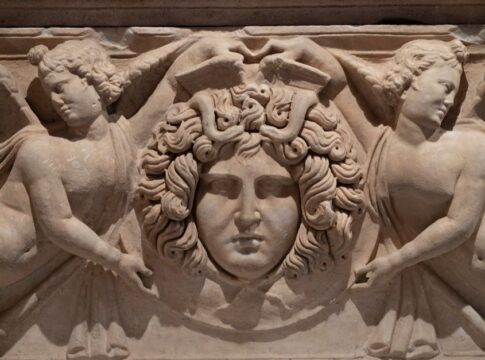
Ancient Greeks didn’t just tell stories about Medusa—they used her image as powerful protection. The Gorgoneion, a depiction of Medusa’s head, appeared everywhere in the classical world. Soldiers painted it on shields. Architects carved it above doorways and on temple pediments. Craftsmen fashioned it into jewelry and amulets.
The logic was straightforward: if Medusa’s gaze could petrify enemies, her image might ward off evil. This apotropaic function—using a frightening image to repel harm—was common in Mediterranean cultures. The “evil eye” belief held that envious or malicious gazes could cause misfortune, and an even more terrifying countenance could deflect such curses.
Archaeologists have discovered Gorgoneia dating back to the sixth century BCE. The images evolved over time. Archaic versions showed Medusa with a wide, grotesque face, protruding tongue, and wild hair mixed with serpents. By the Classical period, depictions became more beautiful, emphasizing her tragic nature rather than pure monstrosity. This artistic shift mirrors the narrative evolution from born-monster to cursed-maiden.
Cultural Symbolism: What Medusa Represented
Scholars have long debated what Medusa symbolized to ancient Greeks. Several interpretations coexist. She may represent the dangerous aspect of female sexuality—beautiful yet deadly, alluring yet forbidden. Her placement on Athena’s aegis suggests she embodies the protective, fierce aspect of femininity that guards sacred spaces.
Some researchers connect Medusa to ancient anxieties about the female gaze itself. In patriarchal Greek society, women who looked too boldly or spoke too freely challenged social order. Medusa’s petrifying stare could symbolize male fears of female power and autonomy. Her punishment for being violated in Athena’s temple—in Ovid’s version—reflects victim-blaming attitudes that persist across cultures and centuries.
The myth also explores the hero’s journey and civilization’s triumph over chaos. Perseus represents order, rationality, and divine favor conquering primordial monstrosity. Yet even in death, Medusa serves Athena, goddess of wisdom and warfare. Her severed head continues protecting the righteous and punishing the wicked.
Frequently Asked Questions
Was Medusa always depicted with snakes for hair?
Yes, serpentine hair is Medusa’s defining characteristic across all versions of the myth, from the earliest Greek sources through Roman adaptations. The snakes symbolized her monstrous nature and connection to chthonic (underworld) powers.
Could Medusa turn herself to stone by looking in a mirror?
Ancient sources don’t address this logical puzzle directly, but the myth implies her power affected others, not herself. Perseus used his shield as a mirror safely, suggesting the reflection didn’t carry the petrifying curse—only direct eye contact with the living Medusa proved deadly.
Why did Athena put Medusa’s head on her shield?
Athena mounted the Gorgon’s head on her aegis to harness its protective power. The image served both as a weapon against enemies and as an apotropaic symbol to ward off evil, combining Medusa’s petrifying ability with Athena’s divine authority.
Are there any modern descendants of the Medusa myth?
The Medusa archetype appears throughout Western art, literature, and popular culture, from Renaissance sculptures to contemporary films and comics. Her image remains a symbol of female rage, victimization transformed into power, and the complexity of feminine archetypes in mythology.
The real story behind Medusa reveals how myths breathe and change, reflecting the societies that retell them. Whether born monstrous or cursed into monstrosity, this snake-haired Gorgon continues to fascinate precisely because her tale asks uncomfortable questions about power, punishment, and whose story gets told. Every generation reimagines Medusa, finding new meanings in those serpentine locks and that deadly gaze.