
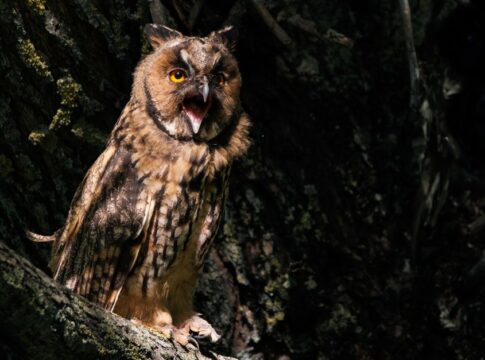
The Hidden Reason Owls Fly Silently Through the Night
By Trivia Daily, Animals Desk — Published October 10, 2026
Table of Contents
- Key Takeaways
- The Hidden Reason Owls Evolved Whisper-Quiet Wings
- How Silent Flight Transforms Owl Hunting Behavior
- Comparing Silent Flyers: Owls vs Other Night Hunters
- The Science Behind Feather Engineering
- Silent Wings Across Owl Species
- Frequently Asked Questions
When an owl swoops down on unsuspecting prey in the darkness, its victim hears nothing until it’s too late. This near-total silence isn’t luck or magic—it’s the result of extraordinary evolutionary engineering. The hidden reason owls can fly without making a sound lies in three specialized feather adaptations that work together to muffle the turbulent air that normally creates noise during flight. While most birds announce their presence with audible wingbeats, these nocturnal hunters have perfected stealth flight over millions of years, turning their wings into nature’s most effective silencers.
This remarkable ability gives owls a decisive advantage in the animal kingdom. Silent flight allows these creatures to hunt with deadly precision while also helping them hear the faint rustles of mice and voles moving through grass or snow. Understanding how owls achieve this feat reveals one of wildlife’s most elegant solutions to the challenges of nocturnal predation.
Key Takeaways
- Owls possess three unique feather adaptations—serrated leading edges, velvety surfaces, and fringed trailing edges—that eliminate flight noise.
- The serrated comb-like structure on the leading edge of wing feathers breaks up turbulent air before it can create sound.
- Not all owl species fly silently; fish-eating owls that hunt in water lack these adaptations since prey can’t hear them approaching.
- Silent flight evolved primarily to enhance hunting success, but it also allows owls to hear prey more clearly during flight.
- Barn owls can fly at speeds up to 10 miles per hour while remaining completely inaudible to human ears from just a few feet away.
- Scientists study owl feathers to develop quieter aircraft, wind turbines, and drone technology.
The Hidden Reason Owls Evolved Whisper-Quiet Wings
Flight normally produces sound through turbulence. As air flows over and under a bird’s wings, it creates swirling vortices that generate noise—the familiar whoosh of pigeons taking off or the rhythmic beating of a crow’s wings. For most birds, this noise poses no problem. But for owls, sound would be catastrophic. These predators hunt primarily by listening for tiny movements in complete darkness, and they target prey with exceptional hearing. A noisy approach would alert their quarry and ruin the element of surprise.
Evolution solved this problem through three distinct feather modifications. The leading edge of an owl’s primary flight feathers features a stiff, comb-like fringe of barbs. This serrated structure acts like the teeth of a saw, breaking up the smooth flow of air into smaller, less turbulent streams. Think of it as splitting one large, noisy wave into dozens of quieter ripples.
The second adaptation covers the wing’s surface. Owl feathers possess a soft, velvety texture created by specialized down-like extensions. This fuzzy coating dampens any remaining sound vibrations, much like acoustic foam in a recording studio absorbs unwanted noise. The texture also reduces friction as air passes over the wing.
The trailing edge completes the system with a flexible, fringed border. These loose barbs create a gradual transition between the wing and the air behind it, preventing the sharp turbulence that occurs when fast-moving air suddenly meets still air. Together, these three features reduce flight noise by as much as 18 decibels compared to similar-sized birds—a dramatic difference in the animal world.
How Silent Flight Transforms Owl Hunting Behavior
The impact of silent flight extends beyond simple stealth. Because owls make no noise during flight, they can rely entirely on their hearing to track prey, even while airborne. A barn owl can detect a mouse moving under snow from 75 feet away, processing minute sound differences between its left and right ears to pinpoint location with remarkable accuracy. If the owl’s own wings created noise, this acoustic hunting would be impossible.
This adaptation shapes owl behavior and habitat preferences. Most silent-flying owl species hunt in open grasslands, forests, and fields where small mammals move through vegetation. The combination of silent approach and acute hearing creates a nearly unbeatable hunting strategy. Prey animals have evolved exceptional vigilance as a counter-measure, but against a silent predator in darkness, even the wariest mouse has limited defense.
Interestingly, not all owls fly silently. Fish owls and fishing owls that hunt in rivers and coastal waters lack the specialized feather adaptations. Their prey lives underwater and cannot hear them approaching, so evolution didn’t favor silent flight in these species. This variation demonstrates that the trait evolved specifically for hunting terrestrial prey with good hearing.
Comparing Silent Flyers: Owls vs Other Night Hunters
| Species | Flight Noise Level | Primary Hunting Method | Special Adaptations |
|---|---|---|---|
| Barn Owl | Nearly inaudible | Acoustic hunting | Serrated feathers, velvety surface |
| Great Horned Owl | Very quiet | Combined vision and hearing | Silent flight feathers |
| Nighthawk | Moderate | Aerial insect catching | Agile flight, wide mouth |
| Bat | Quiet wing membrane | Echolocation | Flexible wing membrane |
The Science Behind Feather Engineering
Researchers have studied owl feathers extensively, both to understand the natural phenomenon and to apply the principles to human technology. Wind tunnel experiments reveal that the serrated leading edge reduces noise most effectively at the specific frequencies owls use for hunting. The adaptation isn’t a general noise reducer—it’s precisely tuned to eliminate the sounds that would interfere with detecting prey.
The velvety surface structure consists of elongated barbs with soft, hair-like extensions called barbules. Under microscopic examination, these create a dense, irregular surface that disrupts sound waves. The randomness matters: a perfectly regular pattern would create its own acoustic signature, but the natural variation in owl feather texture scatters sound in all directions, effectively canceling it out.
Engineers now apply these principles to design quieter aircraft, drones, and wind turbines. By mimicking the serrated edge on airplane wings or turbine blades, designers can reduce operational noise without sacrificing performance. Owl-inspired modifications have appeared in Japanese bullet trains, where noise reduction matters for urban routes, and in experimental aircraft designs where stealth provides tactical advantages.
Silent Wings Across Owl Species
The degree of silent flight varies among owl species based on their specific hunting needs and habitats. Small owls like the Northern Saw-whet Owl possess extremely quiet flight suited to hunting in dense forests where maneuverability matters as much as stealth. Larger species like the Great Gray Owl combine silent flight with powerful wings capable of breaking through snow crust to reach prey tunneling below.
Some owl species have traded complete silence for other advantages. Snowy owls, which hunt in Arctic tundra where prey is scarce and visibility is good, produce slightly more flight noise than forest owls. Their white plumage and diurnal hunting habits suggest they rely more on visual stealth and speed than acoustic invisibility. Still, even these owls fly more quietly than most birds of comparable size.
Frequently Asked Questions
Do all owls fly completely silently?
Most owls fly nearly silently, but not all. Species that hunt terrestrial prey with good hearing have the most developed silent flight adaptations, while fish-eating owls produce more noise since their aquatic prey cannot hear them approaching.
Can humans hear owls flying at all?
Humans typically cannot hear owls flying unless they pass very close—within a few feet. Even then, the sound is a faint whisper rather than the distinct whoosh produced by other birds of similar size.
How fast can owls fly while staying silent?
Most owls maintain silent flight at their typical hunting speeds of 5 to 10 miles per hour. Faster flight generates more turbulence, which eventually overcomes the noise-dampening feather adaptations, but owls rarely need high-speed flight for successful hunting.
Are owl feathers used in human technology?
Yes, engineers study and mimic owl feather structures to design quieter aircraft wings, wind turbine blades, and drones. The serrated leading edge design has been adapted for various applications where noise reduction matters without sacrificing aerodynamic performance.
Next time you walk through the woods at dusk, remember that owls may be gliding overhead completely unheard. These creatures have spent millions of years perfecting an adaptation so effective that modern engineers still struggle to replicate it. Nature’s solutions often surpass our best technology—and in the case of silent flight, the gap remains as wide as the owl’s wingspan.