
9 Surprising Facts About Phoenix Rebirth in World Myths
By Trivia Daily, Staff Writer — Published September 22, 2026
Table of Contents
- Key Takeaways
- The Egyptian Bennu Bird Started It All
- Phoenix Rebirth World Traditions Show Striking Differences
- Comparing Phoenix Traditions Across Cultures
- Why the Phoenix Myth Endures
- Frequently Asked Questions
The phoenix rises from its own ashes in one of humanity’s most enduring symbols of renewal. But this famous firebird appears in far more cultures than most people realize, and the details of phoenix rebirth world traditions vary dramatically from one civilization to another. Some versions involve fragrant spices and self-immolation, while others describe egg-laying and celestial music. These surprising facts reveal how different societies imagined immortality, transformation, and the eternal cycle of death and rebirth.
The phoenix isn’t just one creature with one story. It’s a constellation of related myths that spans continents and millennia, each culture adding its own fascinating details to the legend of the undying bird.
Key Takeaways
- The phoenix myth originated in ancient Egypt with the Bennu bird, associated with the sun god Ra and the cycle of the Nile’s flooding.
- Chinese mythology features the Fenghuang, often mistranslated as “phoenix,” which represents harmony rather than rebirth through fire.
- Ancient Greek writers claimed the phoenix lived for 500 years, while some Roman accounts extended its lifespan to 1,461 years.
- The Arabian phoenix was said to build its nest from cinnamon, frankincense, and other aromatic materials before self-combusting.
- Early Christian writers adopted the phoenix as a symbol of resurrection, linking it to Christ’s return from death.
- The phoenix appears in Jewish folklore as the Milcham, the only animal in the Garden of Eden that refused to eat the forbidden fruit.
The Egyptian Bennu Bird Started It All
The phoenix story begins in ancient Egypt with the Bennu bird, a heron-like creature associated with creation and the sun. The Bennu was linked to the god Ra and represented the soul of Osiris. Egyptian texts describe it as a self-created being that arose from flames on the sacred willow tree in the temple of Ra at Heliopolis. Unlike later phoenix versions, the Bennu didn’t die in fire every few centuries. Instead, it symbolized the daily rebirth of the sun and the annual flooding of the Nile River, which brought life-giving silt to Egyptian farmlands. Greek historians visiting Egypt heard these stories and transformed them into the phoenix myth that spread throughout the Mediterranean world.
Phoenix Rebirth World Traditions Show Striking Differences
1. The Greek Phoenix Chose Its Own Death
Greek historian Herodotus described the phoenix as a bird from Arabia with red and gold plumage. According to his account, when the phoenix felt death approaching, it built a nest of aromatic branches and spices, then ignited itself through the heat of the sun or by fanning its wings. The new phoenix emerged from the ashes, gathered the remains of its predecessor, and carried them to Heliopolis in Egypt to deposit them at the temple of the sun. This voluntary self-sacrifice distinguished the Greek version from accidental death and rebirth. The Greeks calculated the bird’s lifespan at 500 years, though Pliny the Elder later suggested different intervals.
2. Roman Writers Extended the Phoenix Lifespan Dramatically
Roman natural historians couldn’t agree on how long the phoenix lived between rebirths. Pliny the Elder mentioned the traditional 500-year cycle, but also referenced a calculation based on the “Great Year” of the planets aligning, which yielded 1,461 years. The Roman poet Ovid described the phoenix in his Metamorphoses as a creature that renewed itself without any parent, living on frankincense and aromatic gums rather than ordinary food. These Roman elaborations added layers of astronomical and mathematical precision to what had been a simpler Egyptian myth about solar renewal.
3. The Chinese Fenghuang Represents Harmony, Not Fire
Western translators often call the Chinese Fenghuang a “phoenix,” but this magnificent bird has little in common with its Mediterranean counterpart. The Fenghuang doesn’t die in flames or rise from ashes. Instead, it appears during times of peace and prosperity, symbolizing the union of yin and yang. The Feng represents the male principle and the Huang the female, together forming a complete whole. This mythical bird has the head of a golden pheasant, the body of a mandarin duck, the tail of a peacock, the legs of a crane, the mouth of a parrot, and the wings of a swallow. It appears only when a virtuous ruler governs with wisdom and justice.
4. Arabian Legends Featured Aromatic Nest Building
Arabian versions of the phoenix myth emphasized the fragrant materials used in the bird’s final nest. The phoenix gathered cinnamon bark, spikenard, myrrh, and other precious aromatics to construct its funeral pyre. When the bird ignited itself, these spices created a perfumed smoke that rose to heaven. From the ashes and the aromatic residue, a small worm appeared, which grew into the new phoenix over the course of three days. This detail about the worm-like intermediate stage appears in several medieval European accounts that drew on Arabian sources, adding a metamorphosis element similar to butterfly transformation.
5. Jewish Folklore Made the Phoenix Immortal by Virtue
In Jewish legend, the phoenix earned its immortality through moral choice. According to the Midrash, when Eve ate the forbidden fruit in the Garden of Eden, she convinced Adam and all the animals to eat it as well. Only one bird, called the Milcham or Chol, refused to disobey God’s command. As a reward for its righteousness, God granted this bird eternal life through cycles of rebirth. Every thousand years, the Milcham’s body burns away, leaving only an egg from which the bird is reborn. This version transforms the phoenix from a natural phenomenon into a moral exemplar, rewarded for choosing obedience over temptation.
6. Early Christians Adopted the Phoenix as Resurrection Proof
Early Christian writers seized upon the phoenix as evidence that resurrection was possible. Clement of Rome, writing in the first century, described the phoenix in detail as proof that God could raise the dead. If a bird could rise from its own ashes, surely God could restore human beings to life. The phoenix appeared in Christian art, manuscripts, and even on tombstones as a symbol of Christ’s resurrection and the promise of eternal life for believers. Medieval bestiaries treated the phoenix as a real creature whose existence demonstrated divine power and the truth of Christian doctrine.
7. Persian Simurgh Combined Phoenix Traits with Wisdom
Persian mythology features the Simurgh, an enormous bird that shares some phoenix characteristics but adds the quality of ancient wisdom. The Simurgh has lived long enough to see the world destroyed and renewed three times, giving it complete knowledge of all ages. It nests in the Tree of Knowledge, and its feathers have healing properties. While the Simurgh doesn’t die and revive in flames, it represents immortality through incredible longevity and serves as a mentor to heroes in Persian epic poetry. The bird’s name means “thirty birds,” and in Sufi poetry, it represents the unity of the divine discovered through spiritual seeking.
8. Hindu Mythology’s Garuda Shares the Solar Connection
The Hindu Garuda, while not identical to the phoenix, shares the association with the sun and divine fire. This golden bird serves as the mount of the god Vishnu and represents birth and heaven. Garuda hatched from an egg with such brilliant light that the gods mistook him for Agni, the god of fire. Unlike the phoenix, Garuda doesn’t die and revive, but the shared solar imagery and association with fire and light suggest common Indo-European mythological roots. Both creatures embody the power of the sun and the concept of divine radiance taking bird form.
9. Japanese Ho-o Appears Only in Peaceful Eras
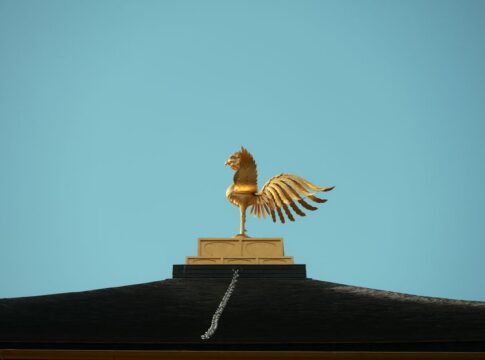
Japanese mythology adapted the Chinese Fenghuang as the Ho-o, maintaining its association with imperial virtue and peaceful times. The Ho-o appears when a wise and benevolent emperor rules, and its presence signals an era of prosperity and justice. Like its Chinese counterpart, the Ho-o doesn’t undergo death and rebirth through fire. Instead, it simply vanishes when peace ends and reappears when harmony returns. This makes the Japanese version a barometer of social and political health rather than a symbol of individual transformation through death and renewal.
Comparing Phoenix Traditions Across Cultures
| Culture | Name | Lifespan/Cycle | Primary Symbolism |
|---|---|---|---|
| Egyptian | Bennu | Daily/Annual | Solar rebirth, Nile flooding |
| Greek | Phoenix | 500 years | Immortality through self-renewal |
| Roman | Phoenix | 500-1,461 years | Cosmic cycles, astronomical time |
| Chinese | Fenghuang | Immortal | Harmony, yin-yang balance |
| Jewish | Milcham | 1,000 years | Virtue rewarded with immortality |
| Persian | Simurgh | Sees world destroyed 3 times | Ancient wisdom, healing |
Why the Phoenix Myth Endures
The phoenix resonates across cultures because it addresses universal human concerns about death, renewal, and the possibility of transcending mortality. Every civilization must grapple with the cycle of generations, the changing seasons, and the question of what, if anything, survives death. The phoenix offers a compelling answer: transformation rather than extinction. Whether through literal flames or symbolic disappearance and return, the phoenix promises that endings contain the seeds of new beginnings.
Different cultures emphasized different aspects of this promise. Egyptians focused on the daily reliability of the sun’s return. Greeks and Romans emphasized the bird’s agency in choosing its own death and rebirth. Chinese and Japanese traditions linked the phoenix to social harmony rather than individual transformation. Jewish and Christian versions made the phoenix a moral exemplar and theological proof. These variations show how a single mythological image can be adapted to express diverse cultural values and spiritual concerns.
Frequently Asked Questions
Did ancient people believe the phoenix was a real bird?
Many ancient writers treated the phoenix as a real but extremely rare creature from distant lands. Herodotus expressed skepticism about some details, but Pliny the Elder and other Roman naturalists included it in their encyclopedias of natural history alongside actual animals. The distinction between mythical and natural creatures was less rigid in ancient thinking than it is today.
How did the phoenix set itself on fire?
Different accounts offer varying explanations. Some sources say the phoenix fanned its wings to generate heat through friction, while others claim the sun’s rays ignited the aromatic nest materials. Still other versions suggest spontaneous combustion from the bird’s internal heat. The mechanism was less important than the symbolic meaning of voluntary self-sacrifice leading to renewal.
What did the new phoenix do with the ashes of the old one?
Greek and Roman accounts typically describe the reborn phoenix gathering the ashes and remnants of its predecessor, forming them into an egg or ball, and carrying this to the temple of the sun in Heliopolis, Egypt. This journey honored the phoenix’s Egyptian origins and completed the cycle by returning the remains to the sacred birthplace of the myth.
Are there any real animals that inspired the phoenix myth?
Several candidates have been proposed, including the golden pheasant, the flamingo, and various heron species that might have inspired the Egyptian Bennu. Some scholars suggest the myth arose from observations of birds building nests in the crowns of palm trees, which could catch fire in the desert sun, with new birds later appearing in the same location from surviving eggs.
The phoenix continues to appear in modern literature, film, and popular culture precisely because its core message remains relevant. Every person experiences endings and must find ways to begin again. The phoenix reminds us that destruction and creation are not opposites but partners in an endless dance, and that the end of one cycle plants the seed for the next.