
The Truth About Sloths Being Faster Swimmers Than Walkers
By Trivia Daily, Animals Desk — Published November 9, 2026
Table of Contents
- Key Takeaways
- Why the Truth About Sloths Being Faster in Water Makes Perfect Sense
- How Sloth Swimming Speeds Compare to Other Movements
- The Ecological Purpose Behind Aquatic Ability
- Common Misconceptions About Sloth Behavior
- What This Reveals About Animal Adaptation
- Frequently Asked Questions
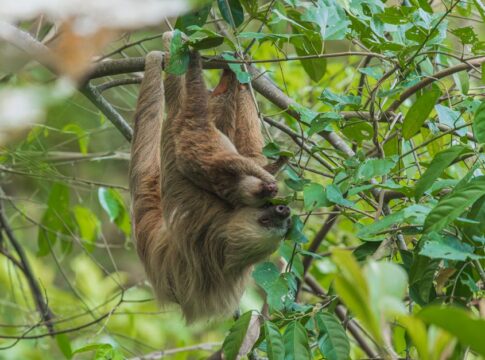
Sloths have earned their reputation as the slowpokes of the animal kingdom, inching along tree branches at a glacial pace that barely registers as movement. But here’s a surprising twist: these languid creatures transform into surprisingly capable swimmers when they hit the water. The truth about sloths being faster swimmers than walkers reveals one of nature’s most delightful contradictions—an animal so famously slow on land can move up to three times faster in water than in trees.
This remarkable behavior showcases how wildlife adapts to different environments, even within the same species. While a sloth might crawl across the ground at roughly 0.15 miles per hour, it can swim at speeds approaching 0.5 miles per hour, making water travel its preferred mode of transportation when crossing rivers in its rainforest habitat.
Key Takeaways
- Sloths can swim approximately three times faster than they move on land or through trees
- Their long arms, built for hanging and climbing, act as effective paddles in water
- Both two-toed and three-toed sloth species are competent swimmers despite their terrestrial slowness
- Sloths sometimes drop from overhanging branches directly into rivers to cross waterways
- Swimming ability helps these creatures navigate the fragmented rainforest habitat of Central and South America
- Their buoyant bodies and strong limbs make them surprisingly graceful in aquatic environments
Why the Truth About Sloths Being Faster in Water Makes Perfect Sense
The physics behind this phenomenon relates directly to how these animals are built. On land, sloths struggle because their long, curved claws—perfect for gripping branches—make walking awkward and inefficient. They must drag their bodies along the ground, pulling themselves forward with those same arms designed for a completely different purpose. Gravity works against them with every labored movement.
Water changes everything. Buoyancy supports their body weight, eliminating the gravitational burden that makes terrestrial travel so exhausting. Those elongated arms that seem cumbersome on land become powerful swimming strokes. The sloth’s naturally low muscle mass, which contributes to its legendary slowness on land, matters less in an aquatic environment where technique trumps raw power.
Sloths employ a dog-paddle style stroke, extending their arms forward and pulling back with surprising efficiency. Their fur, which grows in the opposite direction from most mammals (from belly to back, allowing rain to run off while hanging upside down), doesn’t impede their swimming. In fact, these creatures appear almost comfortable in water, a stark contrast to their ungainly terrestrial locomotion.
How Sloth Swimming Speeds Compare to Other Movements
| Movement Type | Approximate Speed | Environment |
|---|---|---|
| Tree climbing | 0.15 mph (6-8 feet per minute) | Canopy |
| Ground movement | 0.15 mph or slower | Forest floor |
| Swimming | 0.4-0.5 mph | Rivers and waterways |
The Ecological Purpose Behind Aquatic Ability
This swimming prowess isn’t just a quirky party trick—it serves genuine survival purposes in the sloth’s natural habitat. The Amazon basin and other Central and South American rainforests where sloths live are crisscrossed with rivers, streams, and seasonally flooded areas. During the wet season, water levels can rise dramatically, fragmenting the forest canopy and creating gaps too wide to cross via branches.
Rather than becoming stranded, sloths simply drop into the water and swim to the next tree. Some wildlife researchers have observed sloths swimming across rivers more than 100 feet wide. This behavior allows these animals to access new feeding territories, escape predators, and maintain genetic diversity by reaching other sloth populations that might otherwise be isolated.
The ability also matters for young sloths. Mother sloths occasionally need to relocate with their offspring, and swimming provides a viable travel option when tree routes aren’t available. Given that sloths are solitary creatures with large home ranges, the capacity to cross water barriers significantly expands their usable habitat.
Common Misconceptions About Sloth Behavior
Many people assume sloths avoid water or would sink due to their apparent lack of athleticism. This couldn’t be further from the truth. While they’re not aquatic animals by any means, they show no hesitation when faced with water obstacles. The misconception likely stems from their overall reputation for inactivity—if they barely move on land, surely they can’t swim, right?
Another myth suggests that sloths are slow because they’re lazy or unintelligent. The reality involves energy conservation. Sloths survive on a diet of leaves, which provide minimal calories and take days to digest. Their slow metabolism and deliberate movements represent an elegant adaptation to a low-energy lifestyle, not a deficiency. Swimming faster than walking doesn’t contradict this strategy—it simply shows they can be efficient when the physics work in their favor.
What This Reveals About Animal Adaptation
The sloth’s dual-speed nature demonstrates how evolution shapes creatures for specific environmental niches. These animals didn’t develop swimming ability as a primary survival trait. Instead, their tree-dwelling adaptations—long limbs, strong grip, lightweight build—happened to translate well to aquatic movement. Nature rarely wastes a good design, and the sloth’s body plan proves versatile across multiple environments.
This versatility matters increasingly as rainforest habitats face fragmentation from human activity. Sloths that can swim between isolated forest patches have better chances of finding food, mates, and suitable territory. What began as an incidental ability may become more critical for species survival as their habitat continues to change.
Frequently Asked Questions
Can all sloth species swim?
Yes, both two-toed and three-toed sloth species are capable swimmers. All six existing sloth species found in Central and South America demonstrate swimming ability, though they’re not aquatic animals and only swim when necessary to cross waterways or flooded areas.
How do sloths avoid drowning with their slow metabolism?
Sloths can hold their breath for up to 40 minutes by slowing their already-low heart rate even further. This exceptional breath-holding capacity, combined with their buoyant bodies and efficient paddle stroke, makes drowning unlikely during typical river crossings.
Do sloths swim in the ocean?
Sloths are not ocean swimmers and stick to freshwater rivers and streams in their rainforest habitat. They have no reason to enter saltwater environments and are never found in coastal marine areas despite their swimming ability.
What is the slowest movement a sloth makes?
On the ground, sloths move at their absolute slowest, sometimes taking an entire minute to travel just five or six feet. This extreme slowness occurs because their bodies are optimized for hanging in trees, making terrestrial locomotion awkward and energy-intensive.
The next time you picture a sloth barely moving through the treetops, remember there’s more to these fascinating animals than meets the eye. Sometimes the slowest creatures on land know exactly when to pick up the pace—they just need the right element to do it in.