
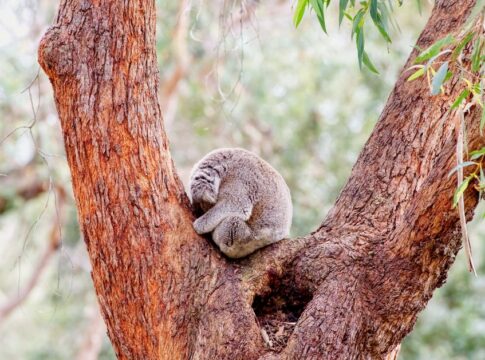
The Truth About Koalas Sleeping Twenty-Two Hours Daily
By Trivia Daily, Staff Writer — Published November 6, 2026
Table of Contents
- Key Takeaways
- The Truth About Koalas Sleeping: Separating Rest from Sleep
- Why Eucalyptus Leaves Demand So Much Rest
- Comparing Sleep Patterns Across Species
- The Koala Brain: Small by Design
- Myths and Misconceptions About Koala Behavior
- Frequently Asked Questions
Few animal facts capture our imagination quite like the claim that koalas sleep twenty-two hours every day. This fuzzy tidbit has spread across the internet, appearing in countless trivia lists and wildlife articles. But the truth about koalas sleeping habits is more nuanced than this catchy number suggests. While these iconic Australian marsupials do spend most of their time resting, the reality of their daily routine reveals fascinating adaptations to a unique dietary challenge.
Koalas don’t actually sleep for twenty-two consecutive hours. Instead, they rest, doze, and engage in what scientists call “inactive behavior” for extended periods. This distinction matters when we explore the surprising biology behind their sedentary lifestyle.
Key Takeaways
- Koalas rest or doze for 18 to 22 hours daily, though not all of this time qualifies as true sleep in the scientific sense.
- Their low-energy lifestyle is a direct adaptation to their diet of eucalyptus leaves, which are toxic and nutritionally poor.
- Eucalyptus leaves require enormous digestive effort, leaving koalas with minimal energy for other activities.
- Koalas possess one of the smallest brain-to-body ratios among mammals, another energy-saving adaptation.
- The exact amount of sleep varies by age, sex, and environmental conditions like temperature and food availability.
- Wild koalas may be slightly more active than their zoo-dwelling counterparts due to the need to search for preferred eucalyptus species.
The Truth About Koalas Sleeping: Separating Rest from Sleep
When researchers observe koalas in their natural habitat, they notice these marsupials remain motionless in tree forks for most of the day and night. The popular “twenty-two hours” figure represents total inactive time rather than deep sleep alone. Scientists distinguish between different states of rest. True sleep involves specific brain wave patterns and physiological changes. Koalas also spend considerable time in lighter dozing states or simply sitting still with eyes open, conserving energy without fully sleeping.
Studies using behavioral observation have found that koalas typically sleep between 14 and 18 hours daily, with the remaining inactive hours spent in restful wakefulness. The variation depends on individual koalas, seasonal changes, and environmental factors. During cooler weather, koalas may rest more to conserve body heat. In warmer conditions, they seek shaded positions in tree canopies and remain still to avoid overheating.
Why Eucalyptus Leaves Demand So Much Rest
The koala’s extreme sedentary lifestyle makes perfect sense when you examine their diet. Eucalyptus leaves are among the least nutritious foods any mammal regularly consumes. These leaves contain high amounts of indigestible fiber, very little protein, and toxic compounds called terpenes and phenolic acids that most animals cannot tolerate. Koalas have evolved specialized digestive systems to process this challenging food source, but the effort comes at a steep metabolic cost.
A koala’s digestive tract includes an exceptionally long cecum—a specialized organ where bacteria ferment the fibrous eucalyptus material. This fermentation process extracts whatever nutrients exist in the leaves, but it’s incredibly slow and energy-intensive. The entire digestive process can take over 100 hours for a single meal to pass through completely. During this time, the koala’s body dedicates tremendous resources to breaking down toxins and extracting minimal calories.
The energy yield from eucalyptus is so low that koalas must budget every calorie. They’ve evolved one of the slowest metabolic rates among mammals, operating at roughly half the rate expected for an animal of their size. This metabolic slowdown means less energy for movement, brain function, and other activities. Resting becomes not a luxury but a biological necessity.
Comparing Sleep Patterns Across Species
| Animal | Average Daily Sleep | Primary Reason |
|---|---|---|
| Koala | 14-18 hours (plus 2-4 hours resting) | Low-energy diet, toxic food processing |
| Brown Bat | 19-20 hours | High metabolic rate requires recovery time |
| Giant Armadillo | 18-19 hours | Energy conservation, nocturnal hunting |
| Sloth | 15-18 hours | Low-energy diet of leaves |
| Human | 7-9 hours | Brain maintenance, memory consolidation |
| Giraffe | 4-5 hours | Predator vigilance, feeding time needs |
The Koala Brain: Small by Design
One of the most interesting facts about koala biology relates to their brains. Relative to body size, koalas have unusually small brains—among the smallest brain-to-body ratios of any mammal. The brain accounts for only about 0.2% of their body weight, compared to roughly 2% in humans. Even more curious, the koala brain doesn’t fill its entire skull cavity. It’s surrounded by cerebrospinal fluid in a space that, in their ancestors, likely housed a larger brain.
This reduced brain size represents another energy-saving adaptation. Brain tissue is metabolically expensive, consuming significant calories even at rest. By maintaining a smaller brain, koalas reduce their baseline energy requirements. They retain sufficient cognitive function for their lifestyle—recognizing preferred eucalyptus species, navigating their home ranges, and managing social interactions—while minimizing the metabolic burden.
Myths and Misconceptions About Koala Behavior
The twenty-two-hour sleep claim isn’t the only misconception about koalas. Many people believe koalas are constantly intoxicated or “drunk” on eucalyptus, explaining their sluggish behavior. This is false. While eucalyptus does contain compounds that affect the central nervous system, koalas have evolved mechanisms to process these safely. Their lethargy stems from energy conservation, not intoxication.
Another common myth suggests koalas never drink water, getting all moisture from eucalyptus leaves. The name “koala” allegedly derives from an Aboriginal word meaning “no drink.” While koalas do obtain most of their water from leaves, they will drink from streams and other water sources, especially during droughts or heat waves. Researchers have documented this behavior more frequently in recent years as climate patterns shift.
Some people also assume koalas are bears, leading to the incorrect term “koala bear.” Koalas are marsupials, more closely related to kangaroos and wombats than to any bear species. This confusion likely arose from their rounded, bear-like appearance and the tendency of early European settlers to describe unfamiliar Australian animals using familiar terms.
Frequently Asked Questions
Do koalas really sleep 22 hours a day?
Koalas rest or remain inactive for 18 to 22 hours daily, but they actually sleep for approximately 14 to 18 hours. The remaining inactive time is spent in restful wakefulness or light dozing rather than true sleep.
Why do koalas sleep so much compared to other animals?
Koalas sleep extensively because their diet of eucalyptus leaves provides very little energy and requires enormous digestive effort to process. Their bodies conserve every possible calorie by minimizing activity and maintaining an exceptionally slow metabolism.
Are baby koalas as sleepy as adults?
Young koalas, called joeys, are generally more active than adults as they explore their environment and learn which eucalyptus species to eat. However, they still rest considerably more than most young mammals due to their developing digestive systems and low-energy diet.
Do koalas in zoos sleep more than wild koalas?
Zoo koalas may rest slightly more than wild individuals because they don’t need to search for food or navigate territories. Wild koalas must occasionally move between trees to find preferred eucalyptus leaves, adding a few extra active hours to their routine.
The next time you hear that koalas sleep twenty-two hours daily, you’ll know there’s more to the story. These remarkable marsupials have evolved an entire lifestyle around processing one of nature’s least rewarding food sources, turning extreme rest into an elegant survival strategy. Their sleepy reputation isn’t wrong—it’s just wonderfully more complex than a single number suggests.