
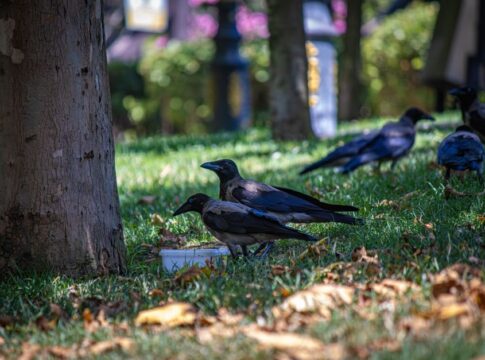
9 Strange Facts About Crows Holding Grudges and Funerals
By Trivia Daily, Staff Writer — Published November 6, 2026
Table of Contents
- Key Takeaways
- The Science Behind Crow Intelligence
- What Crow Funerals Really Mean
- Nine Remarkable Crow Behaviors
- Comparing Crow Intelligence to Other Animals
- Frequently Asked Questions
Crows possess an intelligence that borders on the uncanny. These black-feathered birds don’t just remember faces—they actively hold grudges against humans who’ve wronged them, and they gather in what researchers call “funerals” to mourn their dead. The strange crows holding these complex behaviors reveal a level of cognition that rivals many primates, making them one of the most fascinating creatures in the animal kingdom.
From passing warnings about dangerous humans down through generations to using tools with startling precision, crows demonstrate abilities that continue to surprise scientists. What you’re about to discover will change how you see these often-overlooked birds forever.
Key Takeaways
- Crows can remember individual human faces for at least five years and will scold people who have threatened them in the past.
- When crows find a dead crow, they gather in large groups to learn about potential dangers, not to mourn in the human sense.
- Crows teach their offspring which humans are dangerous, creating multi-generational grudges against specific people.
- These birds possess problem-solving abilities comparable to seven-year-old children in certain cognitive tests.
- Crows use at least 250 distinct calls to communicate complex information to their flock.
- Wild crows have been observed making and using tools, a behavior once thought unique to humans and great apes.
The Science Behind Crow Intelligence
Crows belong to the corvid family, which includes ravens, jays, and magpies—all remarkably intelligent birds. Their brain-to-body ratio rivals that of great apes, and the structure of their brains allows for complex cognitive processing. The pallium region of a crow’s brain, responsible for higher-level thinking, contains a neuron density similar to that found in primate brains.
Research from the University of Washington has demonstrated that crows can recognize individual human faces and remember them for years. In controlled experiments, researchers wearing specific masks while capturing and banding crows found that the birds would scold and dive-bomb anyone wearing those same masks years later—even if the person beneath the mask had never interacted with the birds before.
This facial recognition ability isn’t just impressive—it’s strategic. Crows use this skill to identify threats, remember food sources, and recognize helpful humans. Some crows have been known to bring gifts to people who regularly feed them, suggesting they understand reciprocity and social exchange.
What Crow Funerals Really Mean
When crows encounter a dead member of their species, they engage in behavior that researchers initially called “funerals.” Large groups gather around the deceased crow, calling loudly and appearing agitated. This gathering can last for hours and may include dozens of birds.
However, recent research suggests these gatherings serve a practical rather than emotional purpose. Crows are learning. They’re studying the area around the dead crow to identify potential dangers—predators, toxic substances, or hazardous locations. Scientists at the University of Washington found that crows would remember and avoid areas where they’d seen dead crows, and they’d scold any humans or animals present at the scene.
The birds appear to be asking: “What killed this crow, and how do I avoid the same fate?” This behavior demonstrates sophisticated risk assessment and information sharing within the flock. Young crows attending these gatherings learn which threats to avoid, creating a collective knowledge base that protects the entire community.
Nine Remarkable Crow Behaviors
1. Crows Remember Faces for at Least Five Years
University of Washington researchers conducted a landmark study where they wore caveman masks while trapping and banding crows. Five years later, crows still recognized and scolded anyone wearing those masks, even though the birds had only been captured once. The grudge persisted across seasons and through significant changes in the crows’ lives, including migration patterns and territory shifts. This long-term memory rivals that of elephants and demonstrates that crows don’t forgive easily.
2. They Teach Their Young Which Humans Are Dangerous
Crows don’t keep grudges to themselves. Parent crows actively teach their offspring to recognize and avoid specific threatening humans. In the University of Washington mask experiments, crows that had never been trapped themselves learned to scold people wearing the “dangerous” masks by watching their parents’ reactions. This cultural transmission of information creates multi-generational grudges, where young crows inherit their parents’ enemies without ever having a negative interaction themselves.
3. Crow Funerals Serve as Danger Education Classes
When crows gather around their dead, they’re conducting what amounts to a community safety briefing. Research shows that crows will avoid the specific location where they saw a dead crow for at least six weeks. They also remember and react negatively to any person who was holding the dead crow, treating that individual as a potential threat. This behavior allows the entire flock to learn from one bird’s misfortune, dramatically improving survival rates.
4. They Use Tools with Surprising Sophistication
New Caledonian crows manufacture and use tools in the wild, fashioning hooks from twigs to extract insects from tree bark. These birds don’t just use found objects—they actively modify materials to create better tools. In laboratory settings, crows have solved multi-step puzzles that require using one tool to obtain another tool, which then retrieves food. This sequential tool use demonstrates planning and abstract thinking.
5. Crows Understand Water Displacement
In experiments based on Aesop’s fable about the crow and the pitcher, researchers found that crows genuinely understand the principle of water displacement. When presented with a tube of water with a floating treat just out of reach, crows dropped stones into the water to raise the level until they could reach the food. They preferentially chose larger stones and avoided dropping objects into tubes filled with sand, showing they understood the physics involved.
6. They Hold Grudges Against Entire Families
Crows don’t just remember individual faces—they generalize their grudges to people who resemble their enemies. If a crow has a negative experience with a tall man wearing a red hat, it may react negatively to other tall men or people wearing red hats. This pattern recognition helps crows avoid potential threats but occasionally leads to cases of mistaken identity, where innocent people find themselves the target of crow harassment simply because they resemble someone who once threatened a local crow.
7. They Communicate Threat Levels Through Distinct Calls
Crows use different vocalizations to communicate varying levels of danger. Researchers have identified specific calls that mean “aerial predator,” “ground predator,” and “dead crow alert.” Other crows respond appropriately to these calls even if they can’t see the threat themselves, demonstrating that crow language conveys specific, actionable information. The complexity of their communication system includes at least 250 distinct calls, though scientists are still working to decode their full vocabulary.
8. They Engage in Tactical Deception
Crows have been observed pretending to hide food in one location while actually concealing it elsewhere, but only when they know other crows are watching. This behavior suggests they understand that other birds have minds and intentions—a concept called theory of mind. They also remember which individual crows watched them hide food and will re-hide it later if they think that bird might steal it, showing they track the knowledge states of specific individuals.
9. They Recognize Themselves in Mirrors
While mirror self-recognition results in crows remain somewhat debated, several studies suggest corvids possess at least some level of self-awareness. Magpies, close relatives of crows, have passed the mirror test—recognizing that the bird in the reflection is themselves, not another bird. Crows show similar behaviors, using mirrors to groom parts of their bodies they cannot normally see and reacting to marks placed on their bodies that are only visible in a reflection.
Comparing Crow Intelligence to Other Animals
| Animal | Tool Use | Facial Recognition | Problem-Solving | Self-Awareness |
|---|---|---|---|---|
| Crows | Advanced (makes tools) | Yes (years-long memory) | Comparable to 7-year-old child | Possible (debated) |
| Chimpanzees | Advanced (makes tools) | Yes | Comparable to young child | Yes (confirmed) |
| Dolphins | Basic (uses objects) | Yes | High (complex strategies) | Yes (confirmed) |
| Dogs | Minimal | Yes (strong with humans) | Moderate | No |
| Octopuses | Advanced (solves puzzles) | Uncertain | High (problem-solving) | Uncertain |
Frequently Asked Questions
How long can a crow hold a grudge against a person?
Crows can remember and hold grudges against specific people for at least five years, and possibly much longer. They will scold, dive-bomb, and avoid individuals who have threatened them, even if the interaction happened years earlier.
Do crows actually mourn their dead like humans do?
Crows gather around their dead in what looks like mourning, but research suggests they’re actually learning about potential dangers rather than experiencing grief in the human sense. These gatherings help the flock identify and remember threats.
Can crows recognize individual human faces?
Yes, crows can distinguish between individual human faces and remember them for years. They use this ability to identify both threats and friendly humans, and they can even recognize people they’ve only seen once or twice.
Will crows attack people who have never harmed them?
Crows may attack people who resemble someone who threatened them or who are in an area where a crow died. They also learn from other crows, so they might target someone their parents or flock-mates identified as dangerous, even without personal experience.
The next time you see a crow watching you from a telephone wire, remember that it might be taking mental notes. These birds possess memories that outlast most human friendships and problem-solving skills that shame many mammals. In a world where we often overlook the intelligence of non-human animals, crows remind us that remarkable minds come in unexpected packages—and that making an enemy of a crow means making an enemy for life.