
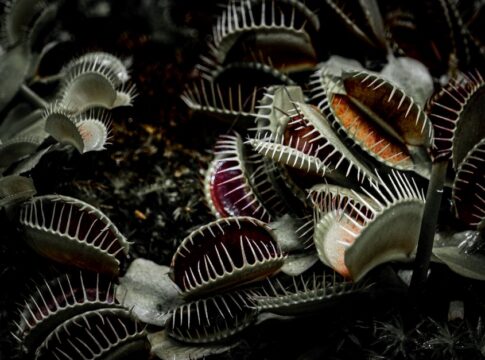
7 Bizarre Facts About Venus Flytraps Counting Touches
By Trivia Daily, Staff Writer — Published September 12, 2026
Table of Contents
- Key Takeaways
- The Most Bizarre Venus Flytraps Facts Start With Electrical Memory
- Why Counting Matters for Survival
- Frequently Asked Questions
The Venus flytrap doesn’t just snap shut at random. This carnivorous plant possesses a remarkable ability that borders on the uncanny: it can count. When an insect brushes against the trigger hairs inside its trap, the plant tallies each touch with astonishing precision. These bizarre Venus flytraps demonstrate a form of memory and decision-making that challenges our understanding of plant intelligence. What seems like a simple reflex is actually a sophisticated survival strategy honed over millions of years.
Scientists have discovered that these fascinating plants use electrical signals similar to animal nerve impulses to track mechanical stimulation. The Venus flytrap won’t waste energy closing unless it receives at least two touches within roughly twenty seconds, ensuring that only genuine prey—not raindrops or debris—trigger the trap. This counting ability represents one of the most surprising examples of plant behavior in nature.
Key Takeaways
- Venus flytraps require two touches within approximately 20 seconds before closing their traps
- The plants use electrical action potentials similar to animal neurons to count and remember touches
- Additional touches after closure trigger the release of digestive enzymes in stages
- Venus flytraps can distinguish between living prey and false triggers like rain or wind
- Each trap can only close a limited number of times before it dies and is replaced
- The counting mechanism prevents the plant from wasting energy on non-nutritious stimuli
The Most Bizarre Venus Flytraps Facts Start With Electrical Memory
Inside each Venus flytrap lobe, tiny trigger hairs act as mechanical sensors. When something touches a hair, the plant generates an electrical charge called an action potential—the same type of signal that travels through animal nerve cells. But here’s where it gets truly interesting: the plant stores this electrical charge as a form of short-term memory.
The first touch creates a charge that dissipates over time. If a second touch occurs while that charge still lingers, the combined electrical potential reaches a threshold that triggers the trap to slam shut in less than a tenth of a second. This makes the Venus flytrap one of the fastest-moving plants on Earth. The mechanism prevents the plant from responding to non-living stimuli like falling twigs or wind-blown debris, which rarely touch the same hair twice in quick succession.
Research has shown that the plant’s cells maintain calcium ion concentrations that rise with each touch and gradually decline. When the calcium level crosses a critical threshold after the second touch, it initiates a rapid change in cell pressure that snaps the trap closed. This biochemical counting system operates without a brain, nerves, or muscles.
Why Counting Matters for Survival
Closing a trap is metabolically expensive. The Venus flytrap lives in nutrient-poor soil in the coastal bogs of North and South Carolina, where nitrogen and phosphorus are scarce. The plant evolved carnivory as a solution, but catching insects requires significant energy investment.
Each trap closure uses ATP, the cellular energy currency, and requires the plant to pump water rapidly between cells. If the trap closes on nothing, the plant has wasted precious resources and must wait a day or more before the trap can reopen. Even worse, each trap can only close about four to seven times during its lifespan before it becomes blackened and dies. The counting mechanism ensures that closures happen only when there’s a high probability of a meal.
False positives would be disastrous. Rain falls frequently in the plant’s native habitat. Without the two-touch rule, every raindrop hitting a trigger hair would cause closures, exhausting the plant’s energy reserves and limiting its traps’ useful life. The counting system filters out these false alarms with elegant simplicity.
1. The Plant Counts Beyond Two—It Goes to Five
The counting doesn’t stop once the trap closes. Venus flytraps continue tracking touches inside the sealed trap, and the number determines what happens next. After closure, if the plant detects three more touches—bringing the total to five—it begins secreting digestive enzymes. This second counting threshold ensures the plant doesn’t waste enzymes on inedible objects that might have triggered the initial closure.
Living prey struggles inside the closed trap, repeatedly stimulating the trigger hairs. These continued touches signal to the plant that it has captured something worth digesting. The more the prey moves, the more enzymes the plant produces, and the tighter the trap seals around its meal. A cricket thrashing inside can trigger dozens of touches, leading to maximum enzyme production and a hermetic seal that creates a stomach-like chamber.
2. Each Trap Has Its Own Independent Memory
A Venus flytrap typically has four to seven traps at any given time, and each one operates independently. A touch on one trap doesn’t prime or influence any other trap on the same plant. Each maintains its own electrical charge, its own countdown timer, and its own decision-making process.
This distributed intelligence means the plant can simultaneously monitor multiple potential prey items across different traps. One trap might be on its first touch while another has just closed on a fly. The system lacks any central processing, yet coordinates complex behavior across the entire organism through localized electrical and chemical signaling.
3. Temperature Affects the Counting Speed
The twenty-second window between touches isn’t fixed—it varies with temperature. In warmer conditions, the electrical charge dissipates more quickly, shortening the window. In cooler weather, the charge persists longer, giving potential prey more time between touches before the memory resets.
This temperature sensitivity affects the plant’s hunting success across seasons. During hot summer days when insects are most active, the faster reset time means the plant is less likely to close on slow-moving or hesitant prey. The trade-off helps the plant avoid wasting closures during peak insect season when better opportunities are abundant.
4. The Counting Mechanism Works Without a Nervous System
Plants don’t have neurons, brains, or anything resembling an animal nervous system. Yet Venus flytraps perform a task—counting to five—that seems to require memory and information processing. The plant accomplishes this through clever biochemistry using calcium ions and electrical gradients across cell membranes.
Each touch causes calcium to flood into specific cells. The calcium concentration decays exponentially over time, but if another touch arrives before it drops too low, the new calcium influx adds to the existing level. When the cumulative calcium crosses a threshold, it triggers the mechanical closure. Scientists have measured these calcium waves moving through the trap tissue, confirming the counting happens through chemical accumulation rather than any neural circuit.
5. Genetic Mutations Can Break the Counter
Researchers have identified specific genes responsible for the counting mechanism. When these genes are disabled through mutation or experimental interference, the plants lose their ability to count properly. Some mutant flytraps close after a single touch, wasting energy on false alarms. Others require three or four touches, making them slower to respond to genuine prey.
These genetic studies have revealed that the counting ability evolved from genes that control ion channels—the same molecular machinery that regulates electrical signaling in all plants. Venus flytraps repurposed existing plant hardware for a novel function, demonstrating how evolution tinkers with available tools rather than inventing entirely new mechanisms.
6. The Plant Remembers Touches for Different Purposes
Beyond the initial two-touch closure and the subsequent enzyme-triggering touches, the Venus flytrap uses its counting system for another function: determining how long to stay closed. The more touches it receives from struggling prey, the longer it remains sealed and the more resources it invests in digestion.
A trap that closes but receives no further stimulation will reopen within 24 hours, having determined it caught nothing worth digesting. A trap that counts many touches will stay closed for a week or more, fully digesting its prey before reopening. The plant essentially uses the touch count as a proxy for meal size, scaling its digestive effort accordingly.
7. Scientists Use Venus Flytraps to Study Plant Intelligence
The counting ability of Venus flytraps has made them a model organism for studying plant cognition and behavior. Researchers at institutions worldwide use these plants to explore questions about memory, decision-making, and information processing in organisms without brains. The discoveries have implications beyond botany, informing fields like robotics and distributed computing.
Some scientists argue that the Venus flytrap’s ability to count, remember, and make decisions qualifies as a primitive form of intelligence. While the plant obviously doesn’t think in any way comparable to animals, it processes information from its environment and responds with appropriate behavior. This challenges traditional definitions of intelligence and memory, which have historically assumed the necessity of a nervous system.
Frequently Asked Questions
How fast does a Venus flytrap close after the second touch?
A Venus flytrap snaps shut in approximately one-tenth of a second once the second touch triggers closure. This makes it one of the fastest movements in the plant kingdom, achieved through rapid changes in cell pressure rather than muscle contraction.
Can you trigger a Venus flytrap too many times?
Yes, each trap can only close about four to seven times during its lifespan before it dies and turns black. Repeatedly triggering traps without feeding the plant will exhaust them prematurely, which is why it’s best to avoid touching captive Venus flytraps unnecessarily.
Do Venus flytraps only grow in one place?
Wild Venus flytraps are native exclusively to a small region within a 60-mile radius of Wilmington, North Carolina, and adjacent areas of South Carolina. They grow naturally nowhere else on Earth, though they’re now cultivated worldwide as houseplants.
What happens if a Venus flytrap catches something it can’t digest?
If the plant closes on an indigestible object that doesn’t continue triggering touches, the trap will reopen within a day or two. If it seals around something indigestible that does trigger touches, the trap may die after failing to extract nutrients, turning black and eventually being replaced by the plant.
The Venus flytrap’s counting ability reminds us that intelligence and memory can emerge from unexpected places. Next time you see one of these remarkable plants, consider the sophisticated biochemical calculations happening inside those deceptively simple leaves—a botanical computer running on sunlight and patience.