










1 / 10 Questions
0 Points

What flowering plant gives us vanilla flavoring?

Jasmine

Orchid

Lilac

Magnolia

Points won
0
Correct score
0%

More Questions

Why Lightning Creates Glass When It Strikes Sand

Lightning glass forms when lightning strikes sand at temperatures exceeding 3000°F, instantly fusing silica into hollow tubes called fulgurites.

9 Bizarre Facts About Medusa and the Gorgon Sisters

Discover shocking truths about the Medusa myth and her Gorgon sisters that ancient sources reveal. From her origins to her deadly gaze and legacy.

What flowering plant gives us vanilla flavoring?

What flowering plant gives us vanilla flavoring? Question 1: What flowering plant gives us vanilla flavoring? A. Jasmine B. Orchid C. Lilac D. Magnolia Explanation: Vanilla comes from the seed...

More Articles

Why Butterflies Taste With Their Feet: Strange But True

Why Butterflies Taste With Their Feet: Strange But True

Why Butterflies Taste With Their Feet: Strange But True

By Trivia Daily, Staff Writer — Published September 18, 2026

Table of Contents

Imagine walking barefoot through a garden and tasting every flower, leaf, and blade of grass beneath your soles. For butterflies, this isn't imagination—it's everyday reality. These delicate insects possess taste sensors on their feet, allowing them to sample potential food sources and identify suitable plants for laying eggs simply by landing. This surprising adaptation reveals just how differently nature equips its creatures to survive, and it's one of those amazing facts that challenges our assumptions about how senses work across the animal kingdom.

The truth about how butterflies taste with their feet opens a window into insect biology that most people never discover. It's a curiosity that demonstrates evolution's creative solutions to survival challenges, and it's just the beginning of what makes these winged creatures so fascinating.

Key Takeaways

  • Butterflies have chemoreceptors on their feet that function as taste organs, detecting chemical compounds upon contact with surfaces.
  • Female butterflies use their feet to identify host plants suitable for laying eggs, ensuring caterpillars have appropriate food when they hatch.
  • These foot-based taste sensors are far more sensitive than human taste buds, capable of detecting plant chemicals at extremely low concentrations.
  • Butterflies can taste sweetness, bitterness, and other flavors through their feet before deciding whether to unroll their proboscis to feed.
  • This adaptation allows butterflies to make rapid feeding and reproductive decisions without wasting energy on unsuitable plants.

How Butterflies Taste With Their Feet

The mechanism behind this remarkable ability lies in specialized sensory structures called chemoreceptors, located on the tarsi—the lowest segments of a butterfly's legs. When a butterfly lands on a surface, these receptors make contact with the plant or object and detect chemical compounds present on its surface. The information travels through nerve cells to the butterfly's brain, where it's processed as taste information.

These chemoreceptors work similarly to taste buds in mammals but are positioned externally rather than inside a mouth. They can identify sugars, which signal nectar-rich flowers, as well as bitter or toxic compounds that warn of unsuitable or dangerous plants. This immediate chemical analysis happens in seconds.

Female butterflies rely especially heavily on this ability. Before laying eggs, they drum their feet on leaves—a behavior entomologists have observed across numerous butterfly species. This drumming action activates the chemoreceptors and allows the butterfly to verify that the plant belongs to the correct species that will nourish her future caterpillars. Monarch butterflies, for instance, seek out milkweed plants exclusively, and their feet help them distinguish milkweed from similar-looking but unsuitable vegetation.

The Science Behind Insect Chemoreception

Insects experience the world through a sensory framework vastly different from mammals. While humans have roughly 10,000 taste buds concentrated on the tongue, butterflies and many other insects distribute their chemoreceptors across multiple body parts. Beyond feet, butterflies also have taste sensors on their antennae and proboscis—the long, coiled feeding tube they extend to sip nectar.

Research has shown that butterfly taste receptors can detect sugar concentrations far lower than humans can perceive. Some species can identify sweetness at concentrations hundreds of times more dilute than what our tongues would register. This hypersensitivity makes evolutionary sense: in nature, finding energy-rich food sources quickly can mean the difference between survival and starvation.

The sensitivity isn't limited to sweetness. Butterflies can also detect defensive chemicals plants produce to ward off herbivores. Caterpillars of certain butterfly species have evolved to tolerate or even sequester these toxins for their own defense, but the adult butterfly must still verify the plant's identity before committing to it as a nursery for her offspring.

Comparing Sensory Adaptations Across Insects

Insect Primary Taste Location Main Function
Butterflies Feet (tarsi) Identifying food sources and host plants for eggs
Honeybees Antennae and mouthparts Evaluating nectar quality and pollen
Flies Feet and proboscis Detecting sugars and suitable breeding sites
Ants Antennae Chemical communication and food assessment

Why This Adaptation Matters for Survival

The ability to taste with their feet gives butterflies a significant survival advantage. Consider the alternative: if butterflies could only taste with their mouthparts, they would need to extend their delicate proboscis and sample every plant they encountered. This would waste precious energy and time, and potentially expose them to toxins before they could identify danger.

With taste sensors on their feet, butterflies conduct instant quality control. A quick landing tells them whether a flower contains nectar worth harvesting or if a leaf belongs to the right plant species for egg-laying. This efficiency matters in the brief adult lifespan many butterfly species experience—sometimes just a few weeks.

The foot-tasting ability also helps butterflies avoid predators. By quickly identifying and rejecting unsuitable plants, they spend less time exposed on any single surface, reducing their vulnerability to birds, spiders, and other hunters. Speed and accuracy in decision-making translate directly to reproductive success.

Other Surprising Butterfly Facts

The foot-tasting phenomenon represents just one of many interesting adaptations butterflies have developed. These insects exhibit several other remarkable traits:

  • Butterflies cannot fly if their body temperature drops below roughly 55 degrees Fahrenheit, which is why they bask in sunshine with wings spread to warm their flight muscles.
  • Some butterfly species migrate thousands of miles, with monarch butterflies traveling from Canada to Mexico—a journey that spans multiple generations.
  • Butterfly wings are covered in thousands of tiny scales that create color through both pigmentation and microscopic structural effects that refract light.
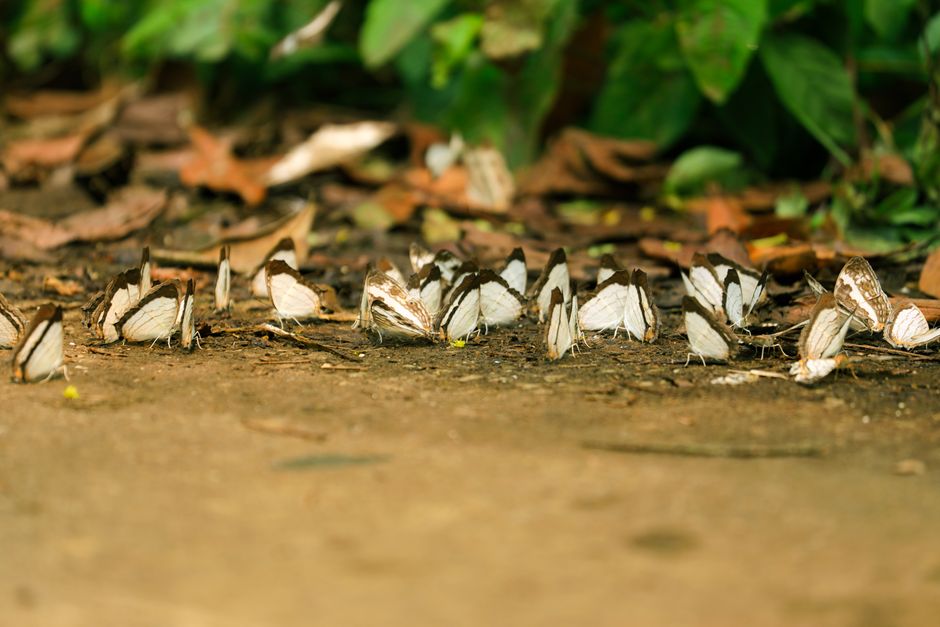
  • Adult butterflies subsist entirely on liquids, including nectar, tree sap, rotting fruit juice, and even dissolved minerals from mud puddles—a behavior called "puddling."
  • The smallest butterfly species has a wingspan of about half an inch, while the largest can exceed 11 inches across.

Frequently Asked Questions

Can butterflies taste food before they eat it?

Yes, butterflies taste potential food sources by landing on them and using the chemoreceptors on their feet. This allows them to evaluate whether a flower or fruit is worth feeding from before extending their proboscis to drink.

Do all insects taste with their feet?

Not all insects have this ability, but it's common among several groups. Flies, some bees, and certain wasps also possess chemoreceptors on their feet that help them identify food and suitable environments for reproduction.

How sensitive are butterfly taste receptors compared to humans?

Butterfly chemoreceptors are significantly more sensitive than human taste buds, especially for detecting sugars. Some species can perceive sweetness at concentrations hundreds of times weaker than the threshold for human detection.

Do butterflies have taste buds in their mouths like humans?

Butterflies don't have mouths in the traditional sense or taste buds like mammals. Their proboscis does contain some chemoreceptors, but their primary tasting occurs through sensors on their feet and antennae, giving them a completely different sensory experience than vertebrates.

The next time you watch a butterfly land on a flower, you're witnessing a creature literally tasting the world beneath its feet—a reminder that nature's solutions to survival often look nothing like what we'd expect. In six tiny legs lies a sophisticated chemical laboratory, analyzing the environment one footstep at a time.
How Many Atoms Are in a Human Body: The Stunning Count

How Many Atoms Are in a Human Body: The Stunning Count

How Many Atoms Are in a Human Body: The Stunning Count

By Trivia Daily, Staff Writer — Published August 30, 2026

Table of Contents

The human body is a walking universe of particles. Every breath you take, every thought you have, every cell that divides—all of it depends on an almost incomprehensible number of atoms working in concert. Scientists estimate that the average adult human body contains approximately seven octillion atoms. That's 7,000,000,000,000,000,000,000,000,000 atoms. To put that in perspective, there are more atoms in your body than stars in the observable universe.

Understanding how many atoms human bodies contain isn't just trivia—it's a window into the fundamental building blocks of life itself. These atoms aren't just passengers; they're constantly moving, bonding, breaking apart, and being replaced as your body maintains the delicate chemistry that keeps you alive.

Key Takeaways

  • The average human body contains approximately 7 octillion (7 × 1027) atoms, outnumbering the stars in the observable universe by a factor of billions.
  • Oxygen atoms make up roughly 65% of your body's mass, followed by carbon (18%), hydrogen (10%), and nitrogen (3%).
  • Despite hydrogen atoms being the most numerous in your body, they contribute only about 10% of your total mass because they're incredibly light.
  • Your body replaces approximately 98% of its atoms every year, meaning you're essentially a different collection of atoms than you were twelve months ago.
  • About 60% of the atoms in your body are hydrogen, making it the most abundant element by count, though not by weight.
  • Trace elements like iron, zinc, and copper account for less than 0.1% of your body but are essential for survival.

The Atomic Composition of Many Atoms Human Bodies Actually Contain

Not all atoms are created equal when it comes to building a human. Your body is overwhelmingly made of just six elements: oxygen, carbon, hydrogen, nitrogen, calcium, and phosphorus. These six account for about 99% of your atomic mass. Oxygen dominates because water (H₂O) makes up roughly 60% of your body weight, and each water molecule needs oxygen.

Carbon forms the backbone of organic molecules—proteins, fats, carbohydrates, and DNA all depend on carbon's unique ability to form stable bonds with other atoms. Hydrogen, while the lightest element, is everywhere: in water, in organic molecules, even in the acids that help you digest food. Nitrogen is critical for proteins and DNA. Calcium builds your bones and teeth. Phosphorus powers cellular energy through ATP molecules.

But the fascinating part? By count rather than mass, hydrogen atoms vastly outnumber everything else. For every oxygen atom in your body, there are roughly five hydrogen atoms. This is because hydrogen is so light that even though it's numerically dominant, it contributes relatively little to your overall weight.

Breaking Down the Numbers

Element Percentage by Mass Percentage by Atom Count Role in the Body
Hydrogen 10% 60% Component of water and organic molecules
Oxygen 65% 26% Essential for water and cellular respiration
Carbon 18% 11% Backbone of all organic molecules
Nitrogen 3% 1.3% Critical for proteins and DNA
Calcium 1.5% 0.2% Bone structure and cellular signaling
Phosphorus 1% 0.1% DNA, RNA, and energy transfer (ATP)

The Surprising Truth About Atomic Replacement

Here's something that challenges our notion of identity: you're not made of the same atoms you were a year ago. Your body is in constant flux. Cells die and are replaced. You breathe in new oxygen atoms and exhale carbon dioxide. You eat food, breaking down its molecules and incorporating those atoms into your own tissues. You shed skin cells, lose hair, and excrete waste.

Scientists estimate that roughly 98% of the atoms in your body are replaced annually. Some atoms stick around longer than others—calcium atoms in your bones might remain for years, while atoms in your stomach lining are replaced within days. The atoms in your red blood cells last about four months before being recycled.

This constant turnover raises philosophical questions. If nearly all your atoms are different from those you had last year, are you still the same person? Biologically, the answer is yes—what matters is the pattern, the information encoded in how those atoms are arranged, not the specific atoms themselves.

Tracing Where Your Atoms Come From

Every atom in your body has a history stretching back billions of years. The hydrogen atoms were forged in the Big Bang roughly 13.8 billion years ago. The heavier elements—carbon, oxygen, nitrogen, calcium—were created inside stars through nuclear fusion. When those stars died in supernova explosions, they scattered these atoms across space.

Eventually, these atoms coalesced into our solar system, then Earth, and finally into the food you eat and the air you breathe. You are, quite literally, made of stardust. The calcium in your bones was forged in a dying star. The iron in your blood was created in a supernova explosion. This isn't poetic metaphor—it's verified astrophysics.

The Role of Trace Elements

While six elements dominate your atomic makeup, trace elements play outsized roles despite their tiny quantities. Iron atoms in hemoglobin carry oxygen through your bloodstream. Without them, you'd suffocate despite breathing normally. Zinc atoms help over 300 enzymes function properly. Copper assists in energy production and iron absorption.

Iodine, found in minuscule amounts, is essential for thyroid hormone production. Too little, and your metabolism falters. Selenium acts as an antioxidant. Fluorine strengthens tooth enamel. These elements appear in parts per million or even parts per billion, yet their absence causes serious health problems. Your body is a masterpiece of chemistry where even the rarest ingredients matter.

Common Myths About Body Atoms

One persistent myth claims that because atoms are mostly empty space, humans are 99.9% empty space. This is misleading. While atoms do have vast distances between their nuclei and electron clouds relative to their size, the electron clouds themselves aren't "empty"—they're regions of electromagnetic force fields. You can't pass your hand through a table because the electron clouds in your atoms and the table's atoms repel each other with real, measurable force.

Another misconception is that your body contains "old" atoms. All atoms are ancient—there's no such thing as a young atom. The atoms in a newborn baby are just as old as those in a centenarian. What changes is how they're arranged, not their age.

Frequently Asked Questions

How many atoms are replaced in your body each day?

Billions of atoms are replaced every second through breathing, eating, and cellular turnover. Your stomach lining replaces itself every few days, while bone cells take years to fully regenerate, creating a constant but varied rate of atomic replacement throughout your body.

Do all humans have the same number of atoms?

No, the number varies based on body size, composition, and weight. A larger person contains more atoms than a smaller person, and someone with higher muscle mass has a different atomic composition than someone with more adipose tissue, though the proportions of elements remain relatively consistent.

Can you actually share atoms with historical figures?

Yes, statistically it's almost certain. Given the constant recycling of atoms through Earth's ecosystems over centuries, you likely contain atoms that were once part of Julius Caesar, Cleopatra, or any historical figure—though tracking specific atoms is impossible.

What's the heaviest element naturally found in the human body?

Iodine is typically the heaviest element found in measurable, functional quantities in the human body, with an atomic number of 53. Some people may have trace amounts of heavier elements from environmental exposure, but these aren't part of normal human biochemistry.

The seven octillion atoms in your body aren't just numbers—they're a testament to the universe's ability to organize simple elements into something capable of contemplating its own existence. Every atom you contain has traveled billions of years and countless miles to become part of you, if only temporarily, before continuing its journey through the cosmos.