







Venus Flytrap Counting: How It Knows When to Snap Shut
By Trivia Daily, Staff Writer — Published September 4, 2026
Table of Contents
- Key Takeaways
- The Mechanics of Venus Flytrap Counting
- How Plants Count Without a Brain
- Why Counting Matters for Survival
- Comparing Venus Flytrap Speed to Other Carnivorous Plants
- Common Myths About Venus Flytraps
- Frequently Asked Questions
The Venus flytrap doesn't just react blindly to touch. This carnivorous plant counts. Before snapping shut on an unsuspecting insect, it waits for a second touch within about twenty seconds. This remarkable example of venus flytrap counting reveals one of nature's most surprising facts: plants can perform basic arithmetic without a brain or nervous system. It's a fascinating curiosity that challenges everything we thought we knew about the line between plants and animals.
Scientists have discovered this amazing ability protects the plant from wasting energy on false alarms like falling raindrops or windblown debris. The Venus flytrap evolved in nutrient-poor soils of North and South Carolina, where every snap costs precious resources. By counting touches, it ensures its prey is worth the effort.
Key Takeaways
- Venus flytraps count to five: two touches trigger closure, three stimulate digestive enzymes, and five activate nutrient absorption
- The plant uses electrical signals similar to animal nerve impulses, called action potentials, to track touches
- Each trigger hair touch must occur within roughly 20 seconds for the count to continue
- The trap can distinguish between living prey and non-food objects by continuing to count after closure
- Closing and reopening a trap without catching prey can take 12 hours and costs significant energy
- This counting mechanism was only scientifically confirmed in recent decades through careful electrical measurements
The Mechanics of Venus Flytrap Counting
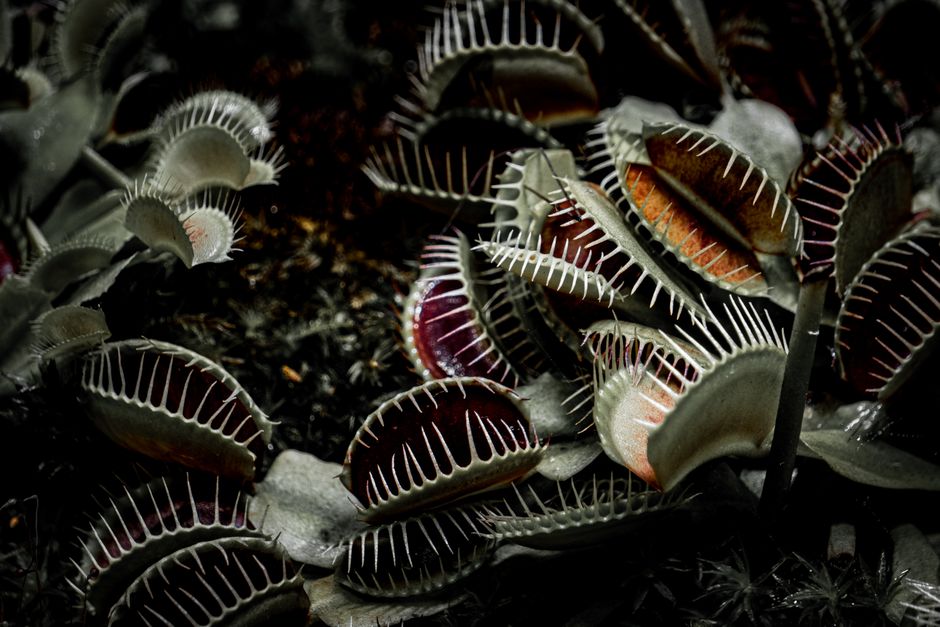
Each Venus flytrap leaf contains three to six tiny trigger hairs on its inner surface. When an insect brushes against one hair, it bends at the base and generates an electrical signal. Just one touch won't do anything. The plant holds that information in a short-term memory lasting about 20 seconds.
A second touch within that window—whether on the same hair or a different one—creates another electrical pulse. When these two signals combine, they reach a threshold that triggers the trap to slam shut in less than a tenth of a second. This makes the Venus flytrap one of the fastest-moving plants on Earth.
But the counting doesn't stop there. After the trap closes, continued struggles from the prey generate more touches. Three total touches stimulate the plant to seal the trap tightly and begin producing digestive enzymes. Five touches tell the plant to ramp up enzyme production and activate transport proteins that absorb nutrients from the dissolved insect. It's a graduated response system that matches effort to reward.
How Plants Count Without a Brain
The interesting mechanism behind this ability relies on calcium ions and electrical charges. When a trigger hair bends, it opens ion channels in the plant's cells. Calcium floods in, creating an electrical action potential that travels across the leaf surface at speeds up to four inches per second.
These action potentials work similarly to nerve signals in animals, though much slower. The plant essentially stores each signal as a temporary calcium concentration increase. If a second signal arrives before the calcium levels return to baseline, the combined concentration crosses a threshold that activates motor cells. These specialized cells rapidly pump water out, changing the leaf's curvature and snapping it shut.
Researchers have measured these electrical signals directly using tiny electrodes. The voltage changes are small but measurable, proving that plants can process and integrate information over time. This discover challenged the long-held assumption that only animals with nervous systems could count.
Why Counting Matters for Survival
Energy conservation drives this sophisticated behavior. Opening and closing the trap requires the plant to synthesize new cell wall material and redistribute cellular resources. If the trap closes on nothing, the plant loses 12 hours of photosynthesis from that leaf while it slowly reopens. Do this too many times, and the leaf dies from exhaustion.
In the nutrient-poor bogs where Venus flytraps naturally grow, they supplement their diet with insects because the soil lacks sufficient nitrogen and phosphorus. But carnivory is expensive. The digestive enzymes are costly to produce, and the trap can only close and reopen a limited number of times—typically four to seven—before that leaf dies.
The two-touch rule filters out false positives. Rain rarely hits the same trigger hair twice in quick succession. Wind-blown debris might trigger one hair but seldom triggers a second. A living insect, however, moves around inside the trap, touching multiple hairs repeatedly. The counting system lets the plant distinguish between worth-capturing prey and energy-wasting false alarms.
Comparing Venus Flytrap Speed to Other Carnivorous Plants
| Plant Type | Capture Method | Speed of Action | Trigger Mechanism |
|---|---|---|---|
| Venus Flytrap | Snap trap | 0.1 seconds | Two touches within 20 seconds |
| Bladderwort | Suction trap | 0.002 seconds | Single touch on trigger hairs |
| Sundew | Adhesive trap | Minutes to hours | Contact with sticky surface |
| Pitcher Plant | Pitfall trap | Passive (no movement) | Slippery surface causes fall |
Common Myths About Venus Flytraps
Many people believe Venus flytraps grow in tropical jungles. They don't. These plants are native only to a small region within 60 miles of Wilmington, North Carolina, and a tiny area of South Carolina. They thrive in sunny, wet, acidic bogs—not rainforests.
Another widespread myth suggests feeding your Venus flytrap hamburger or cheese. Don't. The plant evolved to digest insects and spiders, which contain specific nutrients in forms the plant can process. Feeding it human food can cause the leaf to rot from bacterial growth. The trap also doesn't benefit from being triggered for entertainment; each false closure drains energy reserves.
Some assume the trap has a strong crushing force. Actually, the trap closes gently enough that small insects can sometimes escape if they're quick. The initial closure creates a loose cage. Only after the continued counting confirms living prey does the trap seal completely, forming an airtight digestive chamber.
Frequently Asked Questions
How many times can a Venus flytrap close before it dies?
Each individual trap can close and reopen approximately four to seven times during its lifespan before that particular leaf dies. The plant continuously grows new traps, so while individual leaves wear out, the plant itself can live for many years.
What happens if you trigger a Venus flytrap on purpose?
The trap will close if you touch two trigger hairs within about 20 seconds, but it will reopen within 12 to 24 hours when it detects no continued movement inside. This wastes the plant's energy and shortens that leaf's lifespan, so it's best avoided.
Can Venus flytraps recognize different types of prey?
The plant cannot identify specific insect species, but its counting system lets it distinguish between living, moving prey and inert objects. Continued struggles after closure tell the plant it has caught something worth digesting.
Do Venus flytraps need to eat insects to survive?
No, Venus flytraps can survive on photosynthesis alone, but they grow much more slowly and weakly without insects. In their natural nutrient-poor habitat, catching prey provides essential nitrogen and phosphorus that aren't available in sufficient quantities from the soil.
The Venus flytrap's ability to count reveals that intelligence and computation aren't the exclusive domain of brains. Through elegant chemistry and electrical signaling, this plant performs arithmetic that would make a simple calculator proud—all to avoid wasting energy on raindrops while securing its next meal.