











1 / 10 Questions
0 Points

What unit measures the power of earthquakes?

Mohs scale

Beaufort scale

Richter scale

Kelvin scale

Points won
0
Correct score
0%

More Questions

The Hidden Story of Why Sloths Move So Incredibly Slow

Sloth behavior reveals a fascinating survival strategy. Discover the metabolic and evolutionary reasons behind their famously slow movements in the wild.

Air conditioning was invented to fix what problem in a printing plant?

Air conditioning was invented to fix what problem in a printing plant? Question 1: Air conditioning was invented to fix what problem in a printing...

What do the first three digits of a ZIP code identify?

What do the first three digits of a ZIP code identify? Question 1: What do the first three digits of a ZIP code identify? A. A...

More Articles

The Hidden Story of Why the Sky Is Actually Violet

The Hidden Story of Why the Sky Is Actually Violet

The Hidden Story of Why the Sky Is Actually Violet

By Trivia Daily, Staff Writer — Published November 21, 2026

Table of Contents

Look up on a clear day, and you'll see blue. Ask anyone what color the sky is, and blue is the answer. But here's a surprising twist that physics reveals: the sky is actually violet. The hidden story actually involves how our eyes work, not just how light behaves. This fascinating fact challenges one of the most basic observations we make every day, and the explanation takes us deep into the science of light scattering and human vision.

The trivia behind this everyday wonder is more interesting than most people realize. When sunlight enters Earth's atmosphere, it collides with gas molecules that scatter the light in all directions. Shorter wavelengths scatter more intensely than longer ones—a phenomenon called Rayleigh scattering. Violet light has the shortest wavelength in the visible spectrum, so it scatters the most. If our eyes responded equally to all colors, the sky would appear violet, not blue.

Key Takeaways

  • The sky scatters violet light more than any other color due to its short wavelength, but our eyes don't perceive it that way.
  • Human eyes have three types of color receptors (cones), and our violet-detecting cones are less sensitive than our blue-detecting ones.
  • The sun emits less violet light than blue light to begin with, compounding the visual effect.
  • Some animals with different vision systems may actually see the sky as violet or ultraviolet.
  • At sunrise and sunset, the sky appears red and orange because longer wavelengths dominate when light travels through more atmosphere.
  • This same scattering principle explains why distant mountains appear blue and why the ocean looks blue from above.

The Hidden Story Actually Begins With Light Waves

Sunlight looks white, but it's actually a mixture of all visible colors. Each color corresponds to a different wavelength of electromagnetic radiation. Violet sits at one end of the spectrum with wavelengths around 380-450 nanometers, while red occupies the other end at 620-750 nanometers. When this mixed light enters the atmosphere, it encounters molecules of nitrogen and oxygen that are much smaller than the wavelength of visible light.

These tiny molecules scatter short wavelengths far more effectively than long ones. The scattering intensity is inversely proportional to the fourth power of the wavelength—a relationship discovered by physicist Lord Rayleigh in the 19th century. This means violet light, with its shorter wavelength, scatters roughly ten times more than red light. Blue scatters intensely too, but less than violet.

If the physics stopped there, we'd all agree the sky is violet. But biology complicates the story.

Why Our Eyes Betray the Truth

Human color vision depends on three types of cone cells in the retina, each sensitive to different wavelengths. We have red cones, green cones, and blue cones—though "blue" is somewhat misleading. These cones actually peak at yellow-green, green, and blue-violet wavelengths respectively. The blue-violet cones do respond to violet light, but their sensitivity drops off sharply at the violet end of the spectrum.

Our eyes are simply better at detecting blue than violet. The blue-detecting cones are more numerous and more sensitive in the blue range than in the violet range. When we look at the sky, we're seeing a mixture of scattered blue and violet light, but our visual system weights blue more heavily. The brain interprets this signal as blue, not violet.

There's another factor at play: the sun itself. Our star doesn't emit all colors equally. Its spectrum peaks in the blue-green range, and it produces significantly less violet light than blue light. So even though violet scatters more intensely, there's less violet light to scatter in the first place. These two effects—less violet in sunlight and less violet sensitivity in our eyes—combine to make the sky appear blue to human observers.

What Other Creatures See

Vision is far from universal across species. Many birds, insects, and fish can see ultraviolet light, which scatters even more than violet. To a honeybee or a pigeon, the sky might appear as a riot of ultraviolet patterns invisible to us. Some animals may indeed perceive the sky as violet or even colors we can't imagine, since their visual systems process wavelengths differently.

Mantis shrimp possess twelve types of color receptors, compared to our three. Their perception of the sky would be radically different from ours, though scientists are still working to understand exactly what they see. The "true" color of the sky depends entirely on the observer.

How Atmosphere Thickness Changes Everything

The sky's color shifts dramatically depending on how much atmosphere sunlight must traverse. At noon, when the sun is directly overhead, light travels through the least amount of air. Blue and violet scattering dominate, giving us the classic blue sky. At sunrise and sunset, sunlight enters at a shallow angle and must pass through perhaps thirty times more atmosphere.

This extended path scatters away most of the blue and violet light before it reaches your eyes. The longer wavelengths—orange and red—survive the journey, painting the sky in warm hues. The same principle explains why the sun itself appears yellow during the day (blue light scattered away) and red at sunset (even more blue scattered away).

Light Color Wavelength (nm) Scattering Intensity When Visible
Violet 380-450 Highest Midday sky (but eyes less sensitive)
Blue 450-495 Very High Midday sky (eyes most sensitive)
Green 495-570 Moderate Rarely dominant in sky
Yellow 570-590 Low Horizon during transitions
Orange 590-620 Very Low Sunset and sunrise
Red 620-750 Lowest Sunset and sunrise

Discovering This Truth Through History

Ancient philosophers wondered about sky color but lacked the tools to explain it. Aristotle believed the sky was blue because of the mixing of light and darkness. Leonardo da Vinci came closer, suggesting that the atmosphere itself was blue. The breakthrough came in the 1870s when Lord Rayleigh worked out the mathematics of light scattering by small particles.

His equations predicted that shorter wavelengths would scatter more intensely, explaining the blue sky. Later physicists refined the theory and recognized that violet actually scatters more than blue. The full explanation—including the role of human vision—emerged gradually as scientists understood both the physics of light and the biology of sight.

Frequently Asked Questions

Why don't we see a purple sky if blue and violet mix together?

Our eyes don't perceive the scattered blue and violet light as purple because the blue component is much stronger to our vision. The combination of more blue light in sunlight and greater sensitivity of our blue-detecting cones means blue overwhelms violet in our perception.

Would the sky look different on other planets?

Absolutely. Mars has a thin atmosphere rich in dust particles, making its sky appear butterscotch or pinkish-red. A planet with a thicker atmosphere or different gas composition would scatter light differently, potentially creating green, orange, or even violet skies.

Can you ever see the sky as violet?

Under certain rare conditions—such as at high altitudes with very clear air, or using special filters that block blue wavelengths—the violet component becomes more noticeable. Some people report seeing violet tinges during twilight at high elevations.

Is the ocean blue for the same reason as the sky?

Partly, yes. The ocean appears blue both because it reflects the sky and because water itself absorbs red wavelengths more than blue ones. In deep, clear water, the blue color comes primarily from the water's own optical properties rather than just reflection.

Next time you gaze up at a brilliant blue sky, remember you're witnessing a trick of biology as much as physics. The atmosphere scatters violet most intensely, but evolution shaped our eyes to see blue instead. Somewhere overhead, wavelengths of light invisible to us paint patterns only other species can appreciate—a reminder that reality depends on the observer.
Did Humans Really Evolve From Chimpanzees

Did Humans Really Evolve From Chimpanzees

Did Humans Really Evolve From Chimpanzees

By Trivia Owl, Staff Writer — Published September 28, 2026

Table of Contents

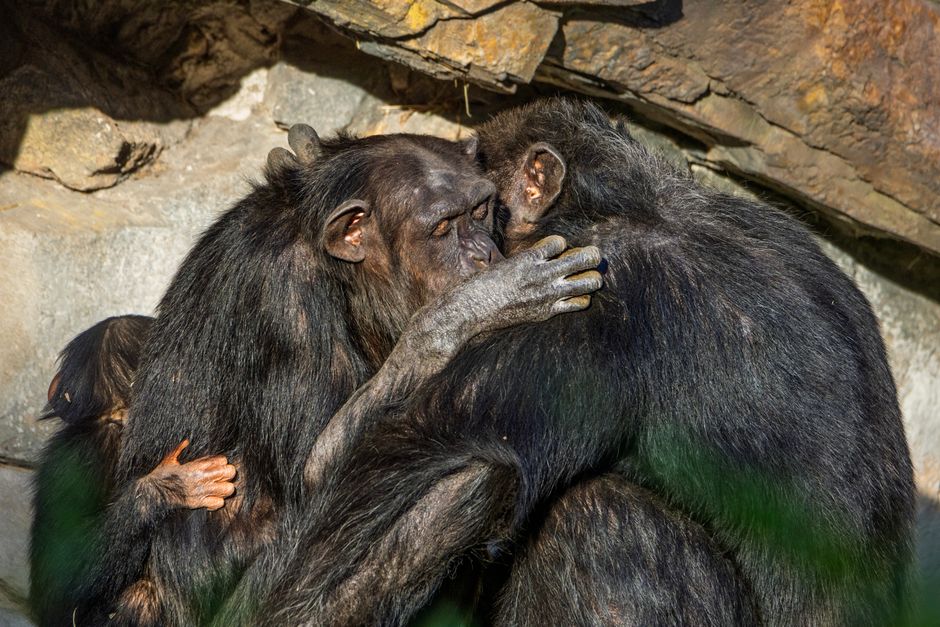
One of the most persistent misconceptions about evolution is the idea that humans evolved directly from chimpanzees. You've probably seen the famous illustration showing a linear progression from ape to human, reinforcing this myth. The surprising truth is far more interesting: humans and chimpanzees share a common ancestor, but neither species evolved from the other. This fascinating fact reveals how evolution actually works and why the question itself misunderstands our relationship with our closest living relatives.

The confusion is understandable. Humans and chimpanzees share roughly 98-99% of their DNA, making them our closest genetic cousins in the animal kingdom. But sharing a recent ancestor is very different from one species directly descending from another. Think of it like this: you and your cousin both descended from your grandparents, but neither of you evolved from each other. This curiosity about human origins leads us to explore one of science's most amazing discoveries about where we actually came from.

Key Takeaways

  • Humans did not evolve from chimpanzees or any other living ape species; we share a common ancestor that lived millions of years ago.
  • The last common ancestor between humans and chimpanzees existed approximately 6-7 million years ago in Africa.
  • Modern chimpanzees have been evolving just as long as humans have since our lineages split, making them equally "evolved."
  • Humans and chimpanzees share 98-99% of their DNA, but that small genetic difference accounts for significant physical and cognitive distinctions.
  • Multiple human species once coexisted on Earth, including Neanderthals and Homo erectus, but Homo sapiens is the only surviving human species.
  • The "march of progress" illustration showing apes transforming into humans is scientifically misleading and oversimplifies evolutionary branching.

The Common Ancestor: Where Humans and Chimpanzees Really Come From

When scientists say humans evolve chimpanzees share a common ancestor, they're describing a branching process rather than a linear transformation. Six to seven million years ago, a now-extinct ape species lived in Africa. At some point, populations of this ancestral species became separated, perhaps by geographical barriers or ecological niches. Over millions of years, these isolated populations evolved independently, eventually becoming distinct enough to be classified as separate species.

One branch led to modern chimpanzees and bonobos. The other led through various hominin species—including Australopithecus, Homo habilis, Homo erectus, and Neanderthals—eventually resulting in modern Homo sapiens. Neither branch is "more evolved" than the other; both have adapted successfully to their environments over the same span of time. The common ancestor itself probably didn't look exactly like either modern humans or modern chimpanzees, though it likely shared characteristics with both.

Paleontologists continue to discover fossils that help fill in the picture of human evolution. Species like Ardipithecus ramidus, which lived about 4.4 million years ago, show a mix of ape-like and human-like features. These intermediate forms don't represent a straight line from ape to human but rather branches on a complex evolutionary tree, many of which went extinct.

Why the "March of Progress" Image Is Misleading

The iconic illustration showing a chimpanzee gradually standing upright and transforming into a modern human has done more to confuse people about evolution than perhaps any other image. This "march of progress" suggests a ladder-like progression with a clear direction and endpoint. Reality is messier and more interesting.

Evolution is better visualized as a branching tree or bush, not a ladder. Multiple human species existed simultaneously at various points in history. Around 100,000 years ago, at least four different human species walked the Earth: Homo sapiens, Neanderthals, Denisovans, and Homo floresiensis. These weren't stages in a progression but separate branches that coexisted, sometimes even interbreeding. Most people of European and Asian descent carry small amounts of Neanderthal DNA, evidence of this ancient genetic mixing.

The linear progression image also implies that evolution has a goal or direction, with humans as the pinnacle. This isn't how natural selection works. Evolution simply favors traits that help organisms survive and reproduce in their specific environments. There's no cosmic scoreboard ranking species by superiority.

What Makes Humans Different Despite Genetic Similarity

If humans and chimpanzees share nearly 99% of their DNA, what accounts for the obvious differences? Small genetic changes can have dramatic effects, especially when they affect how and when genes are expressed during development. Relatively minor alterations in regulatory genes can change brain size, skeletal structure, and cognitive abilities significantly.

Human brains are roughly three times larger than chimpanzee brains relative to body size. This expansion, particularly in the cerebral cortex, enabled complex language, abstract thinking, and advanced tool use. Humans also evolved unique physical traits: our upright posture, opposable thumbs refined for precision grip, and reduced body hair. These adaptations supported our ancestors' survival on the African savanna.

Chimpanzees, meanwhile, evolved their own remarkable adaptations. They're far stronger than humans pound-for-pound, with muscle fibers optimized for power rather than fine motor control. Their social intelligence is sophisticated, involving complex hierarchies, tool use, and cultural transmission of learned behaviors. Different chimpanzee communities develop distinct tool-use traditions, passed down through generations—a form of culture.

Comparing Human and Chimpanzee Evolution

Feature Humans Chimpanzees
Brain Size ~1,350 cubic centimeters ~400 cubic centimeters
Locomotion Obligate bipedalism (walk upright) Knuckle-walking, tree climbing
Communication Complex spoken language with grammar Vocalizations, gestures, facial expressions
Tool Use Advanced, varied, cumulative culture Simple tools, some regional variation
Social Structure Large, complex societies with institutions Fission-fusion communities of 20-150

The Evolutionary Tree Keeps Growing

Our understanding of human evolution continues to evolve as new discoveries emerge. Genetic analysis has revealed extinct human relatives we didn't know existed, like the Denisovans, identified primarily through DNA extracted from a single finger bone. Advanced dating techniques keep refining the timeline of when various species appeared and disappeared.

Recent findings suggest that the last common ancestor of humans and chimpanzees might have had a more complex mating system and social structure than previously thought. Some researchers propose that the split between our lineages wasn't a clean break but involved periods of interbreeding before the populations fully separated. These discoveries remind us that science is a process of continuous refinement, not a collection of unchanging facts.

The fossil record will always have gaps—fossilization is rare, and finding fossils is even rarer. But each new discovery adds another piece to the puzzle, helping us understand not just where humans came from, but how evolution shapes all life on Earth through branching descent with modification.

Frequently Asked Questions

What percentage of DNA do humans share with chimpanzees?

Humans and chimpanzees share approximately 98-99% of their DNA, depending on how the comparison is calculated. This makes chimpanzees our closest living genetic relatives, but the 1-2% difference accounts for significant physical and cognitive distinctions between the species.

Are humans still evolving today?

Yes, humans are still evolving. Evolution occurs whenever genetic variations affect survival and reproduction rates. Recent examples include lactose tolerance in adults, which evolved in populations with dairy farming traditions, and genetic adaptations to high-altitude living in Tibetan populations.

Why are there still monkeys if humans evolved from them?

This question contains a common misconception: humans didn't evolve from monkeys. Humans and modern monkeys share a much older common ancestor that lived tens of millions of years ago. Both lineages have been evolving separately since then, which is why both monkeys and humans exist today.

How many human species have existed throughout history?

At least 21 different human species have been identified in the fossil record, though the exact number depends on how scientists classify fragmentary remains. These include well-known species like Neanderthals and Homo erectus, as well as recently discovered species like Homo naledi and Homo luzonensis.

The next time someone asks whether humans evolved from chimpanzees, you'll know the real story is far more intriguing. We're not descended from our ape cousins but rather fellow travelers on evolution's branching tree, each species shaped by millions of years of adaptation to different challenges and environments. That shared ancestry makes understanding chimpanzees a window into understanding ourselves.