
Did Humans Really Evolve From Chimpanzees
By Trivia Owl, Staff Writer — Published September 28, 2026
Table of Contents
- Key Takeaways
- The Common Ancestor: Where Humans and Chimpanzees Really Come From
- Why the “March of Progress” Image Is Misleading
- What Makes Humans Different Despite Genetic Similarity
- Comparing Human and Chimpanzee Evolution
- The Evolutionary Tree Keeps Growing
- Frequently Asked Questions
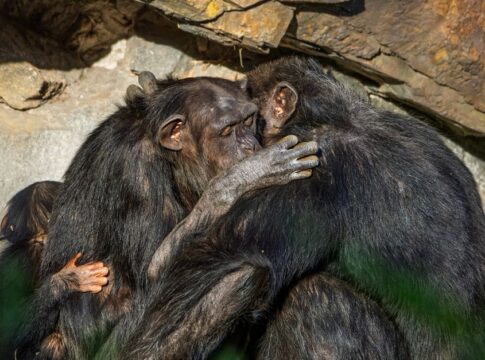
One of the most persistent misconceptions about evolution is the idea that humans evolved directly from chimpanzees. You’ve probably seen the famous illustration showing a linear progression from ape to human, reinforcing this myth. The surprising truth is far more interesting: humans and chimpanzees share a common ancestor, but neither species evolved from the other. This fascinating fact reveals how evolution actually works and why the question itself misunderstands our relationship with our closest living relatives.
The confusion is understandable. Humans and chimpanzees share roughly 98-99% of their DNA, making them our closest genetic cousins in the animal kingdom. But sharing a recent ancestor is very different from one species directly descending from another. Think of it like this: you and your cousin both descended from your grandparents, but neither of you evolved from each other. This curiosity about human origins leads us to explore one of science’s most amazing discoveries about where we actually came from.
Key Takeaways
- Humans did not evolve from chimpanzees or any other living ape species; we share a common ancestor that lived millions of years ago.
- The last common ancestor between humans and chimpanzees existed approximately 6-7 million years ago in Africa.
- Modern chimpanzees have been evolving just as long as humans have since our lineages split, making them equally “evolved.”
- Humans and chimpanzees share 98-99% of their DNA, but that small genetic difference accounts for significant physical and cognitive distinctions.
- Multiple human species once coexisted on Earth, including Neanderthals and Homo erectus, but Homo sapiens is the only surviving human species.
- The “march of progress” illustration showing apes transforming into humans is scientifically misleading and oversimplifies evolutionary branching.
The Common Ancestor: Where Humans and Chimpanzees Really Come From
When scientists say humans evolve chimpanzees share a common ancestor, they’re describing a branching process rather than a linear transformation. Six to seven million years ago, a now-extinct ape species lived in Africa. At some point, populations of this ancestral species became separated, perhaps by geographical barriers or ecological niches. Over millions of years, these isolated populations evolved independently, eventually becoming distinct enough to be classified as separate species.
One branch led to modern chimpanzees and bonobos. The other led through various hominin species—including Australopithecus, Homo habilis, Homo erectus, and Neanderthals—eventually resulting in modern Homo sapiens. Neither branch is “more evolved” than the other; both have adapted successfully to their environments over the same span of time. The common ancestor itself probably didn’t look exactly like either modern humans or modern chimpanzees, though it likely shared characteristics with both.
Paleontologists continue to discover fossils that help fill in the picture of human evolution. Species like Ardipithecus ramidus, which lived about 4.4 million years ago, show a mix of ape-like and human-like features. These intermediate forms don’t represent a straight line from ape to human but rather branches on a complex evolutionary tree, many of which went extinct.
Why the “March of Progress” Image Is Misleading
The iconic illustration showing a chimpanzee gradually standing upright and transforming into a modern human has done more to confuse people about evolution than perhaps any other image. This “march of progress” suggests a ladder-like progression with a clear direction and endpoint. Reality is messier and more interesting.
Evolution is better visualized as a branching tree or bush, not a ladder. Multiple human species existed simultaneously at various points in history. Around 100,000 years ago, at least four different human species walked the Earth: Homo sapiens, Neanderthals, Denisovans, and Homo floresiensis. These weren’t stages in a progression but separate branches that coexisted, sometimes even interbreeding. Most people of European and Asian descent carry small amounts of Neanderthal DNA, evidence of this ancient genetic mixing.
The linear progression image also implies that evolution has a goal or direction, with humans as the pinnacle. This isn’t how natural selection works. Evolution simply favors traits that help organisms survive and reproduce in their specific environments. There’s no cosmic scoreboard ranking species by superiority.
What Makes Humans Different Despite Genetic Similarity
If humans and chimpanzees share nearly 99% of their DNA, what accounts for the obvious differences? Small genetic changes can have dramatic effects, especially when they affect how and when genes are expressed during development. Relatively minor alterations in regulatory genes can change brain size, skeletal structure, and cognitive abilities significantly.
Human brains are roughly three times larger than chimpanzee brains relative to body size. This expansion, particularly in the cerebral cortex, enabled complex language, abstract thinking, and advanced tool use. Humans also evolved unique physical traits: our upright posture, opposable thumbs refined for precision grip, and reduced body hair. These adaptations supported our ancestors’ survival on the African savanna.
Chimpanzees, meanwhile, evolved their own remarkable adaptations. They’re far stronger than humans pound-for-pound, with muscle fibers optimized for power rather than fine motor control. Their social intelligence is sophisticated, involving complex hierarchies, tool use, and cultural transmission of learned behaviors. Different chimpanzee communities develop distinct tool-use traditions, passed down through generations—a form of culture.
Comparing Human and Chimpanzee Evolution
| Feature | Humans | Chimpanzees |
|---|---|---|
| Brain Size | ~1,350 cubic centimeters | ~400 cubic centimeters |
| Locomotion | Obligate bipedalism (walk upright) | Knuckle-walking, tree climbing |
| Communication | Complex spoken language with grammar | Vocalizations, gestures, facial expressions |
| Tool Use | Advanced, varied, cumulative culture | Simple tools, some regional variation |
| Social Structure | Large, complex societies with institutions | Fission-fusion communities of 20-150 |
The Evolutionary Tree Keeps Growing
Our understanding of human evolution continues to evolve as new discoveries emerge. Genetic analysis has revealed extinct human relatives we didn’t know existed, like the Denisovans, identified primarily through DNA extracted from a single finger bone. Advanced dating techniques keep refining the timeline of when various species appeared and disappeared.
Recent findings suggest that the last common ancestor of humans and chimpanzees might have had a more complex mating system and social structure than previously thought. Some researchers propose that the split between our lineages wasn’t a clean break but involved periods of interbreeding before the populations fully separated. These discoveries remind us that science is a process of continuous refinement, not a collection of unchanging facts.
The fossil record will always have gaps—fossilization is rare, and finding fossils is even rarer. But each new discovery adds another piece to the puzzle, helping us understand not just where humans came from, but how evolution shapes all life on Earth through branching descent with modification.
Frequently Asked Questions
What percentage of DNA do humans share with chimpanzees?
Humans and chimpanzees share approximately 98-99% of their DNA, depending on how the comparison is calculated. This makes chimpanzees our closest living genetic relatives, but the 1-2% difference accounts for significant physical and cognitive distinctions between the species.
Are humans still evolving today?
Yes, humans are still evolving. Evolution occurs whenever genetic variations affect survival and reproduction rates. Recent examples include lactose tolerance in adults, which evolved in populations with dairy farming traditions, and genetic adaptations to high-altitude living in Tibetan populations.
Why are there still monkeys if humans evolved from them?
This question contains a common misconception: humans didn’t evolve from monkeys. Humans and modern monkeys share a much older common ancestor that lived tens of millions of years ago. Both lineages have been evolving separately since then, which is why both monkeys and humans exist today.
How many human species have existed throughout history?
At least 21 different human species have been identified in the fossil record, though the exact number depends on how scientists classify fragmentary remains. These include well-known species like Neanderthals and Homo erectus, as well as recently discovered species like Homo naledi and Homo luzonensis.
The next time someone asks whether humans evolved from chimpanzees, you’ll know the real story is far more intriguing. We’re not descended from our ape cousins but rather fellow travelers on evolution’s branching tree, each species shaped by millions of years of adaptation to different challenges and environments. That shared ancestry makes understanding chimpanzees a window into understanding ourselves.