










1 / 10 Questions
0 Points

Which Squishy Toy Was Born From Failed WWII Rubber Experiments?

Super Ball

Silly Putty

Bouncy Ball

Stretch Armstrong

Points won
0
Correct score
0%

More Questions

The Truth About Atlantis: Where Plato Got the Story

Discover the real Atlantis origin story and the historical sources that inspired Plato's legendary tale of the sunken civilization that captivated

Why Honey Never Spoils: The Ancient Food That Lasts Forever

Discover the science behind honey spoilage and why this remarkable food remains edible for thousands of years through unique chemical properties.

7 Strange Facts About Bananas Being Radioactive Fruit

Radioactive bananas contain potassium-40 that emits radiation. Discover why this common fruit is used as a scientific measurement unit and what it means.

More Articles

Medusa Myth: Why She Was Cursed With Snakes for Hair

Medusa Myth: Why She Was Cursed With Snakes for Hair

Medusa Myth: Why She Was Cursed With Snakes for Hair

By TriviaOwl, Staff Writer — Published July 29, 2026

Table of Contents

Few figures in Greek mythology spark as much curiosity as Medusa, the snake-haired Gorgon whose gaze turned onlookers to stone. But the Medusa myth cursed with serpents isn't quite what most people think. The surprising truth behind her transformation reveals a darker, more complex story about power, punishment, and the gods' capricious nature. What many assume is a tale of inherent monstrosity is actually a tragedy of victimization rewritten over centuries.

The earliest versions of her story paint a very different picture than the monster we know today. Discover how this ancient myth evolved and why the reasons for her curse matter more than you might expect.

Key Takeaways

  • Medusa was originally a beautiful mortal woman, not born a monster, according to later Greek and Roman sources.
  • The most famous version of the Medusa myth cursed her after an encounter with Poseidon in Athena's temple, though earlier versions differ significantly.
  • Ovid's Metamorphoses, written around 8 CE, popularized the narrative of Medusa as a victim punished for desecration she didn't initiate.
  • In Hesiod's earlier Theogony, Medusa and her sisters were born as monstrous Gorgons, with no mention of transformation or curse.
  • The conflicting versions reflect how myths changed across cultures and centuries, adapting to different moral frameworks.
  • Medusa's severed head retained its petrifying power even after Perseus killed her, becoming a protective symbol called the Gorgoneion.

The Conflicting Origins of the Medusa Myth Cursed by the Gods

The story most people know comes from the Roman poet Ovid's Metamorphoses. In this version, Medusa was a stunning maiden with gorgeous hair who served as a priestess in Athena's temple. Poseidon, god of the sea, desired her and violated her within the sacred space. Athena, enraged by the desecration of her temple, punished Medusa by transforming her beautiful locks into writhing serpents and making her face so hideous that anyone who looked upon it would turn to stone.

This version raises uncomfortable questions. Why punish the victim rather than the perpetrator? The answer lies partly in ancient Greek religious concepts about pollution and sacred space. Defilement of a temple, regardless of intent or consent, was considered a serious transgression that demanded purification or punishment. Athena's response, though seemingly unjust by modern standards, reflected the idea that the victim herself had become polluted.

But here's the interesting twist: this wasn't the original story at all. Hesiod's Theogony, written roughly 700 years before Ovid, presents Medusa and her two sisters—Stheno and Euryale—as born monstrous. They were daughters of the ancient sea deities Phorcys and Ceto, creatures of primordial chaos. No transformation. No curse. No tragic backstory. They simply existed as fearsome beings from birth, with Medusa being the only mortal among them.

Why the Story Changed Over Time

The shift from born-monster to cursed-maiden reveals how myths adapted across cultures and centuries. Greek mythology had no single canonical version—stories evolved through oral tradition, regional variations, and the creative license of poets and playwrights. Each retelling served different purposes and reflected different values.

Ovid, writing during the Roman Empire, had particular reasons to emphasize transformation narratives. His Metamorphoses is entirely about change, containing over 250 myths of transformation. The Roman audience appreciated these tragic, emotionally complex tales that explored the consequences of divine interference in mortal lives. A story about an innocent woman punished for a god's crime created dramatic tension and moral complexity that a simple monster-slaying tale lacked.

The earlier Greek version served different functions. Monsters in archaic Greek myth often represented primordial chaos and the dangers lurking at the edges of civilization. They didn't need backstories or motivations—they existed as obstacles for heroes to overcome, proving their worth through combat.

The Symbolism Behind Serpent Hair

Snakes held powerful symbolic meaning in ancient Mediterranean cultures. They represented danger, certainly, but also wisdom, regeneration, and chthonic (underworld) power. The serpent's ability to shed its skin made it a symbol of renewal and transformation. In religious contexts, snakes appeared as guardians of sacred spaces and as attributes of various deities.

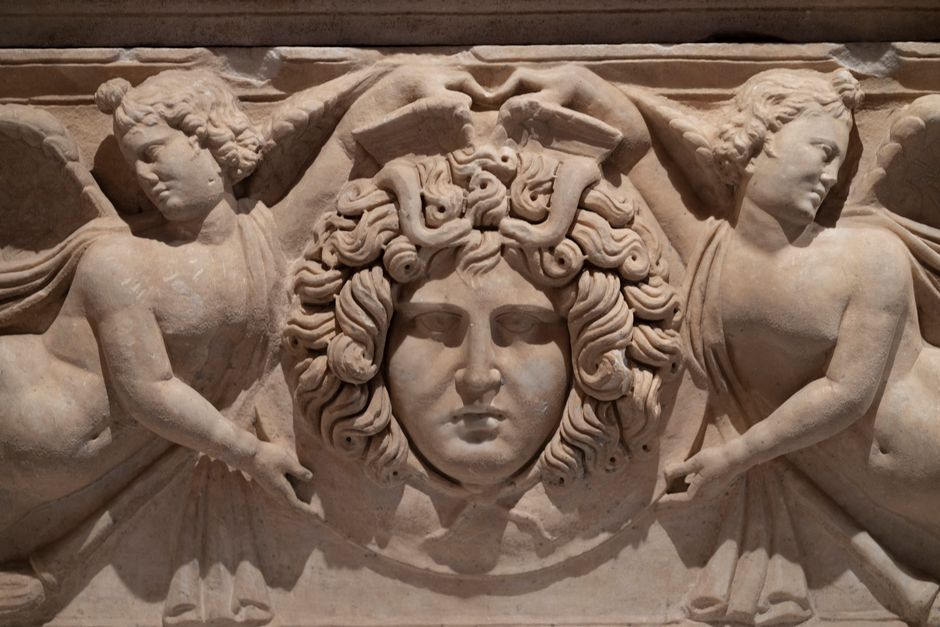
Medusa's serpent hair connected her to this complex web of meanings. The snakes weren't merely grotesque—they marked her as a creature bridging different realms: mortal and divine, beautiful and terrible, protective and destructive. After Perseus beheaded her, Athena placed Medusa's head on her aegis (shield), where it became the Gorgoneion, an apotropaic symbol meant to ward off evil. The same face that brought death now offered protection.

This dual nature appears throughout Medusa's mythology. From her blood sprang both Pegasus, the divine winged horse, and Chrysaor, a golden giant. Even in death, she generated both wonder and terror, beauty and monstrosity.

Comparing the Major Ancient Sources

Source Approximate Date Medusa's Origin Key Differences
Hesiod's Theogony ~700 BCE Born as a Gorgon monster No transformation; mortal sister of immortal Gorgons
Pindar's Poetry ~500 BCE Born monstrous Emphasizes Perseus's heroism; brief mentions
Apollodorus's Library ~100 BCE–100 CE Born as Gorgon Detailed Perseus narrative; no curse story
Ovid's Metamorphoses ~8 CE Cursed by Athena Transformation narrative; emphasizes tragedy

The Legacy of Medusa in Modern Culture

The Medusa myth cursed with serpents continues to resonate today, though interpretations have shifted dramatically. Modern retellings often reclaim her story as one of survival and female rage against patriarchal violence. Feminist scholars and artists have reimagined Medusa not as a monster but as a symbol of women's justified anger and the consequences of male aggression.

The Gorgoneion appears in art, architecture, and popular culture worldwide. Fashion designer Gianni Versace adopted it as his brand's logo, drawn to its apotropaic power and classical beauty. The image adorns buildings from ancient temples to modern courthouses, still functioning as a protective emblem thousands of years after its origin.

Psychologically, Medusa represents the "monstrous feminine"—the idea that female power, particularly when it defies male control, gets coded as dangerous and ugly. Her story asks uncomfortable questions about victimhood, punishment, and whose perspective shapes the narrative. Is she a cautionary tale? A tragic victim? A symbol of power? The answer depends on who's telling the story and when.

Frequently Asked Questions

Was Medusa always depicted with snake hair?

Yes, across all ancient sources, Medusa and her Gorgon sisters are consistently described with serpents for hair. This feature remained constant even as other aspects of her origin story changed between Greek and Roman versions.

Why was Medusa the only mortal Gorgon?

Ancient sources don't explain why Medusa alone was mortal while her sisters Stheno and Euryale were immortal. This distinction made her vulnerable to Perseus and allowed the hero's quest to succeed, serving the narrative function of making her defeatable.

Did Medusa have children?

According to myth, Pegasus the winged horse and the giant Chrysaor sprang from Medusa's neck when Perseus beheaded her. They were fathered by Poseidon, born at the moment of her death rather than through normal birth.

What happened to Medusa's head after Perseus killed her?

Perseus used Medusa's severed head as a weapon several times before giving it to Athena. The goddess mounted it on her aegis (shield or breastplate), where it became the Gorgoneion, a protective symbol used in Greek art and architecture for centuries.

The multiple versions of Medusa's story remind us that myths were never static. They evolved, contradicted each other, and served different purposes across centuries and cultures. Whether you see her as monster, victim, or symbol, her serpent-crowned head continues to captivate imaginations—still powerful, still dangerous, still turning heads after more than two millennia.

Top 10 Mythical Birds

Top 10 Mythical Birds

⏱️ 7 min read

Top 10 Mythical Birds: Legendary Creatures That Soared Through Ancient Stories

Throughout human history, birds have captured our imagination with their ability to soar through the skies, serving as symbols of freedom, power, and divine connection. Ancient civilizations across the world created elaborate myths featuring extraordinary avian creatures that possessed magical powers, immense wisdom, or terrifying abilities. These mythical birds have transcended their original cultures to become enduring symbols in art, literature, and popular culture. This article explores ten of the most fascinating and influential mythical birds from various traditions around the globe.

1. Phoenix

The Phoenix stands as perhaps the most recognized mythical bird in Western culture. Originating from ancient Egyptian and Greek mythology, this magnificent creature is characterized by its brilliant plumage of gold, red, and purple. The Phoenix is immortal, living for hundreds or even thousands of years before building its own funeral pyre. In a spectacular display, the bird combusts in flames, only to be reborn from its own ashes. This cycle of death and renewal has made the Phoenix a powerful symbol of resurrection, transformation, and eternal life. Different cultures have their own versions, with the Chinese Fenghuang and Japanese Hō-ō sharing similar characteristics.

2. Thunderbird

The Thunderbird is a powerful supernatural bird from Native American mythology, particularly prominent among tribes of the Pacific Northwest, Great Plains, and Northeastern regions. This colossal creature is so large that the beating of its wings creates thunder, while lightning flashes from its eyes or beak. The Thunderbird serves as a protector of humans, fighting against evil spirits and malevolent forces. Different tribes attributed various powers to the Thunderbird, including control over weather, storms, and rain. The creature holds such cultural significance that it continues to appear in indigenous art, totem poles, and storytelling traditions.

3. Roc

The Roc, prominent in Middle Eastern and Indian mythology, is an enormous bird of prey capable of carrying off elephants in its talons. This creature features extensively in "One Thousand and One Nights," particularly in the voyages of Sinbad the Sailor. Descriptions depict the Roc as so massive that it could block out the sun when flying overhead, with eggs the size of buildings. While likely inspired by sightings of large raptors or possibly extinct species like the elephant bird of Madagascar, the Roc represented the unknown dangers of distant lands and the marvels that awaited explorers beyond familiar territories.

4. Garuda

Garuda is a divine bird-like creature from Hindu and Buddhist mythology, serving as the mount of Lord Vishnu. This golden-bodied being possesses the head, wings, talons, and beak of an eagle, combined with the arms and torso of a human. Garuda is renowned for its incredible speed, martial prowess, and eternal enmity with serpents, particularly the Nagas. In Hindu tradition, Garuda represents birth and heaven, serving as a symbol of power and divine protection. The creature holds such importance that it appears as the national symbol of Indonesia and Thailand, demonstrating its lasting cultural impact across Southeast Asia.

5. Simurgh

The Simurgh originates from Persian mythology and is depicted as a benevolent, ancient creature with the body of a peacock, the head of a dog or lion, and sometimes a human face. This immortal bird possesses vast knowledge accumulated over its thousands of years of existence, having witnessed the destruction and renewal of the world three times. The Simurgh represents the union of earth and sky, serving as a mediator between the human and divine realms. In Persian literature, particularly in Ferdowsi's "Shahnameh," the Simurgh appears as a protector and nurturer, raising heroes and providing crucial assistance during times of need.

6. Stymphalian Birds

The Stymphalian Birds come from Greek mythology, featured in the sixth labor of Heracles. These man-eating birds possessed beaks of bronze and metallic feathers they could launch at victims like arrows. They inhabited the marshes around Lake Stymphalia in Arcadia, where they terrorized the countryside, destroying crops and attacking humans. The birds were sacred to Ares, the god of war, reflecting their aggressive nature. Heracles defeated them using a rattle given by Athena to startle the birds into flight, then shooting them with arrows. This myth likely symbolized the conquest of nature's dangerous aspects and the triumph of civilization over chaos.

7. Caladrius

The Caladrius is a pure white bird from Roman and medieval European mythology, possessing remarkable healing powers. According to legend, this creature could determine whether a sick person would survive or die. If the patient was destined to live, the Caladrius would look directly at them, absorb their illness, fly toward the sun, and burn away the disease. However, if death was inevitable, the bird would turn its face away from the afflicted person. The Caladrius became a popular symbol in medieval bestiaries and Christian allegory, where it represented Christ's ability to take away the sins and ailments of humanity.

8. Alkonost and Gamayun

These two prophetic birds originate from Slavic mythology and Russian folklore. The Alkonost, with the body of a bird and the face of a beautiful woman, produces such enchanting songs that listeners forget everything else, though the sound also brings comfort and joy. The Gamayun, similarly depicted as a bird with a woman's head, serves as a messenger of the gods and possesses knowledge of all creation. This prophetic bird shares divine wisdom with mortals through its songs. Both creatures represent the connection between the earthly and divine realms, embodying wisdom, prophecy, and the power of celestial knowledge in Slavic tradition.

9. Suzaku

Suzaku, also known as the Vermilion Bird, is one of the Four Symbols of Chinese constellations, representing the south and the element of fire. This elegant creature resembles a pheasant or phoenix with brilliant red plumage and is associated with summer and the color vermilion. In Chinese cosmology, Suzaku guards the southern direction and symbolizes righteousness, prosperity, and good fortune. The creature appears throughout East Asian culture, including in Japanese mythology where it protects the city of Kyoto. Suzaku's influence extends to modern popular culture, appearing in various forms of entertainment while maintaining its symbolic significance in traditional festivals and architecture.

10. Harpies

The Harpies from Greek mythology are depicted as birds with the faces of women, serving as agents of punishment sent by the gods. Originally described as beautiful winged spirits, later accounts transformed them into frightening creatures that snatched people and objects, carrying them off to the underworld. The name "Harpy" derives from the Greek word meaning "to snatch." They appear in numerous Greek myths, most notably tormenting King Phineus by stealing or contaminating his food until driven away by the heroes Jason and the Argonauts. Harpies represent the swift and inescapable nature of divine retribution, as well as the personification of storm winds and sudden destruction.

Conclusion

These ten mythical birds demonstrate humanity's enduring fascination with avian creatures and our desire to explain natural phenomena through storytelling. From the regenerative Phoenix to the prophetic Gamayun, from the mighty Thunderbird to the healing Caladrius, each creature reflects the values, fears, and aspirations of the cultures that created them. Whether representing resurrection, divine power, prophecy, or punishment, these legendary birds continue to captivate modern audiences, appearing in literature, art, films, and popular culture. They remind us that mythology serves not only as entertainment but also as a means of understanding our relationship with nature, the divine, and the mysteries that lie beyond human comprehension. These magnificent creatures will undoubtedly continue to soar through human imagination for generations to come.