
Why Bananas Are Curved: The Sunlight Growth Secret
By TriviaOwl, Staff Writer — Published August 19, 2026
Table of Contents
- Key Takeaways
- How Bananas Curved Sunlight Seeking Actually Works
- Cultivated vs. Wild Bananas: Surprising Differences
- Common Myths About Banana Shape
- The Banana Plant’s Remarkable Life Cycle
- Frequently Asked Questions
Ever wondered why bananas curved sunlight seems to shape their distinctive arc? This everyday fruit hides a surprising botanical secret that most people never discover. The gentle curve of a banana isn’t random—it’s the result of an amazing natural process called negative geotropism, where the fruit literally grows against gravity toward the sun. What seems like a simple design quirk is actually one of nature’s most interesting examples of phototropism at work.
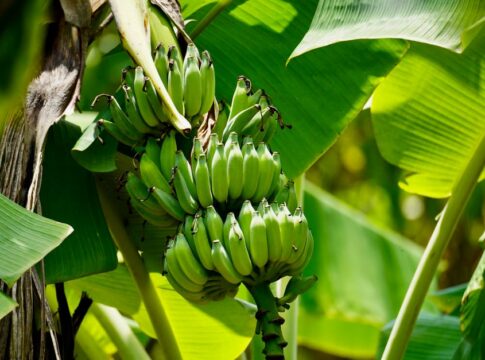
Bananas start their life cycle hanging downward in heavy clusters. As they develop, each individual banana begins reaching upward toward sunlight, creating that familiar curved shape we see in every grocery store. This fascinating growth pattern reveals how even the most common fruits follow complex biological rules we rarely stop to consider.
Key Takeaways
- Bananas curve due to negative geotropism—they grow upward against gravity toward sunlight rather than hanging straight down.
- The fruit develops in clusters called “hands” with individual bananas known as “fingers,” initially pointing downward from the weight of the bunch.
- Phototropism drives each banana to bend toward the sun as it matures, creating the characteristic arc within days of development.
- The curvature is more pronounced in bananas grown outdoors with direct sun exposure compared to those cultivated in shaded conditions.
- Wild bananas, unlike cultivated varieties, contain large seeds and display less uniform curvature patterns.
- Banana plants are actually giant herbs, not trees, and produce fruit only once before dying back to allow new shoots to grow.
How Bananas Curved Sunlight Seeking Actually Works
The science behind banana curvature begins with understanding how the plant produces fruit. Banana plants develop a large flowering structure that emerges from the center of the plant and hangs downward under its own weight. This structure, called an inflorescence, contains rows of flowers that will eventually become bananas arranged in tiers called hands.
When bananas first form, they point downward. Gravity pulls them toward the ground. But here’s where the trivia gets truly fascinating: as the fruit develops, hormones called auxins accumulate on the lower side of each banana. These plant hormones stimulate cell growth, causing the cells on the underside to multiply and expand faster than those on top. The result? The banana bends upward.
This process continues throughout the fruit’s development. Each banana in the cluster independently seeks light, creating individual curves. The uppermost fruits in a hand often curve more dramatically because they receive more direct sunlight, while lower bananas may show gentler arcs. The entire transformation happens relatively quickly—the characteristic curve becomes visible within the first week of fruit development.
The Role of Phototropism in Fruit Development
Phototropism—growth in response to light—drives this amazing transformation. Plants have evolved sophisticated mechanisms to detect light direction and intensity. In bananas, specialized proteins called phototropins sense blue light wavelengths and trigger the redistribution of auxins. This isn’t unique to bananas; sunflowers, houseplants near windows, and countless other species use similar mechanisms. What makes bananas special is how visibly and uniformly this process manifests in the fruit itself.
The curvature serves a practical purpose beyond aesthetics. By orienting upward, bananas position themselves for better sun exposure, which aids in ripening. They also become more accessible to animals that might disperse their seeds—though modern cultivated bananas are seedless, their wild ancestors relied on this strategy for reproduction.
Cultivated vs. Wild Bananas: Surprising Differences
The bananas you find at the supermarket—almost exclusively Cavendish variety—are dramatically different from their wild relatives. Wild bananas contain large, hard seeds that make the flesh nearly inedible. Humans have cultivated seedless varieties through selective breeding over thousands of years, creating the soft, sweet fruit we recognize today.
| Characteristic | Cultivated Bananas | Wild Bananas |
|---|---|---|
| Seeds | Seedless (sterile) | Large, hard seeds throughout |
| Curvature | Uniform, pronounced arc | Variable, less consistent |
| Flesh Texture | Soft, creamy | Firm, often astringent |
| Propagation | Cloning from shoots | Seed dispersal |
| Common Varieties | Cavendish, plantains | Musa acuminata, Musa balbisiana |
Because cultivated bananas are sterile clones, they’re all genetically identical. This uniformity extends to their growth patterns, which is why grocery store bananas display such consistent curvature. Every Cavendish banana is essentially a genetic copy of every other, propagated through cuttings rather than seeds.
Common Myths About Banana Shape
Several misconceptions circulate about why bananas curve. Some claim it’s purely genetic—that banana DNA codes for a curved shape. While genetics determine the plant’s capacity for phototropism, the actual curve forms in response to environmental light. Bananas grown in complete darkness or uniform light from all directions would theoretically develop straighter forms, though such conditions rarely occur in nature or commercial cultivation.
Another myth suggests the curve helps with packing and shipping. While the shape certainly makes stacking easier, this is a fortunate coincidence rather than an evolutionary or agricultural design choice. The curve existed long before modern logistics. In fact, banana shippers must carefully arrange fruit to prevent bruising, working around the natural curvature rather than benefiting from it.
Some people believe bananas curve to fit human hands better. This charming idea is pure coincidence. Bananas evolved their growth pattern millions of years before humans existed, let alone began cultivating them. The ergonomic fit is accidental, though it certainly doesn’t hurt the fruit’s popularity.
The Banana Plant’s Remarkable Life Cycle
Understanding banana curvature requires appreciating the plant’s unusual biology. Banana plants aren’t actually trees—they’re giant herbaceous plants, the world’s largest herbs. What appears to be a trunk is actually tightly packed leaf sheaths. The true stem remains underground.
Each plant produces fruit only once. After the bananas develop and are harvested, the main stem dies. But the plant survives through underground rhizomes that send up new shoots, called “pups” or “suckers.” These clones continue the cycle, meaning a banana plantation might contain plants that are genetically identical across generations spanning decades.
This growth strategy has implications for the curvature phenomenon. Because each fruiting cycle produces a genetically identical plant in similar conditions, the resulting bananas display remarkably consistent curves. Commercial growers can predict with precision how their fruit will develop.
Frequently Asked Questions
Do all bananas curve in the same direction?
No, bananas curve upward toward the light source, which can vary depending on the plant’s orientation and surrounding environment. However, in plantations where plants receive relatively uniform sunlight, most bananas curve in similar patterns.
Can you grow straight bananas?
Theoretically yes, if you could eliminate the light gradient that triggers phototropism, but this would require artificial growing conditions. In natural or commercial settings, the upward curve is inevitable and actually indicates healthy fruit development.
Are curved bananas healthier or tastier than straighter ones?
No, the curvature doesn’t affect nutritional content or flavor. The degree of curve simply reflects how strongly the fruit responded to sunlight during growth, which doesn’t correlate with quality or ripeness.
Why do some bananas in a bunch curve more than others?
Position within the cluster determines sun exposure. Bananas at the top of a hand receive more direct light and typically develop more pronounced curves, while those shaded by upper fruits may curve less dramatically.
The next time you peel a banana, take a moment to appreciate the botanical choreography that created its shape. That gentle arc represents days of cellular growth, hormonal signaling, and light-seeking behavior—a quiet reminder that even the most ordinary objects around us follow extraordinary natural rules. Nature’s attention to detail shows up in the smallest places, if we’re curious enough to look.